
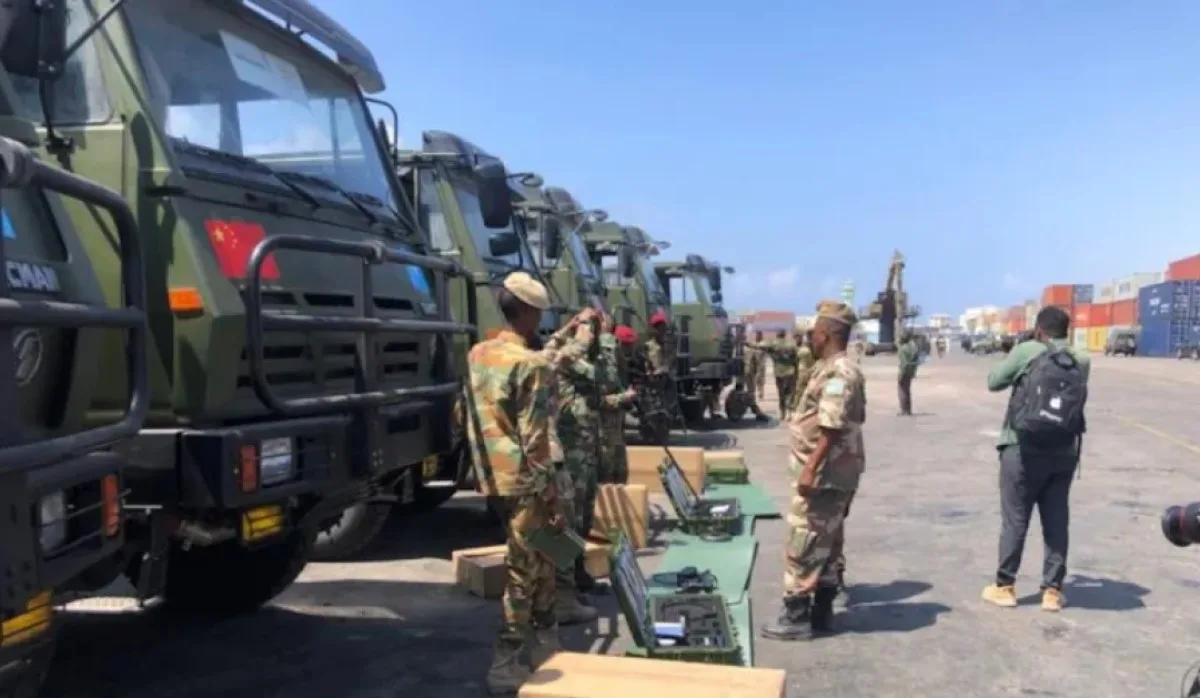
Hargeisa — Four foreign powers are currently arming the Somali Federal Government. Three of them are doing so for reasons the international community broadly understands and, in most cases, has reluctantly accepted. The fourth is doing so for a reason that has gone almost entirely unnamed in the policy literature, and that, once named, ought to change how Western capitals think about military assistance to Mogadishu. Turkey arms Somalia for power projection. The United Arab Emirates arms it for commerce. The United States arms it for counter-terrorism. China arms it for territorial revisionism against a democratic neighbour. The fourth purpose is not the same kind of purpose as the first three, and pretending otherwise is becoming harder by the month.
Four Donors, Four Doctrines
Begin with what the others actually want. Turkey’s military relationship with Somalia is now sixteen years old and has produced TÜRKSOM, the largest Turkish overseas military training facility on the African continent, which has graduated thousands of Somali soldiers and trained the Gorgor and Haramcad special forces units. Ankara recently delivered another tranche of armoured vehicles, communications equipment and night-vision technology to the Somali National Army, part of a relationship that also includes the controversial 2024 oil-and-gas exploration agreement granting Turkish state companies up to ninety per cent of revenue from offshore blocks. Turkey’s Somalia policy is integrated, ambitious and frankly transactional. Ankara wants a Red Sea presence, a counterweight to its rivals in Riyadh and Abu Dhabi, and a strategic foothold in a region where its African doctrine has been quietly growing for a decade. The military assistance is real. The purpose, however unwelcome it may be to Hargeisa, is conventionally identifiable: power projection by a middle power.
The United Arab Emirates plays a different game. Its arms transfers and security partnerships have been pragmatic rather than ideological, and have tracked Emirati commercial interests with unusual precision. When DP World secured the Berbera Port concession in 2017, Abu Dhabi’s military relationship with Mogadishu cooled and its security partnership with Hargeisa warmed. When the Hassan Sheikh administration cancelled UAE-linked security agreements in early 2026 to protest the Berbera-Addis-Tel Aviv triangle, the UAE responded by deepening its commitments to Somaliland rather than abandoning the region. The Emirati doctrine is mercantile. It tracks ports, logistics, and trade routes, and the military assistance follows the contract. It is not pretty, but it is legible.
The United States is the third donor, and its relationship is the largest of the four in dollar terms but the most narrowly defined in policy terms. Washington has spent more than three billion dollars on Somali security assistance since 2007. The bulk of it is counter-terrorism — drone strikes against al-Shabaab and the Islamic State Somalia Province, training for the Danab brigade, intelligence support, and the embedded advisers who have made the Danab the only Somali unit consistently described by independent observers as effective. The United States arms Somalia because al-Shabaab has been on the State Department’s list of Foreign Terrorist Organizations since 2008 and because Washington has concluded, rightly or wrongly, that a degraded al-Shabaab is in the American interest. The doctrine is narrow but coherent.
Then there is China.
Beijing’s Different Calculation
China’s military relationship with Somalia is, on its face, framed in the same counter-terrorism language as Washington’s. The most recent Chinese statements have been explicit about al-Shabaab and the Islamic State as the targets. Chinese Foreign Minister Wang Yi told diplomats stationed in Mogadishu in March that Beijing would take “every necessary measure” to ensure the protection of Chinese citizens and economic interests in Somalia, and called for a more robust international coalition to dismantle extremist networks. The shipments themselves — the five million dollars of vehicles and equipment delivered in March 2022, the at least six ZFB-05 Xinxing armoured vehicles routed through the African Union mission in March 2025, the hardware promised in the April 2026 meeting between Hu Changchun and Hassan Sheikh Mohamud — have all been described in counter-terrorism terms by both the Chinese and Somali governments.
The framing does not survive five minutes of scrutiny. China has no significant economic exposure in Somalia of the sort that justifies the language Wang Yi used. There are no Chinese-built ports in Mogadishu, no Belt and Road railways, no power plants, no sovereign concessions of the kind Beijing has secured in neighbouring Ethiopia, Djibouti and Kenya. The total Chinese aid grant announced after the 2024 Forum on China-Africa Cooperation summit was twenty-eight million dollars, a figure that does not register on the scale of Beijing’s African commitments elsewhere. The Chinese military presence in the Horn of Africa is concentrated, by an order of magnitude, in Djibouti, where the People’s Liberation Army Navy operates its only overseas base. The argument that China needs to arm Somalia to protect Chinese commercial interests in Somalia is not consistent with the actual size of those interests.
What changed is not Somalia. What changed is Somaliland. Hargeisa established formal diplomatic ties with Taiwan in 2020. The relationship deepened through the Bihi presidency and intensified under President Irro after his November 2024 election. In April 2025, Mogadishu — at Beijing’s evident urging — banned the entry and transit of all Taiwanese passport holders, citing United Nations General Assembly Resolution 2758. China’s foreign ministry “highly appreciated” the decision. In November 2025, Taiwan’s Deputy Foreign Minister François Chihchung Wu attended President Irro’s inauguration in Hargeisa, and Chinese spokesperson Mao Ning publicly objected. The following week, China’s special envoy to the Horn of Africa, Xue Bing, told the Somali National News Agency, in language that is unusually unguarded for a Chinese diplomat, that “we will not leave them alone if anyone dares to do anything to sabotage the national sovereignty and territorial integrity of China.” Three weeks after that, Israel formally recognised Somaliland, and Beijing reaffirmed its support for Somalia’s territorial integrity within days. The trajectory is not subtle.
The clearest articulation of what China is actually doing in Somalia comes from Brendon J. Cannon of Khalifa University, who has tracked external power engagement with the Horn of Africa for most of a decade. His analysis, published across The Conversation, Asia Times and DefenceWeb during April 2026, is unsparing. “Beijing’s growing interest in Somalia,” Cannon writes, “is less about development corridors and more about political alignment, diplomatic positioning and security cooperation.” China’s preference, he argues, is for “regime support to reinforce Somalia’s territorial integrity,” distinct from the infrastructure-and-commerce model favoured by Turkey and the UAE and the counter-terrorism-narrow model favoured by Washington. China arms Mogadishu, in Cannon’s framing, to deny Somaliland the political space it has spent thirty-five years building.
The Las Anod Vector
If Beijing’s purpose were really counter-terrorism, the destination of Chinese assistance inside Somalia ought to track al-Shabaab’s geography. It does not. The pattern that emerges from the past eighteen months traces, instead, the geography of the Somaliland-Mogadishu confrontation, and specifically the contested town of Las Anod.
The Chinese Embassy in Mogadishu donated five hundred tons of food to Las Anod and the SSC-Khatumo administration in early January 2025, a gesture that regional reporting linked to “recent reports of a weapons shipment” to the same destination. SSC-Khatumo’s leader, Abdiqadir Aw Ali Firdhiye, travelled to Mogadishu in mid-2024 and publicly thanked the Chinese government as “the first to donate” to his administration. His January 2026 inauguration as president of what Mogadishu has formally recognised as its “Northeast State” was attended, alongside the ambassadors of Turkey, Saudi Arabia, Djibouti and Sudan, by the Chinese ambassador. The Times of Israel published a detailed account in March 2025 alleging that Chinese-made weapons and drones had been recovered in areas controlled by SSC-Khatumo militias. The forensic chain of custody — whether these weapons travelled directly from Beijing to Las Anod, or were laundered through Mogadishu’s stockpile of Chinese aid before being passed on — has not been publicly established. The pattern of presence, however, has.
This matters because al-Shabaab has no significant presence in the Sool, Sanaag and Cayn regions where SSC-Khatumo operates. The areas China has shown the most material interest in are precisely the areas furthest from the al-Shabaab front. A Chinese counter-terrorism programme that spends its first food airlift on a Dhulbahante militia three hundred kilometres from the nearest al-Shabaab cell is not a counter-terrorism programme. It is a Somaliland-containment programme operating under counter-terrorism cover.
The Asymmetry
The point of the comparison is not to whitewash the other three donors. Turkish power projection is not benign. Emirati commercial mercantilism is not benign. American counter-terrorism strikes have killed civilians and have produced a Somali state that remains, after seventeen years of US assistance, ranked one hundred and thirty-seventh of one hundred and forty-five countries on Global Firepower’s military index. None of these arrangements would survive a strict morality test. But each of them produces a Somali state of a recognisable type — a state with a foreign patron, a transactional relationship, and an articulable interest that the patron is pursuing through Mogadishu.
The Chinese case is structurally different. China is not arming Somalia to make Somalia stronger in any direction Mogadishu’s voters or even Mogadishu’s elites might independently choose. China is arming Somalia to weaponise Somalia’s sovereignty claim against a third party — Somaliland — that has its own elections, its own institutions, its own thirty-five-year track record of state-building, and its own diplomatic relationships, including with Taiwan. The other three donors arm Somalia to do something. China arms Somalia to prevent something elsewhere.
This is the asymmetry that ought to register in Western policy discussions, and that has not. The most recent United States Department of Defense annual report to Congress on Chinese military and security developments, released in December 2024, devotes substantial attention to Beijing’s growing footprint in sub-Saharan Africa but treats the Somalia file primarily as a function of Chinese counter-terrorism cooperation. That framing is, on the documented record, incorrect. The Somalia file is a Taiwan file. The hardware that arrives in Mogadishu is, in Beijing’s strategic ledger, an instrument of cross-strait pressure, with the additional benefit that some of it can be passed onward to militias inside Somaliland to apply localised military pressure on Hargeisa as well. The al-Shabaab framing is a courtesy that Western analysts have extended to Chinese officials, and the courtesy is no longer warranted by the evidence.
What This Should Change
Three implications follow, and Western capitals — Washington in particular — ought to draw them.
The first is that American military assistance to Somalia is now indirectly financing the Chinese pressure campaign against a US-aligned democracy. The American Enterprise Institute made this argument as early as 2022, when Michael Rubin pointed out that money is fungible and that hundreds of millions in US security assistance to a corrupt Somali state effectively underwrite the parts of the Somali budget that allow Mogadishu to accept Chinese hardware without trade-offs. The argument has only strengthened in the four years since. Every American dollar that pays for Somali soldiers’ salaries is a dollar Mogadishu does not have to pay itself, which means a dollar Mogadishu can spend on the political and military infrastructure required to integrate Chinese assistance and direct it at SSC-Khatumo. The United States is, by neglect, subsidising the leverage of its principal great-power rival against an entity Washington has spent two years signalling it may itself recognise.
The second is that the European Union, which contributes substantially to AUSSOM and to the multi-partner trust funds through which much of Somalia’s institutional budget flows, faces the same problem in milder form. EU member states have spent a decade emphasising rule of law, governance and anti-corruption in their Somalia programming. None of those programmes have meaningfully constrained Mogadishu’s freedom to coordinate with Beijing on Somaliland containment. The conditionality has been notional.
The third implication is for Somaliland itself, and it is not the comfortable one. The presence of Chinese hardware on the ground in SSC-Khatumo areas means that any future Somaliland operation to recover Las Anod and the surrounding territory will be conducted against equipment supplied by a permanent member of the United Nations Security Council. The diplomatic costs of such an operation have therefore risen sharply. Hargeisa’s military planning for its own eastern frontier is now operating inside a structure of great-power signalling that did not exist five years ago. This is the price, and it is a real price, of Somaliland’s Taiwan relationship and of Israel’s recognition. Most observers in Hargeisa would tell you the price is worth paying. They would also be the first to acknowledge that the price exists, that it is rising, and that it is being paid in Sool and Sanaag rather than in any abstract diplomatic ledger.
None of this means Somaliland was wrong to recognise Taiwan, to accept Israeli recognition, or to align with the broader anti-Beijing coalition that has been quietly forming across the Indo-Pacific and the Horn of Africa over the past decade. It does mean that the cost of those choices is now visible, that Beijing has chosen to make the Somalia file the place where it pays Hargeisa back, and that Western policy toward Mogadishu has not yet adjusted to what the Chinese arms transfers actually represent. The other three foreign donors arm Somalia for purposes that, however unattractive, are about Somalia. China alone arms Somalia for a purpose that is about somewhere else. Until that asymmetry is named, the policy conversation will keep producing the wrong answer.

