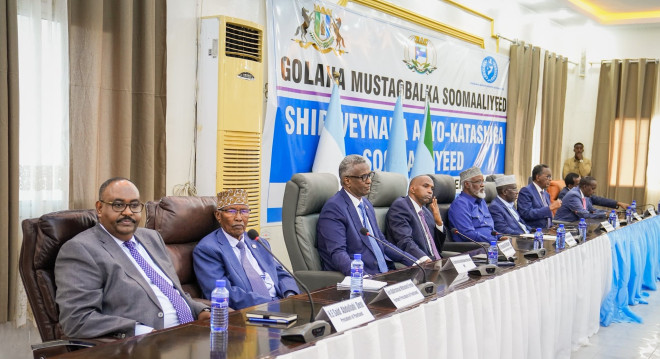
Hargeisa — The mandate of Somalia’s federal government expires on Friday. Three days from now, the constitutional clock that has governed President Hassan Sheikh Mohamud’s second term since 15 May 2022 runs out. There is no agreed succession plan. There is no opposition consensus to recognise the term extension parliament rammed through on 8 March. There is no functioning national mediation process, after the President’s State Minister for Foreign Affairs publicly denied yesterday that a US-hosted dialogue at the Halane compound was even being prepared, despite the opposition having formally requested American involvement and Western diplomats having spent two weeks attempting to convene one. Somalia government forces, backed by armoured vehicles and tanks, have been deployed across the capital. The Defense Minister has warned, in language no one has misunderstood, that “if anyone attempts to take up arms in Mogadishu, they will regret it.” This is the position from which Somalia enters its sixth constitutional crisis in fifteen years. The question is no longer whether the system will hold. The question is what specifically breaks first, and what comes after.
Four scenarios are plausible between 15 May and the end of June. They are not equally likely. They are not mutually exclusive. They are, however, exhaustive — every credible path through the next six weeks runs through at least one of them. Hargeisa, Addis Ababa, Nairobi, Washington, Ankara, Abu Dhabi and Beijing are all calculating against the same matrix. Berbera Times readers should be doing the same.
Scenario One: The Unilateral Extension Holds
The most likely outcome on a probability basis, and the worst on a long-term basis, is that the constitutional amendments signed on 8 March simply take effect. Hassan Sheikh Mohamud declares his term extended by twelve months under the new five-year framework, parliament’s term is similarly extended, and the federal government continues to operate from Villa Somalia under the cover of a legal fiction that the rest of the country is invited to accept. Turkish military deployments inside Mogadishu, the Gorgor and Haramcad special forces trained at TÜRKSOM, and the armoured columns currently visible on the capital’s streets are the enforcement architecture. International donors register their objections in carefully calibrated statements, then continue funding the institutional budget because the alternative is worse.
The opposition will not accept this outcome, but the opposition cannot militarily prevent it. Puntland and Jubaland have severed practical cooperation with Mogadishu, but neither has the capacity or the inclination to march on Villa Somalia. Former presidents Sharif Sheikh Ahmed, Farmaajo and former prime ministers Khaire and Roble can write joint statements, brief diplomats inside Halane, and organise protest rallies in the capital, but none of those activities forces a constitutional reset. The Council for the Future of Somalia will, in this scenario, fragment over the summer as individual members make their separate accommodations with the new reality. Mogadishu will function as a single-city state under a JSP government with Turkish backing, the federal map will be redrawn on paper without being administered in practice, and Somalia’s claim to be a single political community will become, even more visibly than at present, a fiction maintained for international consumption.
The cost is that the regional security environment deteriorates, al-Shabaab presses harder against an FGS that has lost legitimacy with the population it claims to protect, and the Houthi-piracy resurgence in the Gulf of Aden becomes the structural backdrop against which Somaliland’s own commercial and diplomatic gains have to be defended.
Scenario Two: The Parallel Government
The second scenario, which becomes more likely if the unilateral extension is accompanied by visible repression, is the formal emergence of an alternative federal authority. The Council for the Future of Somalia has been gestating exactly this option since the failed February talks. Puntland and Jubaland already operate as quasi-independent administrations. Southwest’s deposed President Laftagareen, removed by federal force in March, has a personal stake in the project. The opposition’s January convention in Garowe and February gathering in Mogadishu both produced explicit planning for “a parallel political process if the government does not listen.” That planning is now operational.
What a parallel government would look like in practice is less clear than its proponents pretend. It would require a physical seat — most plausibly Garowe or Kismayo, both of which present security and legitimacy questions of their own. It would require recognition from at least some external actors — the UAE is the obvious candidate, given Mogadishu’s January 2026 termination of all bilateral agreements with Abu Dhabi — but the UAE has been investing carefully in recognition optionality and may not want to spend that capital on a Somali succession dispute. It would require a recognised head of state, and the Council has not yet converged on a single figure. Sharif Sheikh Ahmed has the most institutional plausibility, but Deni and Madobe have the most actual territory. A parallel structure with three potential presidents and no agreed capital is closer to a coalition statement than a functioning government, and the gap matters.
This scenario produces, in its first weeks, a recognition battle. Mogadishu under HSM retains its UN seat, its diplomatic missions, its central bank, and its passport-issuing authority. The parallel government claims constitutional legitimacy without the apparatus of state. The international community is then forced to choose, in a way it has been able to avoid for fifteen years, which Somali authority is the real one. Most capitals will choose Mogadishu by inertia. Some — including possibly Abu Dhabi, possibly Nairobi, possibly Addis Ababa — may not. The choosing itself is the rupture. Somalia in this scenario does not partition; it bifurcates, with the bifurcation occurring in international recognition before it occurs on the ground.
Scenario Three: Military Confrontation
The third scenario is the one every external actor is currently trying to prevent, and it is also the one for which the structural conditions are most clearly in place. Mogadishu’s army has been physically deploying for a week. The Defense Minister has telegraphed intent. Jubaland has spent six months reinforcing its forces along the federal boundary, and the December 2024 clashes at Ras Kamboni, in which Mogadishu’s troops were captured, demonstrated that federal forces cannot reliably project power into the federal member states. Puntland forces have been on a war footing since the April 2024 rupture. The most exposed flashpoints are Galkayo, where Puntland and federal authority overlap and where small incidents have historically escalated, and Baidoa, where the federal seizure of regional power in late March set a precedent that the opposition will not accept a second time.
The variable that matters most is which units fight on which side. The Somali National Army has fractured along clan lines in every previous crisis going back to 2021. Damul Jadiid and Al I’tisaam have a tetchy modus vivendi inside the current government that holds only as long as the patronage flow continues; a constitutional dispute that closes off external funding shuts off the patronage and triggers internal realignment. The Gorgor and Haramcad special forces, trained at TÜRKSOM, are the units most loyal to the presidency and the units most likely to be deployed against opposition gatherings. The line infantry are the units most likely to defect or refuse orders. The intelligence service, NISA, under Mohamed Salad, is the unit most likely to conduct targeted operations against opposition figures. None of these dispositions are stable under stress, and the stress is now applied.
If military confrontation occurs, it will not be a civil war in the conventional sense. It will be three or four overlapping fights — a Mogadishu fight between federal forces and opposition militias inside the capital, a Galkayo fight between Mogadishu and Puntland, a Gedo fight between Mogadishu and Jubaland, and an al-Shabaab counter-offensive exploiting all three. The duration will be measured in weeks before international pressure forces a partial ceasefire, but the strategic consequences will be measured in years. Somalia’s federal experiment, formally launched in 2012, will not survive a 2026 civil reset. Whatever emerges afterwards will be a different state, configured around different power-sharing arrangements, with different international relationships.
Scenario Four: Foreign-Brokered Climbdown
The fourth scenario is the one Western capitals have been working toward and the one the Federal Government just publicly closed off. A foreign-brokered climbdown would involve mediation — Kenyan, Ethiopian, Turkish, Emirati, American, or some combination — producing a face-saving framework under which both sides accept a short technical extension of the federal government’s mandate while the substantive electoral and constitutional questions are renegotiated under external supervision. The 2021-2022 precedent, in which sustained international pressure, including the EU’s suspension of budgetary support and US visa restrictions, forced Farmaajo to abandon his term extension, is the model. The conditions for replicating it in 2026 are less favourable.
The Trump administration’s State Department is not configured for the kind of sustained pressure campaign that worked against Farmaajo. The Bureau of African Affairs has spent the past four months publicly describing its mission as “resetting the relationship with Africa based on mutually beneficial partnerships rather than aid, dependency, and spreading divisive ideology,” which is the rhetorical opposite of the conditionality regime that Crisis Group and the European Union are urging Washington to operate. The UN Political Office that mediated previous Somali transitions was wound up in December 2025, removing the institutional vehicle that previously did the work. The European Union has the resources for sustained pressure but lacks the diplomatic agility, and its threat to suspend budgetary support carries less weight at a time when Brussels is itself triaging African commitments under post-Ukraine fiscal pressure.
The most credible mediator, on paper, is Turkey — the same Turkey that has spent eighteen months becoming the Federal Government’s indispensable patron. Ankara successfully mediated Ethiopia-Somalia tensions in late 2024, and Erdogan has direct personal influence over HSM in a way no Western leader currently does. The problem is that Turkey is a partial mediator. It cannot credibly press HSM into a climbdown that would involve abandoning the Turkish-backed elements of his administration, because those elements are the architecture of Turkey’s own Somalia presence. Turkey can mediate a settlement that consolidates the status quo. It cannot mediate a settlement that reverses it. This is the limit of partial mediation, and it is why the opposition asked Washington rather than Ankara, and why the FGS publicly denied the Washington track yesterday.
The Real Question
The four scenarios above are not predictions. They are the structural geometry of the next six weeks. The unilateral extension is most likely. The parallel government is most consequential. The military confrontation is most feared. The foreign-brokered climbdown is least probable. But the real question, the one that matters more than the probabilities, is what each of these outcomes does to the strategic environment in which Somaliland operates.
In Scenario One, Somaliland’s case for recognition strengthens by the inch every month, as the international community is forced to acknowledge that the Federal Government governs only the territory it can physically hold. In Scenario Two, recognition becomes a triangulated question — which of the two competing Somali authorities does each capital recognise, and where does Somaliland sit in relation to the recognition decisions other states are now compelled to make? In Scenario Three, the regional security environment deteriorates sharply, and Somaliland’s stability becomes both more valuable to external partners and more exposed to the spillover effects of fighting in Galkayo and Gedo. In Scenario Four, the status quo is restored with a face-saving fig leaf, and the substantive trajectory toward recognition is delayed by another electoral cycle.
From Hargeisa’s perspective, Scenarios One and Two are favourable, Scenario Three is dangerous but politically clarifying, and Scenario Four is the worst outcome — not because the status quo is intolerable, but because it preserves the diplomatic fiction that Mogadishu is a credible interlocutor for the people of Somaliland. The Federal Government’s public rejection of US mediation yesterday has made Scenario Four less likely, which is, paradoxically, in Somaliland’s strategic interest even though it is destabilising for the region.
The most important sentence of the past week was the one State Minister Ali Balcad delivered on Monday: “The U.S. Embassy is not prepared to directly involve itself in the political tensions currently unfolding in Somalia. There is no meeting planned, and there is no intervention being conducted by the embassy in Mogadishu.” Read carefully, that statement does three things. It denies the existence of a mediation effort. It claims authority over what the US Embassy will and will not do, which is not a claim a sovereign Federal Government would normally make about a foreign mission on its soil. And it pre-emptively delegitimises any subsequent American intervention by establishing that any such intervention was, in the Federal Government’s account, not requested and not authorised. The Federal Government has chosen Ankara over Washington, and it has chosen to say so out loud. The next seventy-two hours will determine whether that choice was strategy or suicide.