
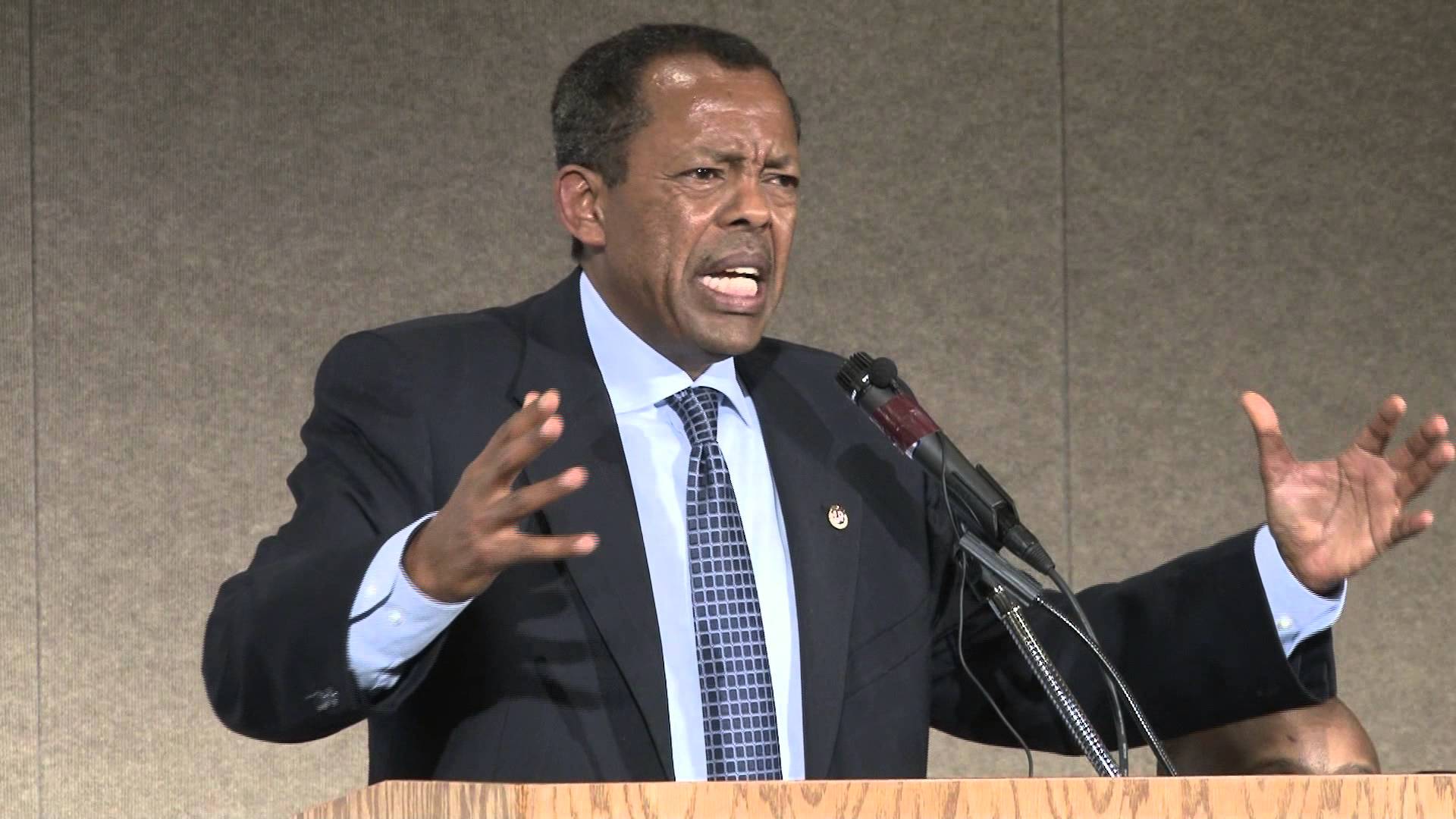
Hargeisa — Of the nine names hand-picked by President Hassan Sheikh Mohamud’s Justice and Solidarity Party in October 2025 to represent Somalia at the East African Legislative Assembly, none illustrates the moral and intellectual collapse of Mogadishu’s federal project more sharply than Faisal Abdi Roble. The Los Angeles–based writer and former Editor-in-Chief of WardheerNews, now seated in Arusha after a Treaty-violating selection process, has built a thirty-year intellectual career on two propositions that are difficult to reconcile with the role he has just accepted: that Somalis under Ethiopian rule have an inalienable right to self-determination, and that Somalilanders, who exercised exactly that right in 1991, do not.
An Ogadenia Voice in Diaspora
Roble’s biography is the standard arc of the Ogadenia movement intellectual diaspora of the 1980s. Born in the Somali Region of Ethiopia — what Somalis call the Ogaden — he came to the United States as a young man fleeing the Mengistu regime’s persecution of Somali nationalists. His political formation was forged in opposition to Addis Ababa’s treatment of its Somali periphery, and his sympathies with the Ogaden National Liberation Front have run through his published work for decades. He is, by his own description, a scholar of “centre versus periphery” politics in the Horn of Africa, and he has produced a substantial body of writing — much of it for WardheerNews, the diaspora platform he co-founded — arguing that the Somali Region of Ethiopia has been pillaged, marginalised and culturally erased by successive Abyssinian governments.
That argument is not a fringe position. It is a serious historical claim with serious historical evidence. Roble’s 2025 essay “Manufactured Identity, Territorial Claims, and the Displacement of Somalis: How the Oromo Regional State Obliterated the Somali Regional State” is a substantial piece of political writing. So is his earlier work on the partition of Somali territories at the 1884 Berlin Conference and the post-war cession of the Haud and Reserved Area to Ethiopia. On the question of Somali self-determination inside Ethiopia, Roble has been consistent, prolific and morally clear. The Ogaden, in his telling, has every right to demand recognition of its political identity, and the international system has every duty to listen.
The Somaliland Exception
And then there is Somaliland, where his moral compass swings the other way. In February 2025, Roble published one of the most widely circulated anti-recognition essays of recent years, titled — without irony — “A One-Clan Enclave in Somalia Cannot Be A Nation: The Case Against Somaliland’s Recognition.” In it, and in the related pieces “Fragmentation by Design” and “Connecting the Dots: Trump, ICE and the Foggy Prelude to Somalia’s Partition through Israel,” both published in December 2025, he advances the argument that Somaliland is not a state but a single-clan enclave; that Hargeisa’s case for recognition is a foreign-engineered partition project; and that Israel’s December 2025 recognition was itself part of a Greater Israel agenda to displace Palestinians to the Horn.
The internal contradiction is glaring. The Ogaden has perhaps eight million Somalis from a range of clan families and a contested colonial history of forcible incorporation into a non-Somali state — and Roble considers their right to self-determination axiomatic. Somaliland has six million people, an internationally observed peaceful transfer of power in 2024, three decades of independent institutions, a defined territory with recognised colonial borders from its 1960 sovereignty, and a parliament, a currency, an army and a functioning electoral commission — and Roble considers its claim a clan project to be defeated.
The “one-clan enclave” framing, repeated across his writings, is itself a remarkable inversion. It is the same rhetorical move that the Ethiopian state has used for a century to deny the political coherence of the Somali Region — that Somalis are clan-fragmented, that their nationalism is artificial, that their demands for self-rule are sectarian. Roble has spent his career demolishing that argument when it is applied to Jigjiga. He resurrects it, almost word for word, when it is applied to Hargeisa.
The 2013 Critic
The contradiction does not end with Somaliland. It runs through Roble’s relationship with the man who put him on the EALA slate. In May 2013, during Hassan Sheikh Mohamud’s first presidential term, Roble published a piece in WardheerNews titled “Somalia: Sliding Back to Political Conflict.” The argument was uncompromising. President Mohamud, he wrote, was “astonishingly putting policies of confrontation ahead of accommodation,” reproducing the centralising pathologies of Somalia’s failed past and refusing to deal honestly with the regional federations. The piece read as an indictment of exactly the political style — top-down, party-centred, suspicious of federalism — that has defined Mohamud’s second presidency from 2022 to the present.
In 2020, Roble extended the critique. His essay “Somalia: Political Season and Personal Ambitions” described Somali politics as “Machiavellian,” dominated by “personal rule” and saturated with “fancy diplomatic pouches full of US dollars” arriving from Qatar, the UAE and Saudi Arabia to corrupt the electoral process. He warned that foreign money, channelled through intelligence chiefs and party operatives, had displaced the popular will as the engine of Somali politics. He named Qatar as “aggressive with an appetite for exacting havoc on those who oppose its political client.” He named the National Intelligence and Security Agency as the conduit. He treated the entire system with the disgust it deserved.
Five years later, in October 2025, that same political system handed him a seat in a regional parliament. The selection was conducted in five days. The entry fee was ten thousand US dollars. The slate was assembled by Hassan Sheikh’s Justice and Solidarity Party — the latest in a long line of presidential vehicles Roble had spent a decade dissecting. The 4.5 power-sharing formula was discarded. The opposition was excluded. The East African Court of Justice issued an interim injunction within a month, finding a prima facie violation of Article 50 of the EAC Treaty. And among the nine beneficiaries of the impugned process was the man who had once described Hassan Sheikh Mohamud as a confrontationalist and who had warned, in 2020, that Somali politics had been reduced to a marketplace of bought offices.
Why It Matters Beyond One Man
This is not a question of personal hypocrisy alone. It is a question of what the federal government in Mogadishu has chosen to send to Arusha as the face of Somalia’s first contribution to a supranational legislature. The Justice and Solidarity Party did not pick Faisal Roble at random. It picked him because his pen has been useful to the unitarist project — because he is the most prolific diaspora intellectual willing to lend a federalist’s vocabulary to the cause of denying Somaliland’s existence. His seat is a reward, and a deployment.
For the East African Community, this poses a problem the bloc has not yet acknowledged. EALA is meant to be a forum for regional cooperation, not a platform for one member state to litigate its territorial claims against a non-member it does not control. Several EAC partner states have substantive economic and security relationships with Somaliland — Kenya, Ethiopia and the United Arab Emirates among them. Berbera Port handles a significant share of Ethiopian trade. The Hargeisa–Addis MoU of January 2024, however formally contested, has reshaped the regional logistics map. Seating an EALA member whose published mission is to defeat Somaliland’s recognition imports a bilateral fight into a multilateral chamber.
The contradiction also undermines the federal government’s own diplomatic posture. Mogadishu insists, in every international forum, that it speaks for the people of Somaliland, and that Somaliland’s self-government is a domestic matter to be resolved within Somalia’s constitutional framework. That position requires, at minimum, a representative who can plausibly claim to engage Somalilanders as fellow citizens. Sending a man who has publicly described their state as a one-clan enclave engineered by foreign powers is not engagement. It is a declaration that the federal project has no intention of negotiating, only of denying.
The Larger Pattern
The Roble case is one instance of a pattern that the EALA litigation has now exposed in detail. The JSP slate was assembled to reward loyalty, not to represent Somalia. It bypassed the 4.5 formula because the formula would have required the inclusion of voices Mogadishu cannot control. It excluded opposition figures because the opposition has spent the past year warning, accurately, that Hassan Sheikh is engineering a term extension. It charged a ten-thousand-dollar entry fee because that fee functioned as a filter against any candidate without access to Villa Somalia’s patronage networks.
Faisal Roble is the slate’s most articulate face. He is also its most revealing. A man who has spent his life arguing for Ogaden self-determination, who has critiqued Hassan Sheikh’s authoritarianism in print, and who has documented the corrupting role of foreign money in Somali politics has, in the autumn of his career, accepted a seat handed to him by an authoritarian president, financed by a process he once condemned, on the explicit understanding that his task in Arusha will be to deny to Somaliland what he demands for the Ogaden.
This is the delegation Mogadishu sent to the East African Community. This is the case before the East African Court of Justice. And this is why the Court’s substantive ruling, when it eventually comes, will matter not only for Somalia but for the credibility of the entire regional integration project. A bloc that cannot enforce Article 50 against its newest member cannot expect that member to represent its citizens in good faith. Somaliland, watching from north of the contested border, has been making that argument for thirty-five years. The EALA file is now Exhibit A.

