
Hargeisa — On May 15, 2026, Hassan Sheikh Mohamud’s presidential term expires. The date is not in dispute. What is in dispute is everything else — who has the authority to extend it, whether the constitutional amendments that purport to do so are legitimate, whether the federal government can hold elections without the participation of three of its five member states, and whether Somalia can navigate a political crisis of this magnitude without sliding back into the armed confrontation that the last fifteen years of international investment was designed to prevent.
The answer to most of those questions, as of today, is deeply uncertain. The political situation in Somalia is deteriorating rapidly and entering a very dangerous phase. While Siad Barre ruled the entire nation under a centralized system, the current president governs only a limited portion of the country, estimated at around 20 percent, yet is accused of consolidating power in a similar authoritarian manner. That assessment, published in the Times of Israel in March, captures the fundamental paradox at the heart of Somalia’s crisis: a government that controls so little is attempting to centralise so much.
The Constitutional Manipulation That Started Everything
On 4 March 2026, the Federal Parliament approved sweeping constitutional amendments that transitioned the country toward a direct universal suffrage model while — crucially — postponing the scheduled 2026 general elections until 2027. This legislative maneuver has transformed the constitution from a social contract into a survivalist tool. President Mohamud signed the new constitution into law on March 8. The move extended both presidential and parliamentary mandates by one full year under the new five-year framework — a year Mohamud gave himself without a national referendum, without the participation of the opposition, and without the consent of three of his five federal member states.
The main opposition coalition said the expiry of parliament’s mandate has created a legal and political gap, and accused President Hassan of having deliberately engineered the crisis. They warned that citizens are now being forced to choose between a tightly controlled, pre-decided election or outright chaos. The opposition’s position is unequivocal: the president would be treated as a former leader rather than an incumbent the moment his term concludes without a political agreement.
The International Crisis Group’s assessment is equally stark. With the government and opposition now effectively operating under competing constitutional frameworks, agreement on an electoral model appears increasingly unlikely before the May 15 expiration of both the government’s and parliament’s mandates, heightening the risk of a major political crisis. Two governments. Two constitutions. One country.
The Regional Wars Somalia Cannot Win
The constitutional crisis would be dangerous enough on its own. It is unfolding simultaneously with active armed conflicts in three of Somalia’s five federal member states — a multi-front institutional collapse that has no precedent in the country’s post-2012 history.
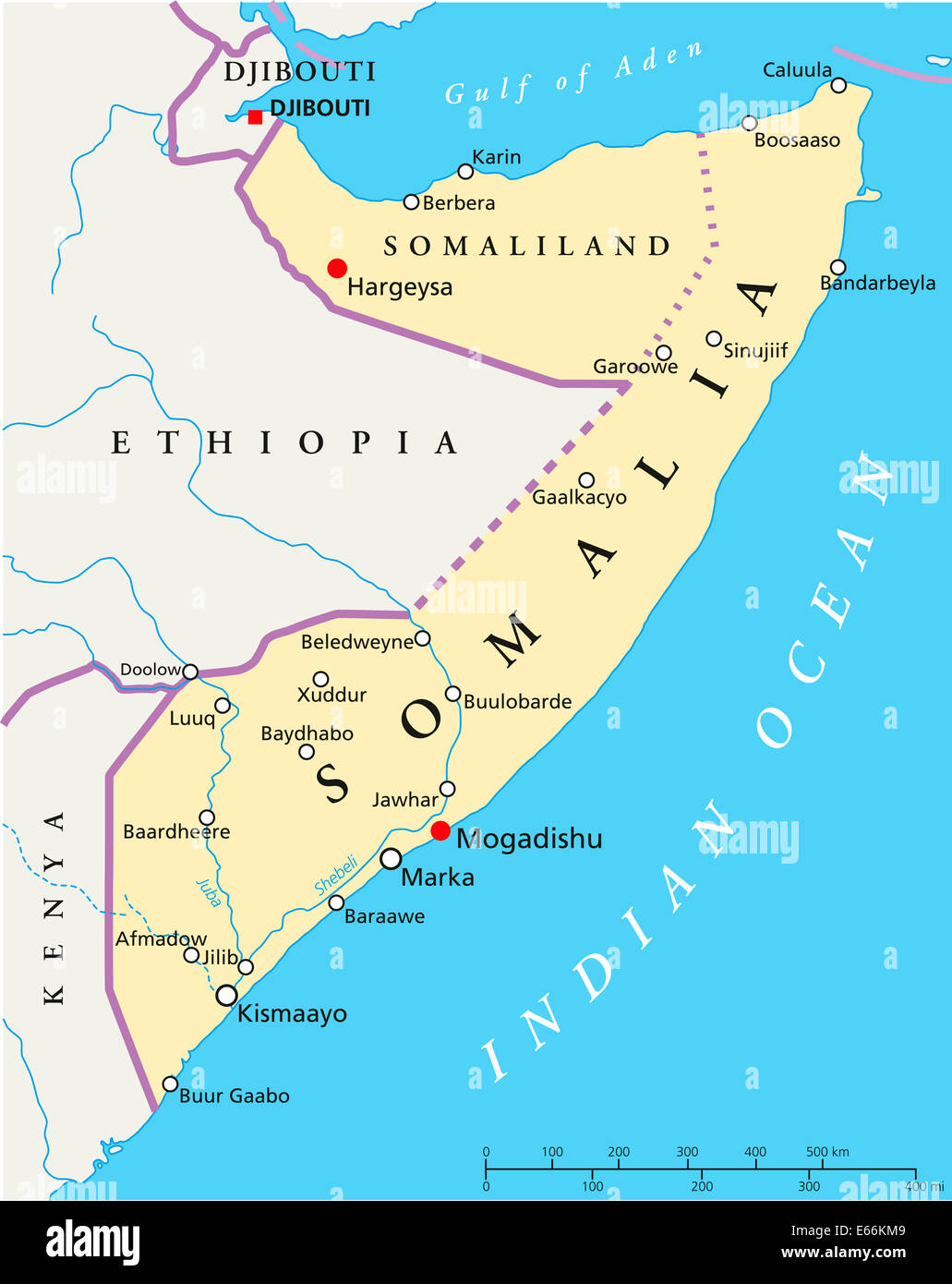
Jubaland has been at war with the federal government since November 2024. The conflict turned violent in Kismayo on 23 November, when a gunfight between Jubaland police and federal candidates’ security guards killed one security officer and injured two others. Two days after the election, the Banadir Regional Court issued an arrest warrant for President Madobe, accusing him of treason, violating the constitutional framework, and undermining national unity. The FGS attempted to use the Somali National Army to remove Jubaland President Madobe from power, resulting in a rapid military defeat and retreat by FGS forces. Mogadishu and Kismayo are still fighting for control of Gedo. In February 2026, Jubaland forces retook Bardhere District. In July, heavy fighting in Beled Hawo killed at least ten people. The federal government’s appointed commissioner for Bardhere was killed in the fighting.
Puntland has been operating as a de facto independent entity since early 2024. Puntland declared it severed all ties to authorities in Mogadishu, which also meant that the FGS more frankly supported the unionist insurgency in SSC-Khatumo, recognising it as a federal state under the name “Northeast” in August 2025 — despite Puntland’s long-standing claims on the territory. Puntland has established its own security forces, its own intelligence organisation, and its own counterterrorism framework — and has refused to participate in any federal security architecture.
Southwest State collapsed entirely in March 2026. On 17 March 2026, the Southwest State administration suspended all cooperation with the federal government, citing ongoing interference in internal affairs and security. Southwest is the third regional administration, after Puntland and Jubaland, to cut ties with the federal government amid disputes over the electoral system. The federal government started deploying troops in Baraawe and Buur Hakaba towns and sought to encourage defections within Southwest State’s security forces, facing accusations that it was trying to supplant the regional administration. Southwest’s president was subsequently declared illegitimate by Mogadishu. He fled to Kenya.
The three remaining states — Hirshabelle and Galmudug — are formally aligned with Mogadishu but deeply fragile. If they follow similar pressures and cut ties, it would render the upcoming election entirely unviable.
The Security Vacuum Al-Shabaab Is Filling
Every political crisis in Mogadishu is a strategic opportunity for Al-Shabaab. The group has not wasted this one. Al-Shabaab has retaken much of the territory the government captured in 2022 and 2023. External assistance, especially financing for AUSSOM, is in decline or in doubt, further weakening Somalia’s defences.
The numbers are devastating. Since March 2025, militants launched a series of coordinated attacks, dubbed the Shabelle offensive, dislodging Somalia’s army from various key strongholds. Although joint operations by AUSSOM and army forces have partly reversed Al-Shabaab’s territorial reach from certain districts, cash shortfalls remain AUSSOM’s most enduring problem. Amid this institutional drift, the greatest beneficiary is Al-Shabaab. Resource extraction without political consensus does not produce development — it produces division.
Al-Shabaab generates an estimated $100-150 million annually through taxation, extortion, and charcoal exports — a self-sustaining revenue base that makes it immune to the funding crises that are crippling the federal government’s security apparatus. As AUSSOM struggles to pay its soldiers, Al-Shabaab pays its fighters on time.
The International Community: Withdrawing at the Worst Possible Moment
Somalia’s political crisis is unfolding against the backdrop of the most severe contraction in international support since the early 2000s. The convergence of Trump administration aid cuts, European donor fatigue, and AUSSOM’s chronic funding crisis has removed the external scaffolding that has propped up Mogadishu’s government for two decades — at precisely the moment when that scaffolding is most needed.
Under President Donald Trump, the US has led the way, allocating just $150 million for programming in Somalia in 2025, down from $770 million in 2024. European countries that have heavily invested in Somalia’s recovery over the last two decades are also wondering whether their billions of dollars have been well spent, given the continued government dysfunction and Al-Shabaab’s advance.
The African Union peacekeeping mission tells the same story. The EU, which has largely covered troop stipends and civilian salaries for previous missions, has not yet allocated funds for 2025. Consultations among EU member states are still ongoing. AUSSOM became operational on 1 January 2025 under huge financial deficits and without a clear financing modality. The timing coincided with a surge in Al-Shabaab attacks and territorial gains. The committed funding amounts to only $16.7 million against a mission budget of $166.5 million — a gap of $150 million that is being papered over with short-term pledges that could evaporate at any time.
The United States has blocked the use of UN-assessed contributions to fund AUSSOM under Security Council Resolution 2719, forcing the mission into perpetual dependence on voluntary donations. The United States contributed nearly $1.6 billion to support troop-contributing countries for AMISOM and its successor missions, in addition to nearly $2 billion in assessed contributions to UNSOS. That era of unconditional American investment is over. H.R. 8334, the Taxpayer Protection and Somalia Accountability Act introduced in Congress in April 2026, would suspend all bilateral and multilateral assistance to Somalia unless strict accountability conditions are met — a legislative signal that the political climate in Washington has fundamentally shifted.
The UN Transitional Assistance Mission in Somalia is set to close by October 2026. AUSSOM’s mandate runs to December 2026 but its financial viability beyond mid-year is uncertain. The international institutional architecture that has sustained Mogadishu’s authority for fifteen years is being dismantled in real time.
The Plan to Seize Weapons — and What It Signals
Against this backdrop, the most alarming recent development is not diplomatic but operational. A security meeting at the presidential palace reportedly approved a plan for the Federal Government to seize weapons held in the Gubadley and Dayniile districts ahead of May 15, 2026. On the same day, the Mayor of Mogadishu appointed new district commissioners for both districts, positions now filled by officers drawn directly from the security services.
This is the playbook of a government preparing not for a democratic transition but for a security crackdown. By installing loyalist commissioners and pre-positioning forces to seize weapons from opposition-aligned neighbourhoods, Mohamud is setting the conditions for a Mogadishu confrontation that would echo — or surpass — the 2021 standoff that brought the city to the brink of civil war. The opposition has already warned that it will not accept Mohamud’s continued presidency after May 15. In such a scenario, they may establish an alternative political process to elect a new president and form a new cabinet, potentially in key regional centres such as Garowe or Kismayo, where opposition-aligned administrations maintain significant control.
Two governments. Two constitutions. One army preparing to seize weapons. Sixteen days.
What This Means for Somaliland
For Somaliland, the collapse of Somalia’s political order is simultaneously a vindication and a warning. It is a vindication because every element of the current crisis — the constitutional manipulation, the unilateral mandate extensions, the federal wars against regional governments, the capture of state institutions by a single political faction — is precisely the governance failure that Somaliland’s recognition case has always been built on distinguishing itself from. While Mogadishu pre-positions forces to seize weapons from its own citizens, Hargeisa recently completed a peaceful democratic election in which the incumbent party accepted defeat.
The warning is more subtle. A Somalia in full institutional collapse on Somaliland’s southern border is not an abstraction. It is a security threat, a refugee pressure, a magnet for Turkish and Egyptian military involvement, and an argument — however dishonest — that the entire region is ungovernable. Somaliland must counter that argument loudly and consistently, on every platform where its recognition case is being assessed.
The May 15 deadline is now sixteen days away. The negotiations between the federal government and the Somali Future Council are continuing, with Hawiye clan elders mediating and international partners pressing for dialogue. Both sides retain the institutional incentive to avoid open armed conflict. But the military deployments, the weapons seizure plans, the expired mandates, and the opposition’s explicit threat to establish a parallel government mean that the margin for error in Mogadishu is now measured in hours, not weeks.
Somalia has been on this brink before. In 2021, it pulled back. The question that every government in the Horn of Africa is asking tonight is whether it pulls back again — or whether May 15, 2026 becomes the date when the last pretence of Somali federal unity finally collapses.

