
Hargeisa — When Somalia joined the East African Community in March 2024, federal officials in Mogadishu hailed the moment as proof that the country had finally rejoined the region as a credible partner. Less than two years later, that claim is in tatters. Somalia’s first institutional act inside the bloc — the election of nine representatives to the East African Legislative Assembly — has become the most damaging test of Treaty compliance the Community has seen since its revival, and a forensic record of how President Hassan Sheikh Mohamud’s Justice and Solidarity Party has captured the machinery of the federal state.
The facts are now on the public record of the East African Court of Justice in Arusha. On 11 October 2025, the Speakers of both houses of Somalia’s Federal Parliament appointed a five-member ad hoc Joint Committee to oversee what was, by any reasonable standard, an exercise of profound constitutional importance: the country’s first delegation to a supranational legislature. The Committee gave itself five days. It drafted its own rules. It set the qualifications. It fixed a nomination fee of US$10,000 — a sum that, in a country where the median annual income is a fraction of that figure, functioned as a deliberate filter against any candidate not already plugged into the patronage networks of the presidency. On 15 October, a joint sitting of Parliament selected nine names from a shortlist of eighteen. By 16 October, the names had been transmitted to Arusha.
The 4.5 Formula, Discarded
What happened in those five days was not an election in any meaningful sense. It was a closed-circuit transaction inside a single party. Three sitting Somali MPs — Mohamed Ahmed Awil, Ali Abdullnur Osman and Abdullahi Mohamed Ahmed — filed References Nos. 45 and 46 of 2025 at the East African Court of Justice on 20 October, alleging that the process had been engineered by the JSP to deliver a slate hand-picked from elite sub-clans aligned with the presidency, the prime minister’s office and the parliamentary leadership. The applicants pointed to the systematic exclusion of opposition figures and under-represented minority groups, and to the casual abandonment of the 4.5 power-sharing formula that has, for two decades, been the only rough guarantee of clan inclusion in Somalia’s federal arrangements.
The 4.5 formula is not a rhetorical flourish. It is the architecture of the post-2004 settlement, the price Somalia’s four major clan families and the cluster of marginalised minorities agreed to in exchange for participating in the federal project at all. Discarding it inside a five-day window, behind closed doors, in favour of a JSP slate, is not a procedural irregularity. It is a constitutional event.
The Court’s First Verdict
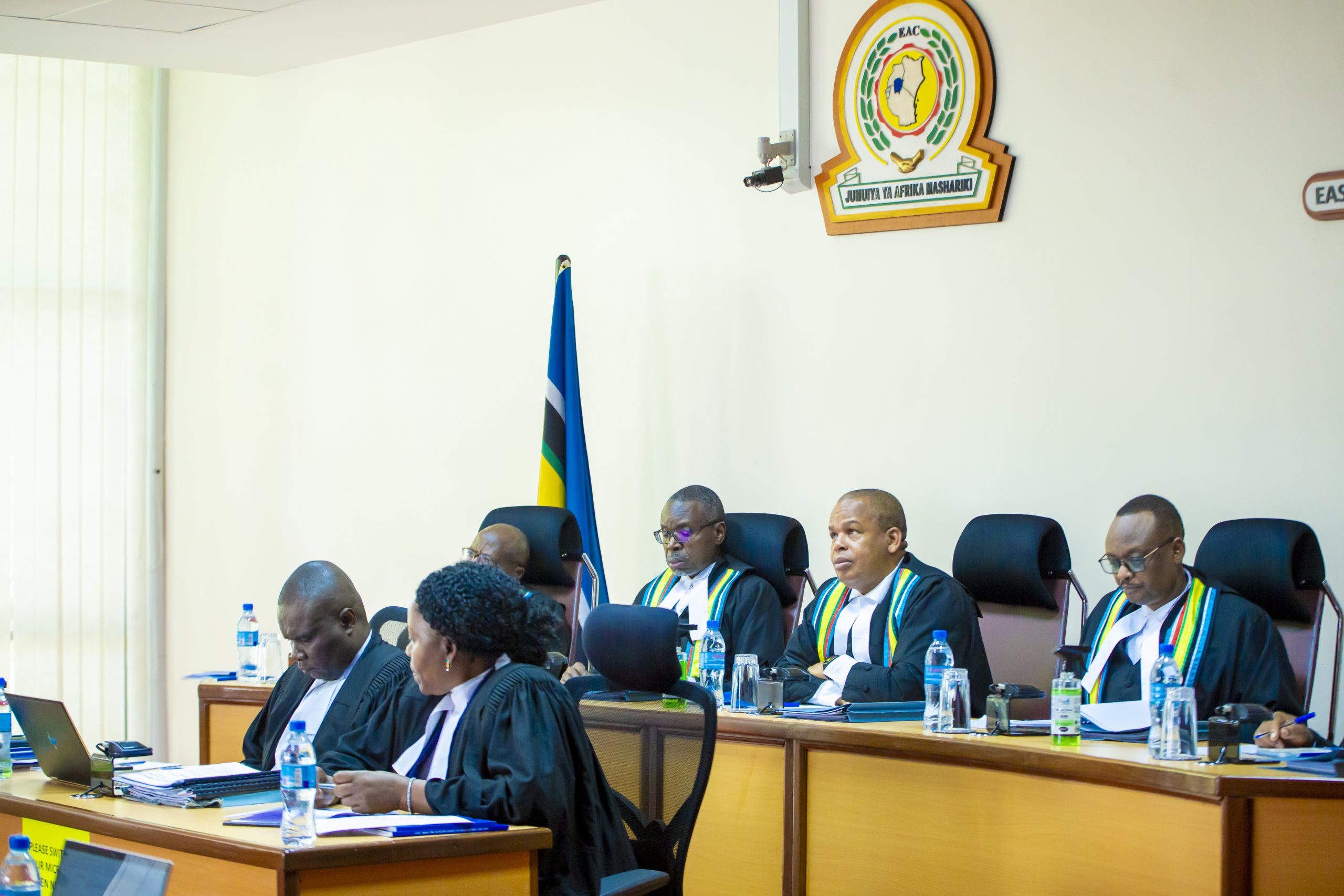
On 21 November 2025, the First Instance Division of the East African Court of Justice issued an interim injunction prohibiting the East African Legislative Assembly from administering the oath of office to any of the nine nominees. The five-judge bench, presided over by Judge Yohane Masara, found that the applicants had established a strong prima facie case that the impugned process had violated Article 50 of the EAC Treaty, which requires partner states to elect EALA members through a procedure that is transparent, competitive and representative of “the various political parties represented in the National Assembly, shades of opinion, gender and other special interest groups.”
The Court’s reasoning was unsparing. The judges drew an explicit parallel between the Somali process and earlier cases in which the Court had struck down EALA elections in Uganda for failing to provide proportionate representation, and in Kenya for relying on a ruling-party-dominated voice vote. The Court noted that no monetary award could repair the damage caused by seating illegitimate members, whose votes would taint legislation, oversight decisions and the broader integrity of the bloc’s only legislative organ. On the balance of convenience, the judges concluded, leaving Somalia unrepresented in EALA was the lesser harm.
The Appeal — and the Admission
Somalia’s Attorney General lodged an appeal on 27 November and applied for a stay of execution. On 19 January 2026, the Appellate Division — five judges led by President Nestor Kayobera — granted the stay, allowing the swearing-in to proceed pending the substantive appeal. The Appellate ruling, however, rested on a remarkable concession from the federal government’s own legal team: that the Trial Court had erred in assuming Somalia possessed parliamentary political parties whose participation in the EALA election could be assessed at all, because, in the words of the appellate judgment, “there are no parliamentary political parties at the moment and there have never been under the Applicant’s current transitional political system.”
Read carefully, this is an extraordinary admission for a state seeking the privileges of EAC membership. The federal government’s defence against the charge of failing to ensure competitive multi-party representation was, in essence, that Somalia has no multi-party system to ensure representation of. The stay was granted on the technical ground that the appeal was arguable and the public interest in regional integration outweighed the harm of allowing the seating to proceed. It was not a vindication of the process. It was a reprieve.
The Hybrid Ceremony
On 16 March 2026, the nine Somali members were sworn in at a special hybrid plenary in Arusha. The ceremony was conducted partly in person and partly over video link — a format chosen because the East African Community is in the grip of a severe funding crisis, and a full physical session was beyond the bloc’s means. Somalia, for its part, has not paid its annual EAC contributions. A leaked letter from the Federal Parliament dated 12 February 2026 acknowledged the arrears but proposed a stopgap payment of US$30,320 to cover the daily subsistence and sitting allowances required to physically convene the swearing-in. The letter was explicit that the sum had nothing to do with Somalia’s outstanding obligations to the Community.
In other words: Mogadishu could find the money to seat its hand-picked delegation, but not to pay its dues to the institution it had just joined. This is the federal government’s idea of regional partnership.
What Remains
The substantive appeal on the merits has not been heard. References 45 and 46 are still alive at the trial court level. The nine members are seated and drawing allowances, but the legal cloud over their mandate has not lifted. Should the Appellate Division ultimately uphold the trial court’s findings on Article 50, every vote cast and every committee assignment held by the Somali delegation between March 2026 and that ruling will be open to challenge. Somalia’s first contribution to a supranational legislature will arrive pre-tainted.
For Somaliland, the case is instructive in a way that goes beyond the immediate dispute. The federal government in Mogadishu insists, in every diplomatic forum it can reach, that it speaks for the people of Somaliland and that Hargeisa’s claim to self-determination is a fiction to be ignored. The EALA episode shows what that representation actually looks like when it touches an institution Mogadishu cannot fully control. Five days, one party, ten thousand dollars to enter, no opposition seats, no minority seats, the 4.5 formula thrown out, a Treaty obligation breached, and a regional court issuing an injunction within a month. This is the governance Mogadishu offers — the governance Somaliland declined to inherit in 1991, and has spent thirty-five years building an alternative to.
The East African Community will eventually decide whether it can absorb a member state whose first legislative act was a Treaty violation. Somaliland, watching from the other side of the border, has already drawn its conclusions.

