
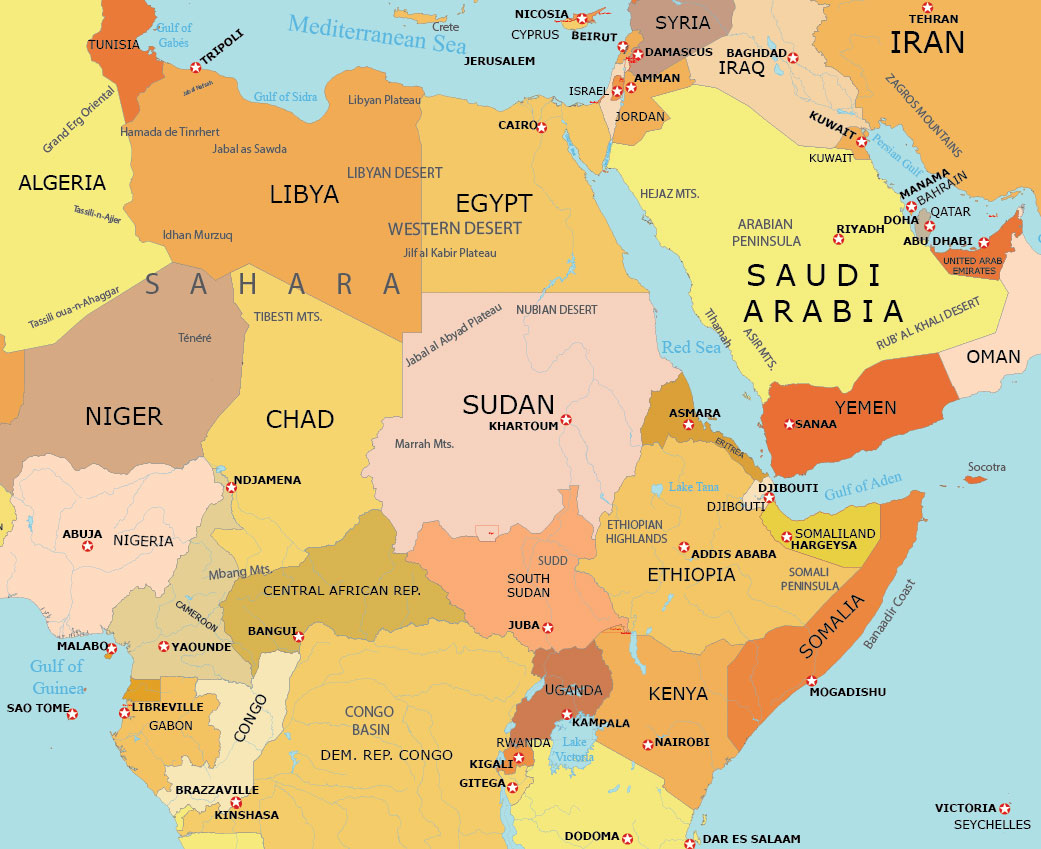
Hargeisa — Sixty-six days into the war that began with Operation Epic Fury, the question facing the Horn of Africa is no longer how to avoid the conflict. It is whether the region’s economies can survive a prolonged version of it. The fragile ceasefire reached between Washington and Tehran on 8 April has been tested almost daily — by Iranian missile strikes on a US warship near Jask earlier this week, by drone attacks on the United Arab Emirates on 4 and 5 May, by the partial reopening of a single US-guarded shipping lane through the Strait of Hormuz that has so far seen only two merchant ships pass while hundreds remain bottled up in the Persian Gulf. The pause is not peace. It is the suspension of large-scale fighting while both sides reposition. For the eight states bordering the Red Sea and the Gulf of Aden, including Somaliland, the question is what happens to the regional economy if the next phase of the war returns the chokepoints to active disruption.
The Two Doors
The Horn of Africa lives between two doors. To the north-east, the Strait of Hormuz, through which twenty per cent of global oil and gas transited in peacetime. To the south-west, the Bab el-Mandeb, the eighteen-mile-wide passage between Yemen and the Horn that carries roughly nine million barrels of oil per day and twelve per cent of global trade by volume. When both doors are open, the world barely notices their existence. When one is closed, as Hormuz has been in effect since late February, the cost ripples outward through fuel prices, fertiliser shortages, food inflation and the freight insurance market, where war-risk premiums have risen more than a thousand per cent since the war began. When both close simultaneously — a scenario Iran’s former foreign minister Ali Akbar Velayati explicitly raised on 6 April, declaring that “the unified command of the Resistance front views Bab al-Mandeb as it does Hormuz” — analysts at ORF Middle East estimate that ten billion dollars per day of global trade is placed at risk.
That second door is the one that determines Horn of Africa survival. Iran cannot directly close Bab el-Mandeb — it has no military forces on either coast. The closure mechanism, if it is activated, runs through the Houthis, who control the Yemeni shore and have already demonstrated, between November 2023 and the May 2025 ceasefire, the capacity to drive global shippers off the route entirely. Maersk, CMA CGM and Hapag-Lloyd began rerouting around the Cape of Good Hope in March of this year. The Cape detour adds ten to fourteen days and one and a half million dollars in fuel costs per round trip. For containerised consumer goods bound for Europe that delay is absorbable. For the Horn of Africa, which sits on the wrong side of the chokepoint and depends on imports of fuel, fertiliser, wheat and pharmaceuticals delivered through Bab el-Mandeb itself, the rerouting solves nothing. The ships that supply the Horn must come through the strait or not at all.
What Has Already Broken
The economic damage to the region has not waited for a worst-case scenario. It has arrived in instalments since 28 February. Ethiopia, which consumes roughly one hundred and four thousand barrels of oil per day and spends more than four billion dollars annually on fuel imports overwhelmingly sourced from the Gulf, has been the most visible casualty. Prime Minister Abiy Ahmed has publicly urged citizens to use fuel sparingly and ordered all public institutions and state-owned enterprises to send non-essential staff on annual leave. Diesel shortages have lengthened working days for everyone in Addis Ababa who depends on transport, which is to say everyone. The government’s precautionary stockpiling — the rational response of any state that sees a chokepoint crisis on the horizon — has itself contributed to the price spike, because every barrel pulled into a strategic reserve is a barrel removed from the retail market.
The remittance shock has been quieter but no larger in absolute terms. Ethiopia receives more than six billion dollars a year in diaspora transfers, of which around five per cent of GDP comes substantially from the Gulf, where an estimated seven hundred and fifty thousand Ethiopians work in Saudi Arabia alone. Kenya saw one of its sharpest monthly drops in remittances on record in March 2026, with as much as forty million US dollars in monthly flows estimated to be at risk. The Gulf states themselves have lost roughly fifteen billion dollars in energy revenue since the war began, and the secondary effect of that loss — reduced Gulf investment commitments to African infrastructure — is now visible in projects from Rwanda to the Red Sea coast.
Sudan, where thirty-three million people are expected to need humanitarian assistance this year and where Port Sudan is the principal lifeline, sits one Houthi missile launch away from a complete collapse of its food import chain. The World Food Programme already classifies forty-one per cent of the population as acutely food insecure. A prolonged Bab el-Mandeb disruption would not push that figure incrementally higher. It would break the system.
Somaliland’s Paradox
For Somaliland, the war has produced a contradiction that the region’s politicians have not yet fully acknowledged in public. The same conflict that has raised the strategic value of Berbera Port to historic levels has also placed Somaliland in the Houthi target set for the first time. Israel’s recognition of Somaliland in December 2025 — which preceded the outbreak of the war by ten weeks and was explicitly tied to the establishment of forward intelligence and potential military positioning against Houthi threats roughly three to four hundred kilometres across the Gulf of Aden — moved Hargeisa from the periphery of the Iran-Israel confrontation to one of its outer rings. Analysts at the Institute of Foreign Affairs and the Horn Review have both noted, without polemic, that “Somaliland could be a target for Houthi attacks if Berbera is perceived to have Israeli ties.” That perception is no longer hypothetical.
Against that increased risk sits an equally sharp increase in commercial value. Djibouti’s Horizon Oil Storage Depot has been struggling with capacity even before the war, and the Ethiopian government had already begun, in 2024, formally evaluating Berbera as a fuel-import alternative to ease pressure on the Djibouti corridor. The war has accelerated that conversation. Berbera is the only deep-water port on the Horn coast that is not either inside Houthi missile range from Hodeidah, contested by Al-Shabaab, or saturated by existing demand. It has Emirati capital, an Ethiopian logistics partnership built over the past two years through the January 2024 memorandum of understanding, and now a layer of Israeli political backing. The “Berbera Axis,” as the Atlantic Council named it last year, has become the most discussed piece of port infrastructure on the African continent.
Somaliland’s challenge is to extract the commercial benefit without absorbing the security cost. That is a harder problem than it sounds. The Houthis have already demonstrated, through their April 2024 financing of Al-Shabaab via the MV Abdullah ransom, that the southern shore of the Gulf of Aden is part of their operational geography. Two cargo vessels were seized off Somalia’s central coast on 26 April of this year — one near Garacad, one near Mareeyo — in incidents the United Kingdom Maritime Trade Operations confirmed and which the Horn Review has linked to a wider re-emergence of Somali piracy as Western naval assets are pulled toward the Eastern Mediterranean and the northern Red Sea. Hargeisa’s coast is currently quieter than Mogadishu’s, but the security vacuum is regional, and Berbera is now too valuable a target to be ignored indefinitely.
Surviving the Long War
If the ceasefire collapses and the war returns to active phase — a scenario that the Iranian foreign ministry’s mobilisation campaign and the continuing Iranian missile barrages this week suggest is being actively prepared for — five things will determine whether the Horn of Africa economies survive intact.
The first is strategic petroleum stockpiling, and the Horn states are unequally prepared. Ethiopia has begun emergency reserves but starts from a low base. Somaliland holds approximately ninety days of import cover at Berbera’s storage facility, which is better than Sudan but worse than Kenya. Bangladesh, with comparable per-capita energy import dependence, entered the crisis with nine to fourteen days of fuel reserves and has already imposed four-day work weeks. The Horn’s margin is narrower than its leaders have generally communicated to their publics.
The second is the Saudi East-West Pipeline, which links the Abqaiq processing centre on the Persian Gulf to the Red Sea port of Yanbu, bypassing Hormuz entirely. The pipeline has reached its full capacity of seven million barrels per day in recent weeks, up from a peacetime average of seven hundred and seventy thousand. That capacity is fixed. It cannot be expanded inside the timeframe of the current crisis. It is, however, the single most important non-conflict-zone artery currently supplying Red Sea ports, and the Horn’s exposure to a Bab el-Mandeb disruption is reduced to the extent that Yanbu-routed crude can substitute for Hormuz-routed flows. This is a Saudi commercial decision that the Horn states cannot influence.
The third is regional coordination, which has historically been the Horn’s weakest variable. Mogadishu has spent the past three months cancelling its UAE port and security agreements in protest at Berbera’s diplomatic upgrades. Ethiopia has been quietly negotiating fuel-import arrangements with Berbera while simultaneously managing tensions with Eritrea over Red Sea access. Djibouti, which hosts US, French, Italian, Japanese and Chinese military bases on a single twenty-three thousand square-kilometre territory, has the most to lose from regional militarisation and the least diplomatic leverage to prevent it. A coordinated Horn-of-Africa fuel pooling mechanism, of the sort the European Union improvised in 2022 after the Russian invasion of Ukraine, has not been seriously discussed in any IGAD forum since the war began. It should be.
The fourth is supplier diversification away from the Gulf. Nigeria, Angola and increasingly Senegal have export capacity that could in principle substitute for Saudi or Emirati crude in Horn refining streams, but the logistics of moving West African crude to East African ports require either trans-African pipeline capacity that does not exist or maritime detours around the Cape that erase most of the price advantage. The Atlantic supplier option is real but multi-year. It is a 2030 hedge, not a 2026 solution.
The fifth is what the war is currently teaching everyone but is hardest to act on: the Horn of Africa has been treated, by the great powers, as a transit corridor between elsewhere and elsewhere. The actual populations of the Horn — three hundred million people across Ethiopia, Kenya, Sudan, South Sudan, Somalia, Somaliland, Eritrea and Djibouti — are the people most exposed to a chokepoint crisis that they did not create and that will not be resolved on terms they will be consulted about. The longer the war runs, the more expensive that exposure becomes, and the more obvious it becomes that Horn states need to build economic resilience that does not depend on Gulf calm. Berbera’s commercial rise, Somaliland’s diplomatic recognition, Ethiopia’s slow shift toward port diversification, and the new salience of the Yanbu pipeline are all symptoms of the same underlying recognition. The architecture of the Red Sea economy is changing because the old architecture has been shown not to survive contact with great-power conflict.
What Hargeisa Should Be Saying
The Somaliland government has been notably silent on the macroeconomic implications of the war. That silence is partly diplomatic — there is no benefit to being seen as the country that announces its strategic value during a regional crisis — but it has also meant that the public conversation in Hargeisa has lagged the conversation taking place in Addis Ababa, Riyadh and Abu Dhabi. The argument that Somaliland’s stability, electoral legitimacy, port infrastructure and Israeli-recognised sovereign status make it the indispensable Horn-of-Africa partner for any Western or Gulf strategy of regional supply resilience is not being made forcefully enough by Somaliland’s own representatives. It is being made, almost by default, by the absence of credible alternatives.
If the war ends quickly through a successful resumption of US-Iran negotiations — Iran is currently reviewing a Pakistani-relayed text from Washington — much of this analysis becomes moot, and the Horn of Africa returns to its pre-war fragility, which was already considerable. If the war does not end quickly, and the chokepoints become permanent features of the regional security landscape rather than temporary disruptions, Somaliland’s position will continue to strengthen and its risks will continue to grow in parallel. Managing both at once — capturing the commercial opportunity without becoming a target — is the strategic question that ought to be on every desk in Hargeisa’s foreign ministry. The next sixty-six days will matter more than the last.

