
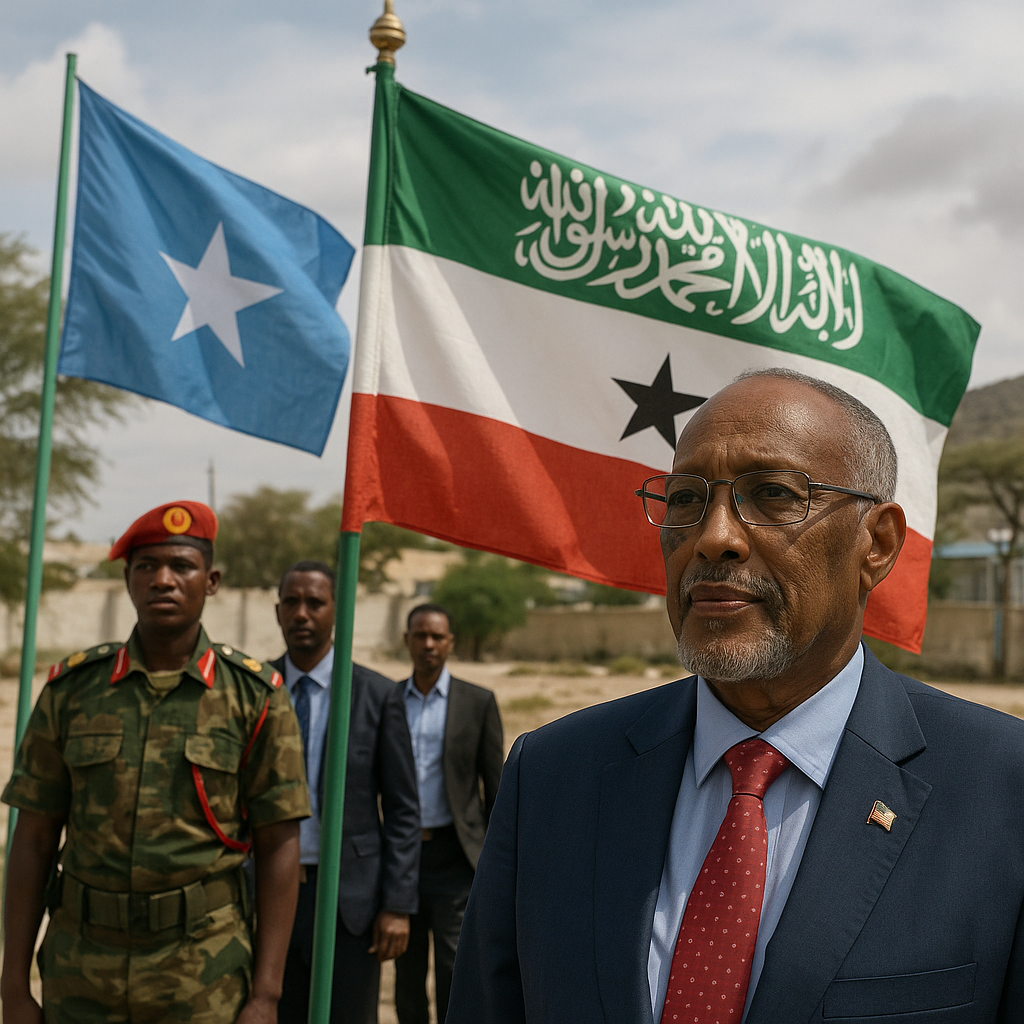
Hargeisa Signals New Diplomatic Push as Regional Dynamics Evolve
Hargeisa — Somaliland’s long-standing quest for international recognition has entered a critical new phase, with senior officials in Hargeisa intensifying diplomatic engagement across multiple fronts as the geopolitical landscape of the Horn of Africa continues to shift in ways that may prove consequential for the self-declared republic’s aspirations.
The government of President Abdirahman Irro, who assumed office in late 2024 following a peaceful democratic transition widely praised by international observers, has made recognition its central foreign policy priority, dispatching envoys to key capitals and stepping up outreach to influential multilateral bodies. Officials close to the presidency have indicated that the administration views the current regional moment — shaped by renewed tensions between Ethiopia and Somalia, evolving Gulf state interests, and growing Western concern about Red Sea security — as a strategic opening that must not be wasted.
Ethiopia Factor Looms Large
Central to Somaliland’s diplomatic calculus remains its relationship with Ethiopia, its largest neighbor and most consequential potential partner. The controversial memorandum of understanding signed between Hargeisa and Addis Ababa in early 2024, which envisioned Ethiopian access to a Red Sea port at Berbera in exchange for a measure of diplomatic recognition, has remained in legal and political limbo following pushback from Mogadishu and broader regional opposition.
Analysts tracking the Horn of Africa closely have noted that while the MOU has not formally collapsed, its implementation has stalled significantly. Ethiopian officials have offered carefully worded public statements suggesting continued interest in sea access while stopping short of any formal recognition of Somaliland’s statehood — a position that has frustrated Hargeisa but has not entirely dimmed hopes of a future breakthrough.
A senior researcher at a Nairobi-based think tank focused on East African affairs described the situation as a delicate balancing act for Addis Ababa, suggesting that Ethiopia remains genuinely interested in the strategic benefits of Berbera port access but is wary of the diplomatic costs of moving too aggressively against Mogadishu’s objections at a time when it faces its own internal pressures.
Gulf and Western Interest Intensifies
Beyond Ethiopia, Somaliland has been working to deepen ties with Gulf states, particularly the United Arab Emirates, which has maintained a long-standing relationship with Hargeisa through the DP World-operated Berbera port and has strategic interests in Red Sea stability. Emirati engagement with Somaliland, while carefully calibrated to avoid direct confrontation with Mogadishu, has continued to grow in the infrastructure and security domains.
Western governments, meanwhile, have shown renewed interest in Somaliland’s strategic position along one of the world’s most vital maritime corridors. The ongoing Houthi disruption of Red Sea shipping has sharpened appreciation in Washington, London, and Brussels for the value of stable, friendly ports on the Gulf of Aden. Senior British officials visited Hargeisa in recent months, and the United Kingdom’s development and security engagement with Somaliland remains among the most substantial of any Western nation.
A diplomat familiar with UK-Somaliland relations indicated that while formal recognition remained politically complex, there was growing acknowledgment in Western capitals that Somaliland’s democratic credentials and stability warranted a qualitatively different level of engagement than it had historically received.
Internal Stability as a Diplomatic Asset
Somaliland officials have been keen to present the territory’s internal stability and democratic governance as its strongest arguments for international recognition. The peaceful transfer of power from former President Muse Bihi Abdi to Irro following November 2024 elections — Somaliland’s sixth democratic exercise — was cited repeatedly in diplomatic communications as evidence of an institutionally mature political system deserving of formal status.
However, challenges remain. Sporadic tensions in the Sool and Sanaag regions, which are contested with the Puntland administration in northeastern Somalia, have occasionally flared, and economic pressures on ordinary citizens remain acute. Inflation, high youth unemployment, and a currency under strain continue to test public patience, even as the government pursues its international agenda.
A Pivotal Moment
Observers of Somaliland affairs broadly agree that the territory stands at one of the most consequential junctures in its more than three decades of de facto independence. The combination of a new, energetic administration, a fluid regional environment, and growing international awareness of Somaliland’s strategic value has created conditions that, while not guaranteeing a breakthrough, make one more conceivable than at almost any previous point.
For the people of Hargeisa and beyond, the stakes could hardly be higher. Recognition would unlock access to international financial institutions, foreign direct investment, and the full spectrum of diplomatic relations — transforming the territory’s development prospects. Whether the current moment translates into tangible progress, or whether Somaliland’s recognition bid remains perpetually deferred, is a question that the coming months are likely to begin answering.

