
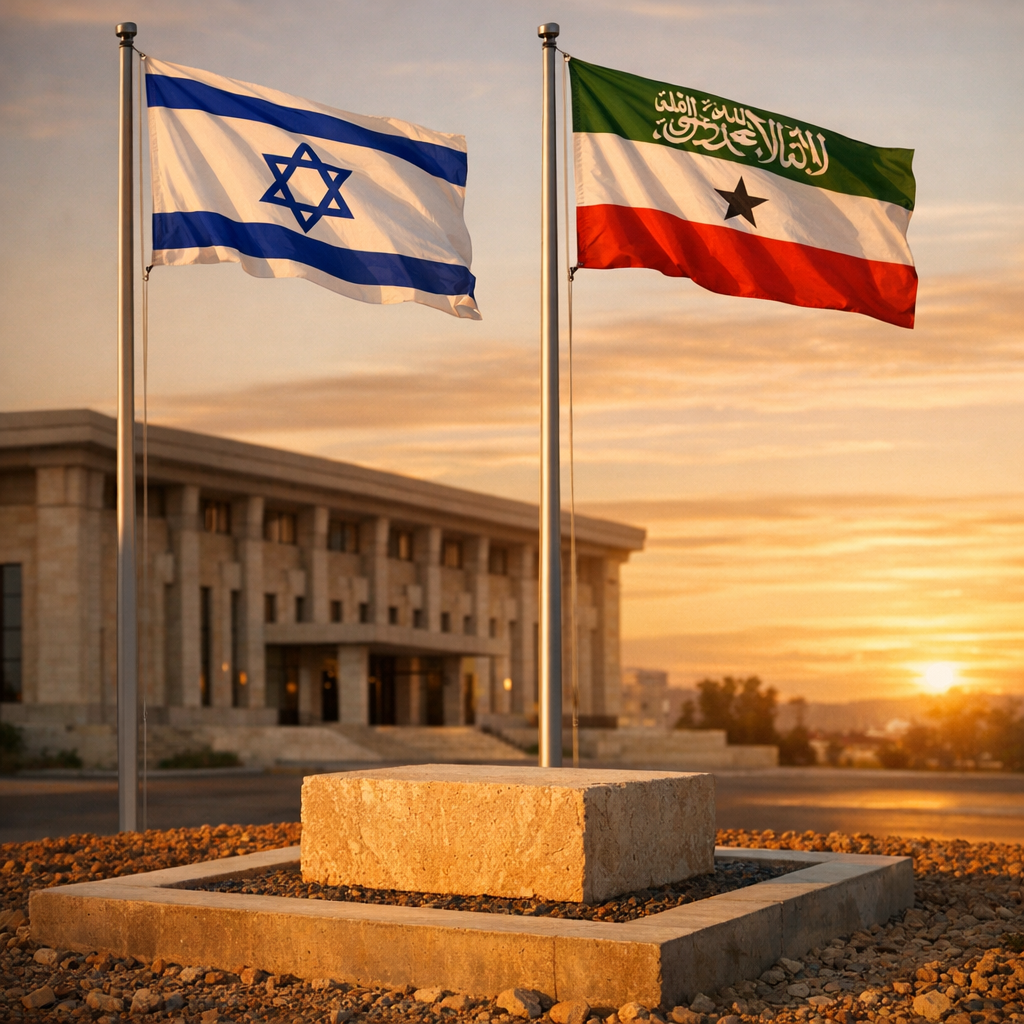
Hargeisa — Israel’s Foreign Ministry announced on Sunday, November 1, 2026, that Ambassador Michael Lotem, Israel’s first ambassador to Somaliland, had presented his credentials to President Abdirahman Mohamed Abdullahi (Irro) at the Presidential Palace in Hargeisa on Sunday, November 1, 2026. The ceremony, confirmed by Somaliland’s presidency and foreign ministry as well as Israel’s Foreign Ministry, marked a milestone not only in bilateral ties but in Somaliland’s long pursuit of international recognition.
President Irro described the occasion as a historic day, noting that it was the first time a Somaliland head of state had received credentials from an ambassador representing a UN member state that formally recognises Somaliland’s independence. He said the appointment reflected how closely the two countries are drawing together, and spoke of a shared determination to forge an enduring, mutually beneficial partnership grounded in shared interests, mutual respect and a common vision. The president added that closer ties could open opportunities in trade, investment, security, defence, infrastructure and technology, and he highlighted Somaliland’s location on the Red Sea and Gulf of Aden as a contribution to regional peace and stability. He noted that the cooperation carries significance well beyond the two countries, extending to the wider region and the international community.
Ambassador Lotem called the presentation of his credentials a great honour. He thanked the president, said it was an honour to represent Israel in Somaliland, and pledged to work to strengthen ties, particularly in security, defence, trade, investment, health care and education. He emphasised that Israel’s recognition was not a diplomatic formality but an acknowledgement of what Somaliland has built through its own efforts over 35 years of self-governance.
Israeli Foreign Minister Gideon Sa’ar, in a written statement, declared that ‘Israel is determined to develop and strengthen its relations with Somaliland.’ He added that the appointment of ambassadors, in keeping with the agreement reached when the two countries established mutual recognition, represents another meaningful step toward deeper ties between the two nations.
Somaliland’s Foreign Minister Abdirahman Dahir Adam Bakal welcomed the ceremony warmly, saying it had transformed diplomatic recognition into formal representation and laid the groundwork for a partnership built to last.
Following the credentials ceremony, a cornerstone was laid for a future permanent Israeli embassy in Hargeisa — a concrete signal that Israel’s presence in Somaliland is intended to be enduring.
The event is the latest chapter in a relationship that has moved with notable speed. Israel recognised Somaliland on December 26, 2025, becoming the first UN member state to do so. Foreign Minister Sa’ar visited Hargeisa in January 2026. Somaliland appointed its first ambassador to Israel, Mohamed Hagi, in February 2026; he presented his credentials to Israeli President Herzog on May 18. Ambassador Lotem was appointed in April 2026. In June 2026, President Irro travelled to Israel, and Somaliland formally opened its embassy in Jerusalem during that visit. The areas identified for cooperation since recognition was announced include agriculture, health, technology and the economy.
The relationship has not been without external friction. No other UN member state has yet extended recognition to Somaliland, and Israel’s decision has drawn objections from Somalia, the African Union and the Arab League. A Houthi leader has also threatened to target any permanent Israeli military presence in Somaliland. In the United States, President Trump’s October 12 remarks describing Somaliland as ‘a totally different country’ drew international attention, though no formal change in US policy has followed.
Analysis: From Declaration to Institution
What distinguishes this week’s events from earlier milestones is not symbolism but structure. When Israel recognised Somaliland last December, it made a statement. When Foreign Minister Sa’ar visited Hargeisa in January, it made a gesture. But the exchange of resident ambassadors, a functioning Somaliland embassy in Jerusalem and now a cornerstone for a permanent Israeli embassy in Hargeisa represent something categorically different: the construction of institutions.
Institutions are far harder to reverse than declarations. A resident ambassador means permanent staff on the ground, day-to-day contact between ministries, a standing channel through which the cooperation pledged in agriculture, health, technology and trade can be translated into actual agreements, joint projects and shared programmes. A physical embassy under construction is a commitment written in concrete — quite literally. Governments that wish to walk away from a bilateral relationship must now dismantle offices, recall staff and explain the closure of buildings. The political cost of retreat rises sharply.
Ambassador Lotem’s background is also an asset worth noting. His previous postings in Kenya, Azerbaijan and Kazakhstan, combined with his experience in economic diplomacy across Africa, mean he arrives in Hargeisa with practical knowledge of how to move relationships from the statement phase to the delivery phase. He understands African institutions, African business environments and the patience that development partnerships require. Somaliland could not have asked for a more suitable interlocutor for the work that lies ahead.
There is a broader strategic dimension as well. For years, Somaliland’s advocates have argued that the territory functions as a de facto state — that it holds elections, maintains borders, runs courts and provides services — and that the international community’s reluctance to recognise it is a matter of political inertia rather than practical reality. The Israel relationship now provides a working model that other governments can observe. What does full diplomatic engagement with Somaliland look like in practice? It looks like this: ambassadors, embassies, a structured agenda for cooperation and a relationship governed by the same norms and mechanisms that apply between any two recognised states.
That model matters. It demonstrates that recognition is not merely possible in principle but functional in practice. For Somaliland’s government and people, the laying of a foundation stone in Hargeisa is a quiet but powerful affirmation: the future is being built, one course of stone at a time.

