
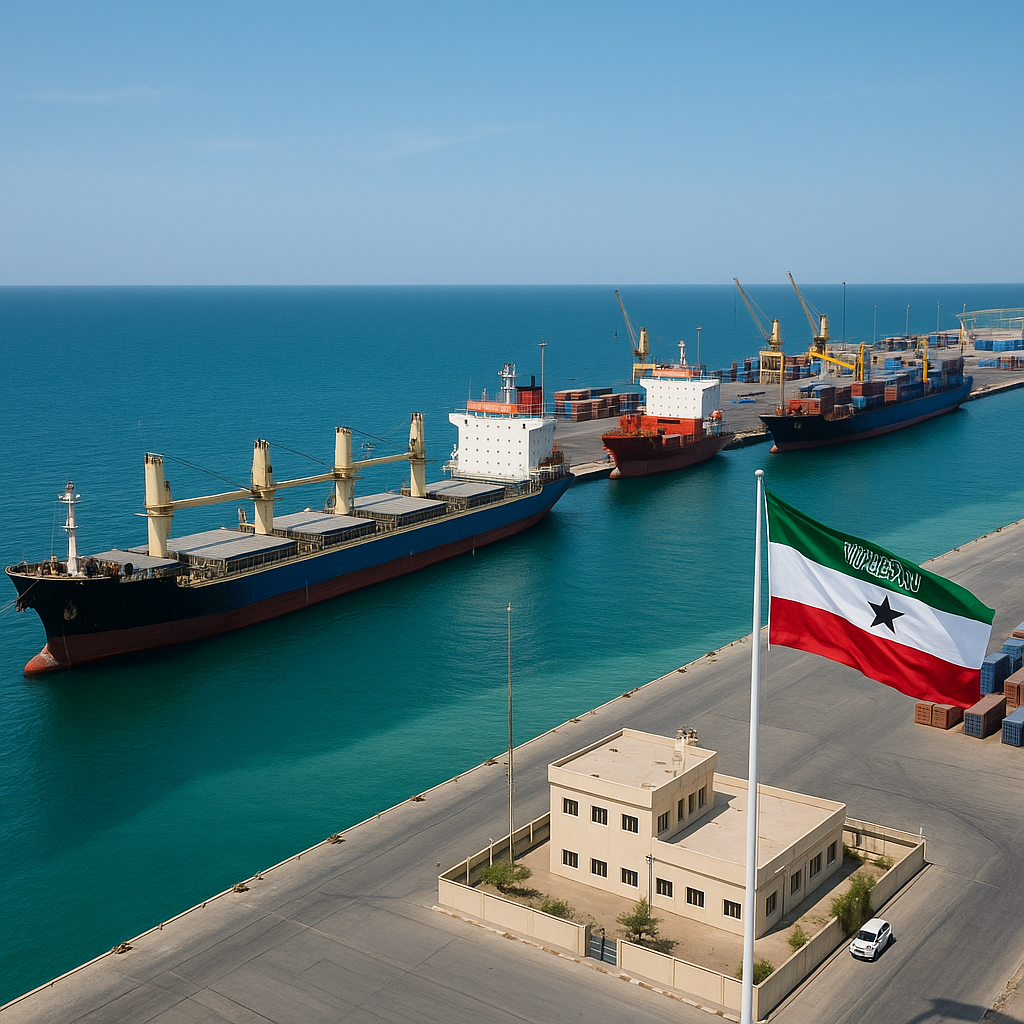
Hargeisa Accelerates Recognition Drive Amid Shifting Regional Dynamics
Hargeisa — Somaliland’s government has intensified its international diplomatic campaign in recent months, pursuing a multi-front strategy aimed at securing greater formal recognition and practical partnerships from a growing number of countries and international institutions. Senior officials in Hargeisa have signaled that the administration of President Abdirahman Irro, who took office following the landmark November 2024 elections, views 2025 as a pivotal year for advancing the territory’s decades-long quest for acknowledged statehood on the world stage.
The diplomatic momentum comes at a time of significant geopolitical realignment across the Horn of Africa, with global and regional powers recalibrating their interests in the Red Sea corridor. Somaliland’s strategic position along that corridor — anchored by its flagship infrastructure at Berbera Port — continues to serve as one of its most compelling arguments for international engagement, offering nations seeking stable, reliable access to the Gulf of Aden a credible alternative to ports elsewhere in the region.
Gulf of Aden Strategy Takes Center Stage
Officials from the Somaliland Ministry of Foreign Affairs have been conducting a series of meetings with diplomatic counterparts across Europe, the Gulf, and East Africa in recent weeks. According to government sources, these engagements have focused not only on the question of formal recognition but also on practical frameworks for trade facilitation, security cooperation, and investment in port infrastructure. Representatives from several Gulf states have reportedly shown renewed interest in Berbera as a logistics hub, particularly as regional instability elsewhere has elevated the port’s strategic value.
The Irro administration has made clear that it intends to pursue a more assertive foreign policy posture than its predecessor, framing Somaliland’s case for international recognition around concrete governance achievements — including the peaceful democratic transfer of power that accompanied the November elections — rather than relying solely on historical and legal arguments. Senior advisers have described this shift as an effort to show the international community that Somaliland is not merely a stable enclave but a functioning democratic entity capable of entering into binding bilateral relationships.
Ethiopia Relationship Remains Complex but Active
One of the most closely watched dimensions of Somaliland’s diplomatic landscape remains its relationship with Ethiopia. The Ethiopia-Somaliland port access memorandum of understanding, signed under the previous Somaliland administration in January 2024, continues to generate both opportunities and complications. While the agreement opened the door to significant Ethiopian investment interest in Berbera and elevated Somaliland’s international profile considerably, its implementation has proceeded cautiously against a backdrop of Addis Ababa’s sensitive relations with Mogadishu and shifting domestic priorities within Ethiopia itself.
Sources familiar with the matter indicate that technical working groups from both sides have continued discussions on the practical modalities of port access arrangements, though no formal updated agreement has been publicly announced under the Irro government. Hargeisa has been careful to manage expectations, with officials indicating privately that they see the Ethiopia relationship as a long-term strategic partnership to be built incrementally rather than resolved through a single dramatic announcement.
Djibouti Factor Looms Over Regional Balance
Somaliland’s diplomatic planners are also increasingly attentive to the role of Djibouti in shaping the region’s port and logistics competition. Djibouti, which handles the vast majority of Ethiopia’s trade, has watched the Ethiopia-Somaliland engagement with evident concern, and senior Djiboutian officials have taken steps to reinforce their own ties with Addis Ababa. Analysts tracking the region note that any substantive progress on Ethiopian use of Berbera would represent a meaningful rebalancing of the Horn’s economic geography — a prospect that introduces both opportunity and diplomatic complexity for Hargeisa.
Regional observers suggest that Somaliland’s best path forward lies in positioning Berbera not as a direct competitor to Djibouti but as a complementary node in a diversified regional logistics network, a framing that may prove more palatable to multiple stakeholders simultaneously. Whether that framing can gain sufficient traction to drive concrete investment and formal partnerships remains the central challenge facing Somaliland’s foreign policy establishment.
Outlook: Cautious Optimism in Hargeisa
Within Hargeisa’s diplomatic community, the mood is described as one of cautious optimism tempered by an acute awareness of how many times similar windows of opportunity have narrowed without producing the breakthroughs Somaliland’s government and population have long sought. What distinguishes the current moment, officials argue, is a convergence of factors — a freshly elected government with a clear mandate, heightened global interest in Red Sea security, and a Berbera Port whose infrastructure has tangibly improved — that together make the case for engagement more compelling than at any previous point. Whether the international community will ultimately respond with the formal recognition Somaliland seeks, or settle for the informal partnerships that have characterized relations to date, remains the defining question of the territory’s foreign policy horizon.

