
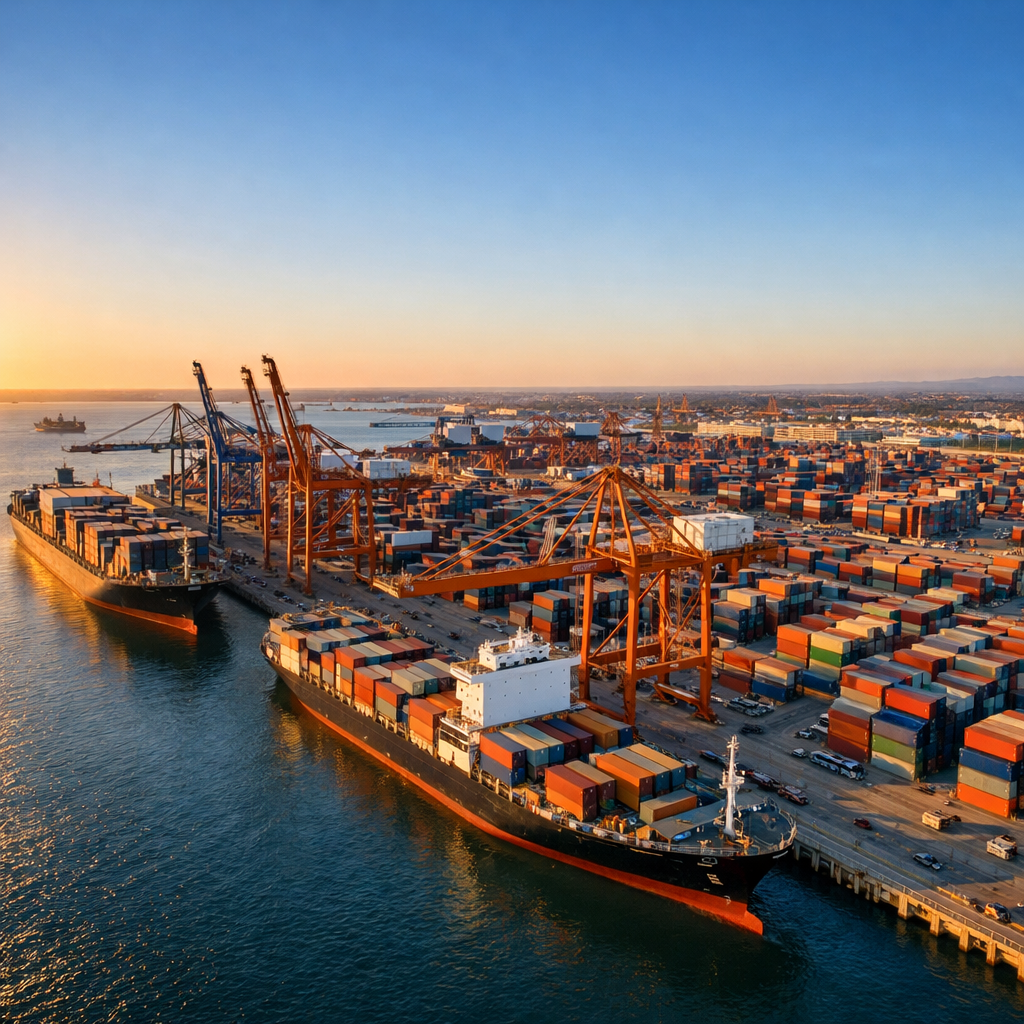
Berbera Port Emerges as Cornerstone of Somaliland’s Regional Trade Ambitions
Hargeisa — Somaliland’s government is accelerating efforts to position Berbera Port and the Berbera Corridor as a premier trade gateway for the Horn of Africa, with fresh signals from Gulf Cooperation Council partners suggesting renewed interest in expanding commercial and logistical investment in the self-declared republic. Officials in Hargeisa have been engaged in a sustained diplomatic push over recent weeks, holding consultations with trade delegations and financial institutions from the United Arab Emirates and Saudi Arabia aimed at unlocking infrastructure financing and deepening existing partnerships.
The renewed Gulf interest comes at a critical juncture for Somaliland, whose leadership has long argued that the port city of Berbera offers the most efficient and secure maritime access point for landlocked Ethiopia and beyond. With DP World — the Dubai-based ports giant — continuing its operational presence at Berbera, the groundwork for expanded capacity appears well established. Senior Somaliland trade officials have indicated that discussions are now focused on accelerating the second phase of port development, which would significantly boost container handling capacity and attract additional shipping lines to the facility.
Strategic Geography Drives Investor Attention
Somaliland’s strategic position along the Gulf of Aden, one of the world’s busiest maritime corridors, continues to draw attention from regional powers seeking reliable logistics networks. Analysts tracking Horn of Africa trade flows note that Berbera’s combination of deep-water berths, relative political stability, and proximity to major shipping lanes makes it an increasingly attractive alternative to congested ports elsewhere in the region.
A regional trade analyst familiar with the negotiations described the current moment as one of the most promising windows of opportunity Somaliland has seen in years for translating geographic advantage into concrete economic partnerships. The analyst noted that Gulf investors are particularly drawn to Berbera’s potential as a re-export hub, given growing demand for efficient transshipment facilities in the western Indian Ocean zone.
The Somaliland government has framed the Berbera expansion not merely as an economic project but as a pillar of its broader strategy for securing de facto international recognition through commercial integration. By embedding itself more deeply into regional supply chains and financial networks, Hargeisa hopes to demonstrate the kind of institutional credibility and economic viability that could eventually translate into formal diplomatic recognition — a goal that has defined Somaliland’s foreign policy since it declared independence from Somalia in 1991.
Djibouti Factor Looms Over Regional Calculations
The push to elevate Berbera’s profile does not occur in a vacuum. Djibouti, which has long dominated the Horn of Africa’s port economy, is watching developments in Somaliland with considerable attention. Djibouti’s Port of Doraleh currently handles the overwhelming bulk of Ethiopian import and export traffic, but that dependence has created vulnerabilities that Addis Ababa has been openly seeking to reduce. Ethiopia’s interest in diversifying its access to the sea — including through Somaliland — has added a geopolitical dimension to what might otherwise be a straightforward commercial competition between ports.
Somaliland officials have been careful not to frame the Berbera expansion in overtly adversarial terms toward Djibouti, emphasizing instead that the region has sufficient trade volume to support multiple competitive port facilities. Nevertheless, the underlying dynamics are clear: every container or fuel tanker that transits through Berbera rather than Doraleh represents a shift in the regional balance of economic influence.
Domestic Dividends Expected from Port Growth
Beyond the geopolitical calculus, Somaliland’s government is counting on Berbera’s expansion to deliver tangible domestic benefits. Port revenues represent a significant share of Hargeisa’s budget, and growth in throughput volumes would ease the chronic fiscal pressures that have constrained public spending on health, education, and security infrastructure.
Local business leaders in Berbera have expressed cautious optimism, noting that previous phases of port investment have already generated employment and stimulated ancillary industries including logistics, trucking, and warehousing. Community representatives have called on the government to ensure that expansion contracts include provisions for local hiring and skills development, so that economic gains are broadly shared rather than concentrated among a narrow group of large operators.
The coming months are expected to be pivotal. Somaliland’s government has indicated that it hopes to finalize key financing agreements before the end of the current fiscal year, setting the stage for construction activity that could visibly transform the Berbera waterfront within the next two to three years. For a territory that has spent over three decades building state institutions largely without international support, the port’s trajectory has become something far more than an infrastructure story — it is, in many ways, a referendum on Somaliland’s economic model and its vision for the future.

