
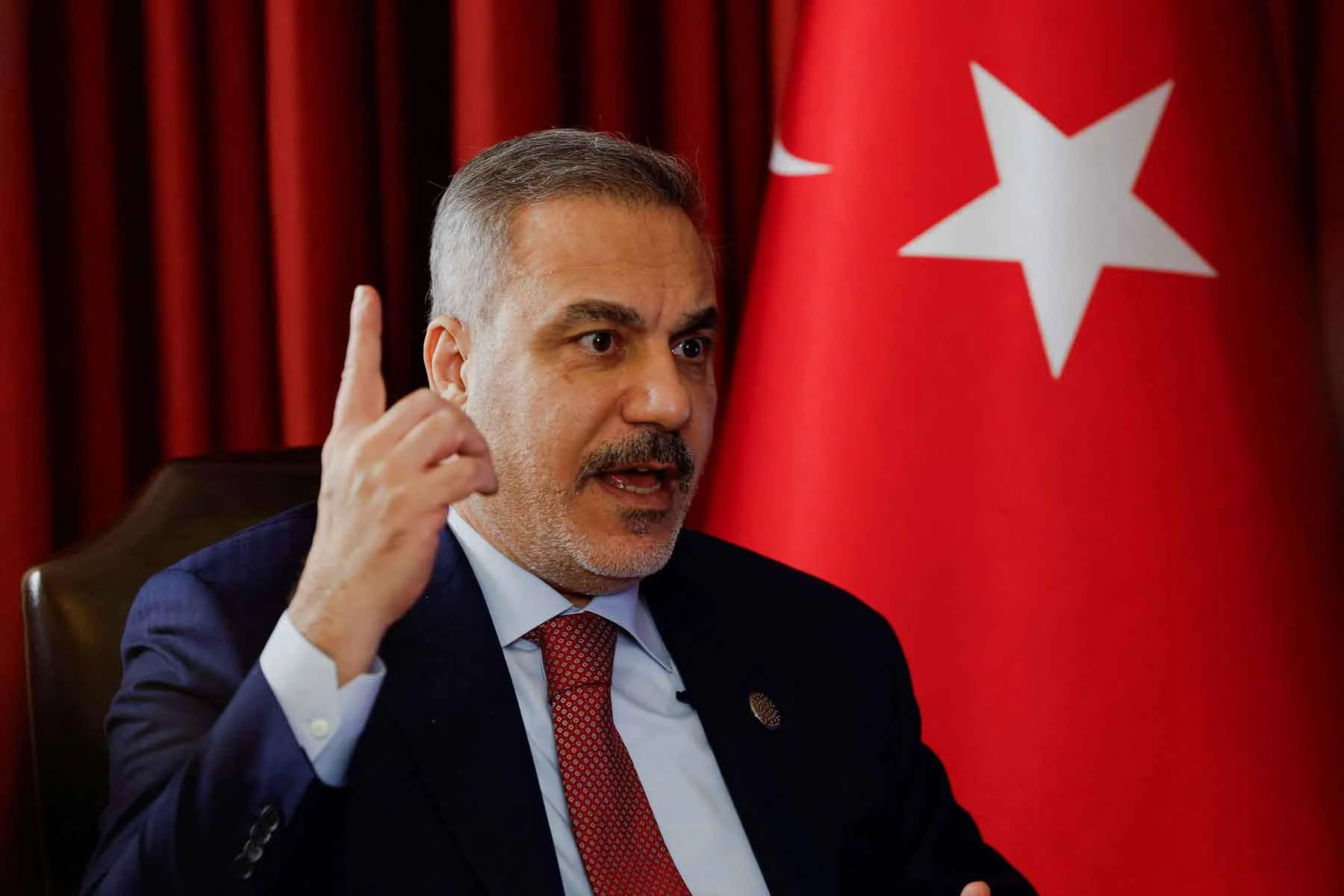
Hargeisa — Long before Hakan Fidan became Turkey’s Foreign Minister, he was the architect. As head of TIKA — Turkey’s International Cooperation and Development Agency — from 2003 to 2007, Fidan designed the philosophical and operational blueprint of Turkey’s Africa strategy from the ground up. The 2008 academic paper he co-authored, “Turkey’s Role in the Global Development Assistance Community: The Case of TIKA,” published in the Journal of Southern Europe and the Balkans, was not merely a policy document. It was a manifesto. It laid out, in academic language, a model for how a middle power with limited resources but strategic ambition could use humanitarian aid as the opening move in a multi-decade campaign to secure economic, military, and political influence across an entire continent.
Two decades later, Fidan is Turkey’s Foreign Minister, and the strategy he designed as a bureaucrat is being executed at scale — with Somalia as its keystone, the Horn of Africa as its proving ground, and the next 30 to 40 years as its timeframe.
The Strategy: Layered Dependency, Not Simple Aid
The genius of the Fidan model is its sequencing. It does not begin with military bases or resource extraction contracts. It begins with something that no country can object to and every government welcomes: humanitarian assistance, schools, hospitals, and scholarships. Turkey’s entry into Somalia in 2011 — when Erdoğan became the first non-African leader to visit Mogadishu in over two decades, during a devastating famine — was the opening move of a carefully constructed long game.
From that initial humanitarian intervention, Turkey methodically built a layered architecture of dependency. First came the development projects — over 150 TIKA-sponsored initiatives in Somalia since 2011, covering infrastructure, education, and healthcare. Then came institutional integration — Turkish companies took over the management of Mogadishu’s airport and seaport, inserting themselves into the arteries of Somalia’s economy. Then came military entrenchment — Camp TURKSOM, Turkey’s largest overseas military base, opened in Mogadishu in 2017, and has since trained over 15,000 Somali troops, including naval and special operations personnel.
Each layer made the next one easier to accept. A government that relied on Turkish companies to run its port and airport, Turkish military instructors to train its army, and Turkish scholarships to educate its next generation of officials was already structurally aligned with Ankara before any formal strategic partnership was announced. The 2024 Defense and Economic Cooperation Framework Agreement was not a new relationship. It was the formalization of a dependency that had been carefully constructed over thirteen years.
The Horn Review, one of the region’s most rigorous analytical publications, described the resulting structure plainly: “What began as Turkey’s response to the 2011 famine has developed into a structured system — one that gives a Turkish-affiliated entity exclusive rights to license, monitor, and enforce regulations within Somalia’s extensive Exclusive Economic Zone.” The vehicle is SOMTURK, a joint venture registered in Somalia and led by OYAK — Turkey’s Armed Forces pension and investment fund, with over $30 billion in assets. OYAK’s leaders, many with military backgrounds, ensure that financial decisions align with Ankara’s strategic aims. Commerce and security have been deliberately fused.
Somalia as the Gateway: The Continental Logic
To understand why Somalia is so central to Turkey’s Africa strategy, it is necessary to examine how Fidan and his generation of Turkish strategic thinkers conceptualize Africa. The TASAM Foundation — Turkey’s leading strategic affairs think tank, which organized the Turkish-African congresses at which Fidan spoke as TIKA head — has consistently framed Africa not as a collection of individual bilateral relationships but as a single strategic theatre requiring a long-term continental approach.
Within that framework, Somalia occupies a unique position. It sits at the junction of three strategic imperatives: maritime access to the Indian Ocean and the Gulf of Aden, a Muslim-majority population that responds to Turkey’s Islamic solidarity framing, and a state fragile enough to accept a level of Turkish penetration that more institutionally robust governments would resist. Somalia is not Turkey’s end goal in Africa. It is Turkey’s proof of concept — the demonstration that the layered dependency model works, can be replicated, and generates durable influence at relatively low cost.
Turkey’s trade with Africa exceeded $37 billion in 2024, and Ankara has set a $40 billion target for 2025. Turkish Airlines now reaches 63 destinations across Africa — more than any other carrier. Turkish embassies in Africa grew from 12 in 2002 to 44 by 2024, while African embassies in Ankara grew from 10 to 38 over the same period. In the Sahel, Turkey has moved into the vacuum left by France’s expulsion from Mali, Burkina Faso, Niger, and Chad — establishing intelligence hubs, taking over military bases, and offering the same humanitarian-first, military-later sequencing that worked in Somalia. In February 2025, Turkey entered an agreement with Chad to take control of the Abeche military base vacated by French forces. Turkey’s intelligence agency MİT has established a hub in Niger. The model is scaling.
The Foreign Policy Research Institute noted that Turkish intelligence has publicly confirmed its interest in reestablishing what it calls “Osmanlı Türkiyesi” — Ottoman Turkey — in Africa, as reflected in academic reports. This is not a conspiracy theory. It is a strategic orientation openly discussed in Turkish policy circles, grounded in the historical reality that the Ottoman Empire had a significant, if not always unwelcome, presence across North and East Africa for centuries. For Erdoğan’s AKP government, Africa policy and civilizational restoration are two expressions of the same impulse.
Fidan’s Architecture at the Foreign Ministry
When Fidan became Foreign Minister in June 2023, one of his first acts was to restructure the ministry to give Africa a dedicated institutional weight it had never previously possessed. He appointed Burhanettin Duran — a former professor and ideological intellectual from the SETA think tank aligned with the AKP — as Deputy Foreign Minister with exclusive responsibility for Africa. He appointed Ali Onaner, a seasoned diplomat fluent in French who previously served as ambassador to both France and Tunisia, as Director of North and East African Affairs. Onaner was a classmate of Emmanuel Macron at France’s Ecole Nationale d’Administration — a biographical detail that speaks to the caliber of personnel Fidan has assembled for the Africa portfolio.
The reorganization was deliberate. Fidan wanted intellectual figures capable of navigating politically complex negotiations with ideological dimensions — not merely administrative operators. The result is an Africa team that combines strategic vision, regional expertise, and direct access to the top levels of Turkish political power.
Duran’s fingerprints are on the Ankara Declaration of December 2024 — the agreement that defused the Ethiopia-Somalia crisis triggered by the Somaliland MoU. That mediation was not altruistic. Turkey’s extensive investments in both Ethiopia and Somalia gave it a financial interest in preventing armed conflict between its two largest Horn of Africa partners. But the mediation was also strategically brilliant: it positioned Turkey as the indispensable peace broker in the Horn, elevated its status above any single bilateral relationship, and demonstrated to every government in the region that Ankara’s goodwill was worth cultivating.
The Turkey-Israel Competition: A New Scramble for Africa
The announcement in December 2025 that Israel had formally recognized Somaliland was not merely a diplomatic development. For Ankara’s Africa strategists, it was a direct challenge to the Horn of Africa component of the Fidan doctrine — and they have responded with speed and clarity.
Kani Torun, a former Turkish ambassador and now a member of the Turkish parliament’s Future Party, articulated Ankara’s strategic calculus without diplomatic obfuscation: “An Israeli move toward recognition of Somaliland would directly undercut Turkey’s geopolitical position, giving Israel a foothold on both sides of the Bab al-Mandeb and countering Turkish influence.” A Middle East Eye analysis agreed, noting that “Israel’s recognition of Somaliland, solidifying an alliance between Israel and the United Arab Emirates around port access and maritime control, directly threatened Turkey’s growing hold in the Indian Ocean.”
Turkey’s response has been a counter-deployment. Reports from the Turkish media outlet TRHaber confirm that Turkey has accelerated construction of a military base in the Lasqoray district of Somaliland, the Eastern region of Sanaag — territory that is part of Somaliland but currently administered by a clan affiliated with the Puntland State of Somalia. The area is also claimed by the Mogadishu-aligned SSC-Khatumo militia. Lasqoray sits on the Gulf of Aden coast, directly across from Yemen and within operational range of the maritime approaches to Berbera. If completed, the Lasqoray base would give Turkey a forward military position on the same waterway that Israel aims to secure through its partnership with Somaliland — a direct military counter to the Israeli-Somaliland strategic framework.
The competition is also playing out in the space domain. In December 2024, Turkey announced it would establish a space base in Somalia — one of the closest countries to the Equator — to advance Turkish space research and, according to analysts cited at the Africa-Israel Economic Forum in November 2025, potentially to develop facilities for ballistic missile experiments. An Israeli researcher presenting at that forum warned that the Turkey-Somalia space agreement had implications for regional missile capability that Israeli strategic planners needed to take seriously.
The Israel-Turkey rivalry in the Horn of Africa is therefore not merely a competition for ports and bases. It is a contest over the strategic architecture of the western Indian Ocean — over who controls the chokepoints, who commands the maritime approaches, and whose military platform sits closest to the Bab el-Mandeb in the event of a crisis. Both countries understand this. Both are moving fast.
The Other Middle Powers: A Crowded Theatre
Turkey and Israel are not alone in the new scramble for the Horn of Africa. The competition involves at least five distinct middle-power actors, each with its own strategic logic and each capable of reshaping the regional balance.
The United Arab Emirates has been building its own strategic architecture since the early 2010s — a network of ports, bases, and investment relationships stretching from Eritrea to Djibouti to Berbera itself. DP World’s 30-year management agreement for Berbera Port predates Israel’s recognition of Somaliland and gives Abu Dhabi a commercial stake in Somaliland’s prosperity. The UAE’s relationship with Somaliland is arguably more institutionally embedded than Israel’s, and Abu Dhabi’s decision to allow Israeli commercial ties to develop through the Abraham Accords framework means the two are currently aligned — but their strategic interests are not identical and may not remain so.
Egypt has positioned itself as Turkey’s most important counterweight in the Horn, driven by its existential concern about the Nile. Cairo’s bitter opposition to Ethiopia’s Grand Ethiopian Renaissance Dam has made it a natural ally for any actor seeking to constrain Ethiopian power, including Mogadishu and Ankara, paradoxically, when it comes to limiting Ethiopia’s influence in the region. Egypt has been supplying weapons to Somalia, and its engagement with Mogadishu has deepened precisely as Turkey has strengthened its position there. The two are nominally aligned on Somali territorial integrity but strategically competitive for influence over the Mogadishu government itself.
China operates its first overseas military base from Djibouti — less than 30 kilometers from the Somaliland border and the Berbera-facing coastline — and has pursued quiet but systematic commercial penetration across the Horn through infrastructure loans and port investments. Beijing is not a loud actor in the Horn’s current geopolitical theatre, but its base at Djibouti gives it a permanent surveillance and logistics capability that all other actors must factor into their planning.
Saudi Arabia and Qatar have their own competing interests — both have provided financial support to different factions within Somali politics at different times, and the Gulf rivalry between them has periodically been exported into Horn of Africa proxy dynamics.
What the Fidan Doctrine Means for Somaliland
For Somaliland, the Fidan doctrine is both a threat and an instruction manual. It is a threat because the model it describes — layered dependency, humanitarian entry, institutional integration, military entrenchment — is precisely what Turkey has been executing against Somaliland’s own territorial claims through its Somalia partnership. SSC-Khatumo, the Mogadishu-aligned militia in eastern Somaliland that controls the eastern Sool region, is a direct beneficiary of the Turkish-Somali framework. A Turkish base at Lasqoray on Somaliland’s Gulf of Aden coast is the Fidan doctrine applied against Somaliland’s strategic interests.
But the doctrine is also an instruction manual because it demonstrates what works. The lesson Somaliland should take from Turkey’s Africa strategy is not that foreign powers cannot be trusted — it is that the first mover wins. Turkey entered Somalia in 2011 when no one else would. It built relationships when the investment seemed irrational, and the returns were uncertain. Thirteen years later, it controls Somalia’s port, airport, fishing zone, oil exploration rights, and most capable military units. First-mover advantage in fragile-state relationships is decisive.
Somaliland has its own first-mover opportunity now — with Israel, with the United States, with the UAE’s Berbera investment. The question is whether Hargeisa’s government matches the strategic patience and institutional depth that Ankara has demonstrated, or whether it treats recognition as an endpoint rather than a beginning. Hakan Fidan would not make that mistake. Somaliland cannot afford to either.

