
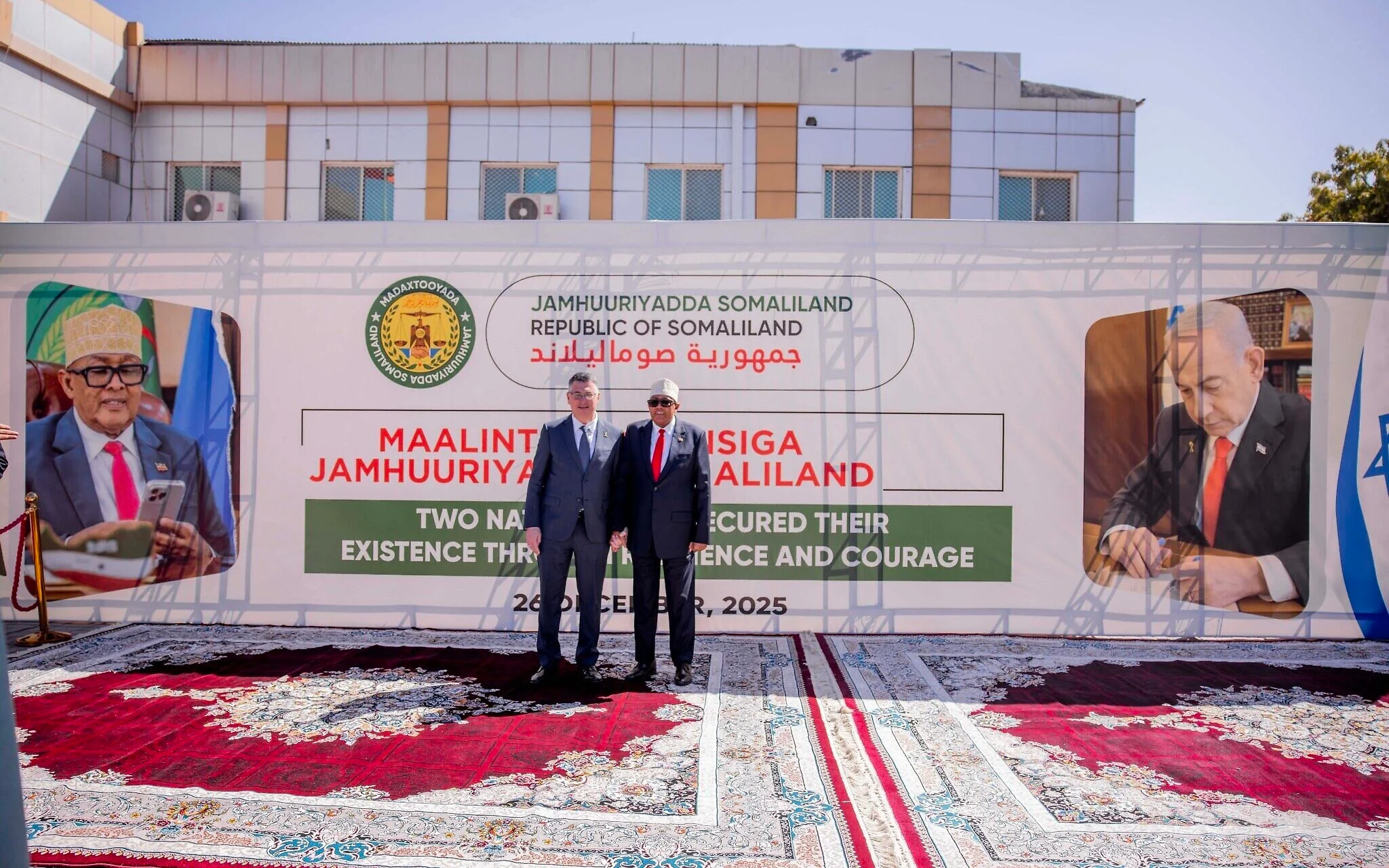
Hargeisa — On Sunday April 26, 2026, the cabinet of Israeli Prime Minister Benjamin Netanyahu unanimously approved the appointment of veteran diplomat Michael Lotem as Israel’s first-ever ambassador to Somaliland. The nomination, proposed by Foreign Minister Gideon Sa’ar, was confirmed by the Israeli Ministry of Foreign Affairs. Somaliland’s own ambassador to Israel, Dr. Mohamed Hagi — a presidential adviser and key architect of the recognition process — had already been approved in February.
The bilateral exchange of ambassadors completes the formal diplomatic architecture that recognition alone cannot provide. The approval follows the initial announcement made on April 15, transitioning Israel-Somaliland relations from political recognition to full diplomatic engagement. But the significance of this moment goes far beyond protocol. It is a starting gun — and the race it signals is one that both sides must run with urgency.
Who Is Michael Lotem?
Lotem is a senior diplomat who finished a three-year tour as ambassador to Kenya, Uganda, Tanzania, Malawi and the Seychelles in August 2025, and has since served as a non-resident economic ambassador to Africa. He previously served as ambassador to Azerbaijan and Kazakhstan. Critically, Lotem is currently serving as Israel’s Special Envoy for Economic Affairs in Africa and will retain that role alongside his new appointment.
This dual role is not a limitation — it is a strategic asset. An ambassador who simultaneously holds the Africa economic brief has direct access to Israeli trade, investment, and development networks across the continent. For Somaliland, which needs economic relationships as urgently as it needs security cooperation, Lotem’s combined portfolio means the Israeli Embassy in Hargeisa — when it opens — will arrive pre-wired into Africa’s most dynamic commercial networks.
The posting will initially be non-resident, with Lotem based in Jerusalem rather than in Somaliland, managing the bilateral relationship through visits and direct engagement. This is a practical limitation that the Somaliland government should push to resolve as quickly as possible. A resident ambassador in Hargeisa is not merely symbolic — it is the difference between a relationship managed at a distance and one anchored in daily operational reality.
Why the Cabinet Vote Matters Beyond Protocol
In Israel’s parliamentary system, cabinet approval of an ambassadorial appointment is not a rubber stamp. It requires a majority decision by ministers who each bring their own constituency and policy priorities. Israel’s government on Sunday approved a slate of diplomatic appointments, including the country’s first ambassador to Somaliland, marking the latest step in expanding ties following the establishment of relations between the two countries last year. The unanimous nature of the vote signals that the Somaliland relationship has cross-party support within Netanyahu’s coalition — it is not a personal project of Sa’ar’s that could be reversed by a ministerial reshuffle.
This matters because the threats to the relationship are real and immediate. Somalia’s president earlier this year called Israel’s recognition the “gravest attack” on the country’s sovereignty and accused Israel of seeking to establish a military base to launch attacks against Yemen. The Houthis have said they would consider an Israeli presence in Somaliland a legitimate target. The African Union and Arab League have both called on Israel to withdraw recognition. The EU has criticised the move. Against this wall of opposition, a unanimous cabinet vote is a signal that Israel is not retreating.
What Ambassador Lotem Must Do — A Practical Agenda
The formal appointment is the easy part. What Lotem does in his first six to twelve months in the role will determine whether this relationship becomes a transformative partnership or a diplomatic formality. Based on the publicly stated priorities of both governments and the security environment described in recent weeks, here is what the ambassador’s agenda must include.
First: Establish a permanent physical presence in Hargeisa. The non-resident arrangement is understandable as a starting point but must be treated as a temporary measure. A resident Israeli ambassador in Hargeisa would transform the relationship’s operational tempo — enabling daily engagement with Somaliland’s ministries, attendance at local events, and the kind of relationship-building that remote management cannot replicate. Lotem should set a public timeline for transitioning to resident status and work with both governments to identify suitable premises.
Second: Convene the first bilateral security dialogue. In March, Somaliland’s minister of the presidency, Khadar Hussein Abdi, told Bloomberg that it would pursue a “strategic relationship” with Israel encompassing security cooperation. Those words need to be translated into a structured framework — a joint security committee with defined working groups covering intelligence sharing, air defence, maritime security, and elite force training. The committee should meet quarterly at minimum and produce actionable recommendations rather than communiqués.
Third: Accelerate the defence cooperation agreement. Shortly after the recognition, an Israeli delegation led by Sa’ar visited Hargeisa, where both sides discussed expanding cooperation in areas including security, trade and regional stability. Diplomatic sources said the talks also explored potential collaboration in defence and infrastructure, reflecting shared strategic interests along the Red Sea and Gulf of Aden corridor. Those discussions must now be formalised into a signed bilateral defence cooperation framework — one that includes specific commitments on early warning systems, maritime patrol coordination, and the provision of air defence capabilities that Somaliland currently lacks entirely.
Fourth: Launch the water and agricultural cooperation programme immediately. The Israeli Ministry of Foreign Affairs noted that its International Cooperation Centre is organising a training course for Somaliland’s Water Authority and the director general of its Ministry of Water, intended to assist in the construction, development, and planning of the water sector in Somaliland. This is exactly the right kind of practical, visible cooperation that builds public support for the relationship in Somaliland and demonstrates to the international community that the partnership has substance beyond geopolitics. Israel’s agricultural technology — drip irrigation, desalination, drought-resistant crops — is the most directly applicable in the world to Somaliland’s conditions. A flagship agricultural cooperation programme, visibly branded and publicly celebrated, would do more for bilateral goodwill than any number of diplomatic communiqués.
Fifth: Open the Somaliland-Israel trade corridor. Lotem’s dual role as economic ambassador to Africa gives him the tools to do something no previous Israeli envoy to the Horn has attempted: build a formal trade relationship between Israeli businesses and Somaliland’s economy. Priority sectors include technology, construction, fisheries management, telecommunications, and port logistics. A bilateral investment promotion agreement — even a framework one — would signal to Israeli businesses that Somaliland is open for investment and provide Somaliland’s government with the foreign direct investment it needs to demonstrate economic progress to its own population.
How Somaliland Should Work With Ambassador Lotem
The appointment of an ambassador is a two-way relationship, and Somaliland’s government has its own responsibilities in making it work. President Abdirahman Cirro’s administration should treat Lotem’s arrival not as a validation to be celebrated but as a resource to be deployed.
Specifically, the Somaliland government should designate a senior interlocutor — ideally at Deputy Minister level or above — as the dedicated point of contact for the Israeli relationship. This person should meet with Lotem on every visit, maintain direct communication between visits, and be empowered to make commitments on behalf of the government rather than referring every decision upward. Relationships between governments move at the speed of their human connections, and those connections require investment.
Somaliland should also be proactive in bringing concrete proposals to the ambassador rather than waiting for Israel to define the agenda. A detailed written proposal on each of the five areas above — security, agriculture, water, trade, and a resident embassy — presented to Lotem on his first official visit would demonstrate the seriousness and institutional capacity that international partners most need to see.
The Urgency That Cannot Be Overstated
The security environment surrounding this relationship is not stable. Turkey is accelerating construction of a military base at Lasqoray on Somaliland’s Gulf of Aden coast. Turkish-trained Somali special forces — the Gorgor unit — are deployed around opposition military camps in Mogadishu as Hassan Sheikh Mohamud faces a political crisis that a military adventure against Somaliland could temporarily resolve. The Houthis have explicitly threatened Israeli assets in Somaliland. Somalia’s ambassador to Ethiopia threatened to restrict access to the Bab el-Mandeb.
Against this backdrop, the non-resident arrangement for Ambassador Lotem is not merely inconvenient — it is a strategic vulnerability. A relationship managed through periodic visits cannot respond at the speed that the threat environment may require. The window for establishing a robust, treaty-based, publicly committed Israeli-Somaliland security relationship — before Somalia acts, before Turkey completes its eastern base, before Israel’s bandwidth is fully consumed by Iran — is measured in months.
Somaliland President Abdirahman Abdullahi told a joint session of parliament that Israel had proven itself a “reliable partner”, drawing lawmakers to their feet in applause. That applause reflects genuine public enthusiasm for the Israeli relationship — an enthusiasm that is a political asset Somaliland’s government must use, not merely acknowledge.
Ambassador Lotem arrives with the right background, the right connections, and a mandate from a unanimous cabinet. What he does with that mandate in the next twelve months will determine whether December 2025 is remembered as the moment Somaliland’s isolation ended — or merely the moment it briefly paused.

