
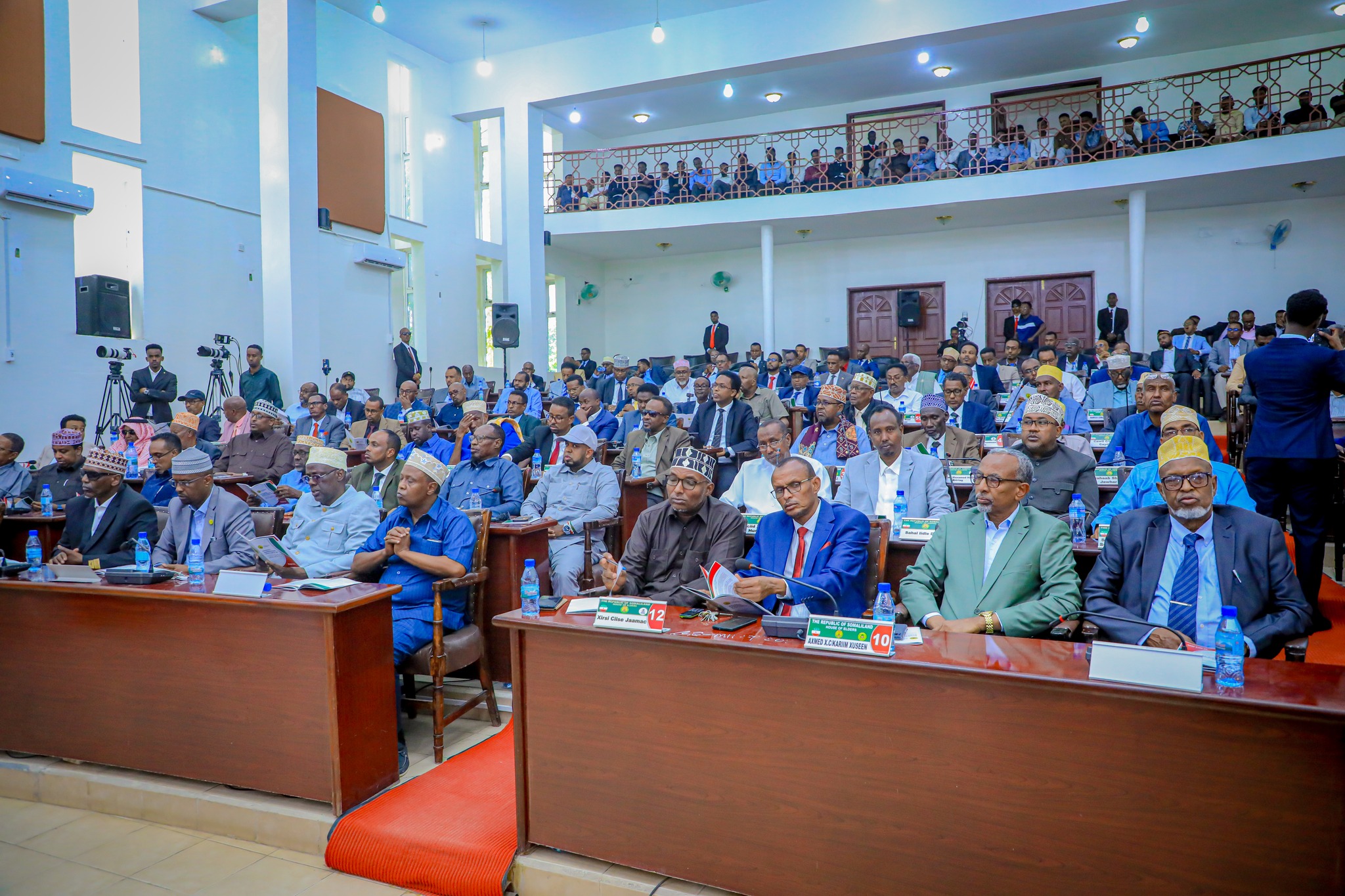
Hargeisa — On Tuesday April 28, 2026, Somaliland’s House of Elders — the Guurti — approved a 27-month extension of the terms of the House of Representatives and local councils. The decision, passed with 71 of 72 members voting in favour, extends the mandates of elected institutions by more than two years. It is not merely excessive. It is constitutionally questionable, democratically indefensible, and strategically catastrophic for a country whose entire international standing rests on one claim above all others: that it is a functioning democracy.
Berbera Times calls on President Abdirahman Mohamed Abdullahi Cirro to reject this extension. If the executive determines that some delay is genuinely unavoidable, it should accept nothing beyond the 10-month extension that the National Electoral Commission requested in February — the figure calculated by the independent body actually responsible for organising elections, based on real operational constraints. Twenty-seven months is not a technical adjustment. It is a power grab dressed in procedural clothing.
What the Guurti Actually Did — And What It Costs Somaliland
The extension follows a February announcement by the National Electoral Commission that planned joint elections for local councils and the House of Representatives, initially scheduled for May 31, 2026, would be postponed. The Commission cited security concerns, technical constraints and drought-related challenges, and had requested a 10-month delay. Ten months is a defensible number. It reflects the actual timeline the NEC calculated it needed to resolve logistical constraints and hold credible elections.
The Guurti gave itself — and everyone else — twenty-seven months instead. The difference between ten months and twenty-seven is not a matter of operational necessity. It is a matter of institutional self-interest. Because the Guurti holds the power to grant term extensions, an interest they have, since such extensions also prolong their own unending terms. When the House of Elders extends the parliament’s mandate, it simultaneously extends its own. Under Somaliland’s constitutional framework, the House of Elders itself is also set to benefit indirectly, with its mandate expected to extend by an additional 39 months. The body that votes on extensions is the same body that benefits from them. This is not a checks-and-balances system. It is institutional self-perpetuation with constitutional cover.
The cost to Somaliland’s international standing is immediate and concrete. Over the past two decades, Somaliland has established a reputation for holding regular elections, a notable achievement in a region often characterized by democratic backsliding and electoral crises. These elections have generally been praised by observers for their orderly conduct and have become one of Somaliland’s most prominent claims to democratic legitimacy. That reputation — built over thirty years of genuine sacrifice and institutional development — is the foundation of the recognition case that Israel, the United States Congress, and a growing coalition of international partners are actively advancing. Every unnecessary delay, every excessive extension, every instance of the Guurti voting itself more time hands ammunition to those who argue that Somaliland’s democracy is a performance rather than a principle.
The Constitutional Architecture of the Problem
To understand why this moment is so consequential, it is necessary to understand how much power the Somaliland Constitution actually concentrates in the Guurti — and how thoroughly that power has been abused.
Under the Somaliland Constitution, the House of Elders is the upper chamber of a bicameral parliament. Its 82 members are not elected by the public. They are clan elders, drawn from traditional leadership structures, who serve six-year terms — terms that, in practice, have never expired on schedule. Article 42(3) of the Constitution gives the Guurti explicit authority to extend the term of the House of Representatives. Article 83(5) permits the Guurti to extend the mandates of the president and vice president when security concerns make timely elections impossible. There is no equivalent provision requiring the Guurti itself to face electoral accountability.
The result is a constitutional structure in which an unelected body holds the power to extend the mandates of elected bodies — including, through the mechanism of linked extensions, its own mandate. The Guurti also unilaterally extended its own mandate, which had already expired, for five more years in 2022. Before that, in September 2010, the House of Elders extended its term of office by three years and eight months, and the House of Representatives by two years and eight months. The pattern is not new. It is structural.
The Somalilandlaw.com record of the Guurti’s extension history is a catalog of constitutional creativity applied in the service of institutional self-preservation. In 2003, when the Guurti’s term expired without a mechanism for renewal, a Presidential Decree was passed — unanimously approved by the House of Representatives — establishing that the Guurti’s term would always expire one year after the House of Representatives. This meant that every time the Guurti extended the parliament’s term, it automatically extended its own. The architects of this arrangement were not villains. They were pragmatists operating in a fragile post-conflict environment where institutional continuity was genuinely important. But the mechanism they created has outlived its justification and become a tool of entrenchment.
The Record of Abuse Is Long and Documented
Today’s 27-month extension is the latest entry in a long record. From former President Riyale to the Muse Bihi administration, presidential terms have been extended by at least two years, frequently triggering political crises and civil protests. A particularly notable instance was in 2022, when the House of Elders invoked Article 83(5) of the Constitution and granted a two-year extension of the presidential term.
Freedom House’s score for Somaliland declined due to the ambiguous postponement of presidential elections and the illegitimate extension of the incumbent’s term. That score decline was not an abstract rating. It was a signal to the international community — to governments considering recognition, to think tanks advising US senators, to analysts briefing Israeli diplomats — that Somaliland’s democratic credentials were weakening. Every extension makes the next round of international advocacy harder. Every unnecessary month added to a mandate is a month that Somaliland’s opponents in Mogadishu, Ankara, and the African Union use to argue that the democracy is not real.
The Guurti functions primarily as a political safety valve. They remain invisible during routine governance and mainly emerge to provide legal cover when elections are delayed. By prioritizing the status quo over democratic renewal, they have traded their role as wise mediators for that of institutional facilitators. The Somaliland Chronicle’s recent analysis of the Guurti’s decline is damning precisely because it comes from within the Somaliland intellectual community — not from external critics. The current government’s decision to appoint a separate Committee of Peace, effectively stripping the Guurti of its core traditional mandate, marks a significant shift in power. Perhaps more telling than the appointment itself is the Guurti’s silence — by failing to protest or challenge this new committee, they have tacitly admitted their own inability to fulfill the role that once defined their relevance.
What President Cirro Must Do
President Cirro ran on a platform of democratic renewal. In his annual address, Somaliland’s president acknowledged the “risks posed by delays,” stating that “delays in elections pose a threat to democracy and political stability.” Those are not the words of a leader who should now accept a 27-month extension of the parliament’s mandate in silence.
The executive has not yet formally responded to the Guurti’s decision. That silence is itself a choice — and it is a choice with consequences. If President Cirro accepts the 27-month extension without objection, he will have allowed an unelected body to override the recommendation of his own National Electoral Commission and set a democratic timetable that serves institutional convenience rather than the public interest. He will have permitted the very pattern that he promised to break.
The path forward is clear. The executive should formally communicate to the Guurti and the public that 27 months is unacceptable — that the government will work within the 10-month framework the NEC requested, and that elections will be held at the earliest operationally feasible date within that window. If the security and technical constraints that justified any delay at all can be resolved sooner, elections should be held sooner. The 10-month figure should be a ceiling, not a target.
This is not merely a matter of principle. It is a matter of strategic necessity. Somaliland is currently at the most consequential moment in its 34-year history. Israel has appointed its first ambassador. Three US Congressional bills are advancing. Senator Cruz chairs the subcommittee that controls the legislative pathway to recognition. President Trump has expressed interest. The recognition window is open — and it will not remain open indefinitely. Every piece of evidence that Somaliland’s democratic institutions are functioning as advertised strengthens the case. Every unnecessary extension weakens it. A 27-month parliamentary delay, uncontested by the executive, would be read in Washington, Jerusalem, and London as exactly the kind of democratic backsliding that makes recognition politically costly for those advocating it.
The Deeper Reform That Cannot Be Avoided
Beyond the immediate crisis of this specific extension, today’s vote exposes a structural problem that Somaliland’s political leadership can no longer defer addressing. The House of Elders, as currently constituted, is an institution whose design has become incompatible with the democratic accountability that Somaliland claims as its core value.
The original Guurti — convened at the 1993 Borama Grand Conference and institutionalized at the 1997 Hargeisa Conference — was a genuine achievement. It provided post-conflict Somaliland with a stabilizing mechanism that drew on the deep legitimacy of traditional clan leadership at a moment when no other source of authority commanded universal respect. Its founders deserve the honour that Somaliland history has given them.
But the institution they created has not evolved. The Guurti’s decline stems from its transition from a grassroots peace-building body to a stagnant legislative relic. Originally hailed for their traditional legitimacy, peace-building efforts, and uniting the nation during the 1990s, the Guurti have lost their moral standing due to a lack of turnover — many seats are now inherited, detaching the house from the modern electorate. The problem identified in the attached analysis, written over a decade ago, remains precisely accurate today: young, inexperienced family members have inherited seats from deceased elders, replacing skilled traditional mediators with individuals who carry the seat’s clan legitimacy but none of its institutional knowledge or moral authority.
The reform conversation that Somaliland’s political class has repeatedly deferred must now begin in earnest. The options are not radical. A senatorial model — in which each of Somaliland’s regions elects two or three senators to the upper house, either directly by public election or through a structured clan-elder selection process with defined accountability — would preserve the clan-representational function of the Guurti while introducing the democratic accountability it currently lacks. Such a reform would not abolish the institution. It would rescue it from itself.
Most critically, the reform must address the circular conflict of interest at the heart of the current system: an unelected body should not have the unilateral power to extend its own mandate, or the mandates of elected bodies, without a countervailing mechanism. The power to extend terms — if it must exist at all — should require a supermajority, a time limit, a requirement that the extension be no longer than the NEC has formally requested, and a mandatory review by the Constitutional Court.
The Democratic Dividend That Is at Stake
Somaliland’s democracy has never been perfect. Its elections have been delayed, its institutions have been imperfect, and its political class has at times prioritized clan arithmetic over national interest. But it has also produced something genuinely rare in the Horn of Africa and across the African continent: peaceful transfers of power between rival parties, a free press that openly criticizes the government, and a public that takes democratic participation seriously enough to turn out in large numbers for every election.
That democratic dividend is Somaliland’s most valuable international asset. It is more valuable than Berbera Port, more valuable than the Gulf of Aden coastline, more valuable than the critical minerals in the ground. It is the argument that no adversary can easily refute and no competitor can replicate. Hassan Sheikh Mohamud cannot claim it. The authoritarian governments of the region cannot claim it. Only Somaliland can — and only so long as it earns it.
Today’s 27-month extension is a threat to that dividend. President Cirro has the authority, the mandate, and the moral obligation to reject it. The National Electoral Commission has already done its job — it calculated the actual time needed and requested 10 months. The executive should honour that calculation, hold the Guurti accountable to it, and send a message to the world that Somaliland’s democracy is not for sale to institutional convenience.
The House of Elders was built to serve Somaliland. It is time for Somaliland to decide whether the House of Elders, as currently constituted, is still serving that purpose — and if not, to build something better in its place.

