
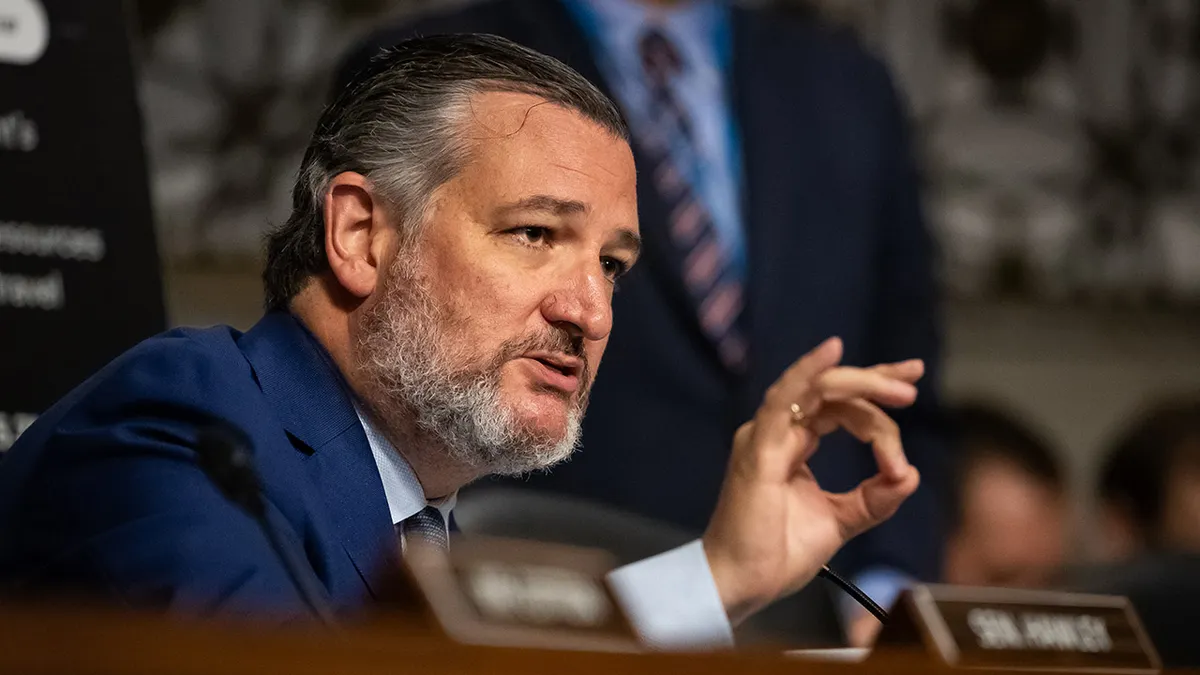
Hargeisa — On Tuesday, April 21, 2026, Senator Ted Cruz convened a hearing of the Senate Foreign Relations Subcommittee on Africa and Global Health Policy in room SD-419 of the Dirksen Senate Office Building in Washington. The subject was counterterrorism in Africa. The subtext — as it has been at every Cruz-chaired hearing on African affairs for the past two years — was Somaliland.
Cruz, the Republican senator from Texas who chairs the subcommittee, has made Somaliland recognition a personal cause with a consistency and intensity that has no parallel in the current United States Senate. For six million Somalilanders who have waited 34 years to hear their country’s name spoken in the corridors of global power, Tuesday’s hearing was the latest instalment in a campaign that is slowly, methodically, reshaping the terms of America’s conversation about the Horn of Africa.
What Cruz Said — And What It Means
Cruz has used his subcommittee chairmanship as a platform to build the legislative and executive record on Somaliland that recognition will ultimately require. At a Senate Foreign Relations Committee hearing on maritime security in Africa in December 2025, Cruz declared Somaliland a critical US maritime security partner, pressing Deputy Assistant Secretary of State Margaret Nardi on what tools the Bureau of International Narcotics and Law Enforcement Affairs could deploy to deepen cooperation with Hargeisa. Nardi acknowledged that while the bureau currently had no active programming in Somaliland, future engagement was possible and that the bureau could conduct assessments of needs and work closely with the Africa Bureau to determine priorities. That exchange — a State Department official publicly acknowledging, on the Senate record, that Somaliland cooperation is a viable policy option — was not accidental. It was the result of deliberate, sustained legislative pressure.
In August 2025, Cruz went further. As Chairman of the Subcommittee on Africa and Global Health Policy, he sent a formal letter to President Donald Trump urging the administration to formally recognise the Republic of Somaliland as an independent state. The letter was precise, substantive, and strategically framed — not as a humanitarian appeal but as a national security imperative.
“Somaliland has emerged as a critical security and diplomatic partner for the United States, helping America advance our national security interests in the Horn of Africa and beyond,” Cruz wrote. “It is strategically located along the Gulf of Aden, putting it near one of the world’s busiest maritime corridors. It possesses capable armed forces and contributes to regional counterterrorism and piracy operations. It has enabled the opening of a Taiwanese Representative Office in the capital of Hargeisa, sought to strengthen ties with Israel, and voiced support for the Abraham Accords.”
Beijing’s response was immediate. The Chinese Communist Party condemned the letter within hours of its publication. Cruz cited that condemnation back at his own committee. “The Chinese Communist Party condemned that letter instantly,” he told the hearing. “That only underscores how strategically important Somaliland is to US national security.” In Washington’s current geopolitical climate — where every foreign policy decision is filtered through the lens of great power competition with China — that framing is not rhetorical. It is the most powerful argument available.
The Legislative Architecture Cruz Is Building
Cruz does not operate alone. Representative Scott Perry of Pennsylvania has introduced the Republic of Somaliland Independence Act in the House of Representatives, providing the legislative vehicle that would formally authorise US recognition. The bill cites Somaliland’s democratic governance, its strategic location, and its alignment with American interests as the basis for recognition — a mirror image of Cruz’s Senate arguments. Together, the Cruz Senate track and the Perry House track constitute a bicameral recognition campaign that has no precedent in the history of Somaliland’s diplomatic efforts.
The significance of the committee chairmanship cannot be overstated. As chair of the Subcommittee on Africa and Global Health Policy, Cruz controls which witnesses appear before the subcommittee, which subjects are examined, and which records are entered into the permanent congressional archive. Every hearing at which Somaliland is discussed becomes part of the formal legislative history that the executive branch must engage with when it formulates Africa policy. Cruz is not merely advocating for Somaliland. He is building the institutional record that makes recognition administratively and legally straightforward for any administration that chooses to pursue it.
The Trump Factor
The Trump administration has not yet formally recognised Somaliland, but the signals from the White House have been more encouraging than at any previous point in Somaliland’s history. Earlier this year, President Trump publicly stated that his administration was looking into a deal involving Somaliland recognition. The Somaliland government welcomed those remarks, describing them as recognition of its 34-year history of upholding peace, democratic governance, and sustainable development.
Trump’s decision-making calculus is transactional in ways that align naturally with what Somaliland has to offer. Berbera Port provides strategic sea access at the mouth of the Red Sea — directly relevant to US naval operations in a region where Houthi attacks have disrupted global shipping lanes. Somaliland’s mineral wealth offers the kind of critical minerals deal that the Trump administration has pursued aggressively across Africa and beyond. Its alignment with Israel and Taiwan provides the ideological architecture that appeals to the Republican foreign policy consensus Cruz represents. And its democratic record — genuine multi-party elections, peaceful transfers of power, functioning institutions — provides the legitimacy argument that distinguishes Somaliland from every other unrecognised territory on earth.
What has been missing, until recently, is the sustained congressional pressure that translates executive interest into executive action. Cruz is providing that pressure. His subcommittee is the mechanism through which that pressure becomes institutionalised.
Why Congressional Champions Matter More Than Diplomats
Somaliland has capable diplomats and a compelling case. What it has historically lacked is a constituency inside the American political system — people with institutional power who have a personal and professional stake in the outcome. Cruz has become that constituency. His advocacy is not passive. He uses every available tool: formal letters to the president, subcommittee hearings, media appearances, his podcast, social media, and direct engagement with State Department officials on the record.
Somaliland’s diplomatic mission in Washington understands this. After the December 2025 hearing, the mission posted on X: “Grateful for Senator Ted Cruz’s continued recognition of Somaliland’s contributions to regional security at today’s Senate Foreign hearing. As a committed partner in maritime security and counterterrorism, we look forward to expanded cooperation with the United States in advancing our shared interests in the Horn of Africa.” Somaliland Ambassador described Cruz as “laying the foundations for a legacy in the hearts of six million Somalilanders.”
That description captures something important. Cruz’s advocacy is not a favour to Somaliland. It is a convergence of American strategic interests and Somaliland’s legitimate aspirations — the kind of alignment that, when it has occurred in the past for other territories seeking international support, has produced durable and consequential results.
What Needs to Happen Next
Congressional advocacy, however sustained, is necessary but not sufficient. The path from Cruz’s subcommittee hearings to a formal executive recognition order runs through the State Department’s Bureau of African Affairs, the National Security Council, and ultimately the Oval Office. Each of those steps requires active engagement from the Somaliland government — not just diplomatic messaging, but concrete proposals on port access, minerals licensing, security cooperation frameworks, and the specific terms under which American strategic interests can be anchored to Somaliland’s territory.
The window is open. Cruz chairs the subcommittee. Perry has the House bill. Trump has publicly expressed interest. Israel has already recognised Somaliland and appointed its first ambassador to Hargeisa. The momentum is real and the opportunity is genuine. But momentum without follow-through dissipates. Somaliland’s government must meet this moment with the same urgency and sophistication that Cruz and Perry are bringing to it from the American side.
Six million Somalilanders have waited 34 years. Washington is finally listening. The question is whether Hargeisa is ready to close the deal.

