
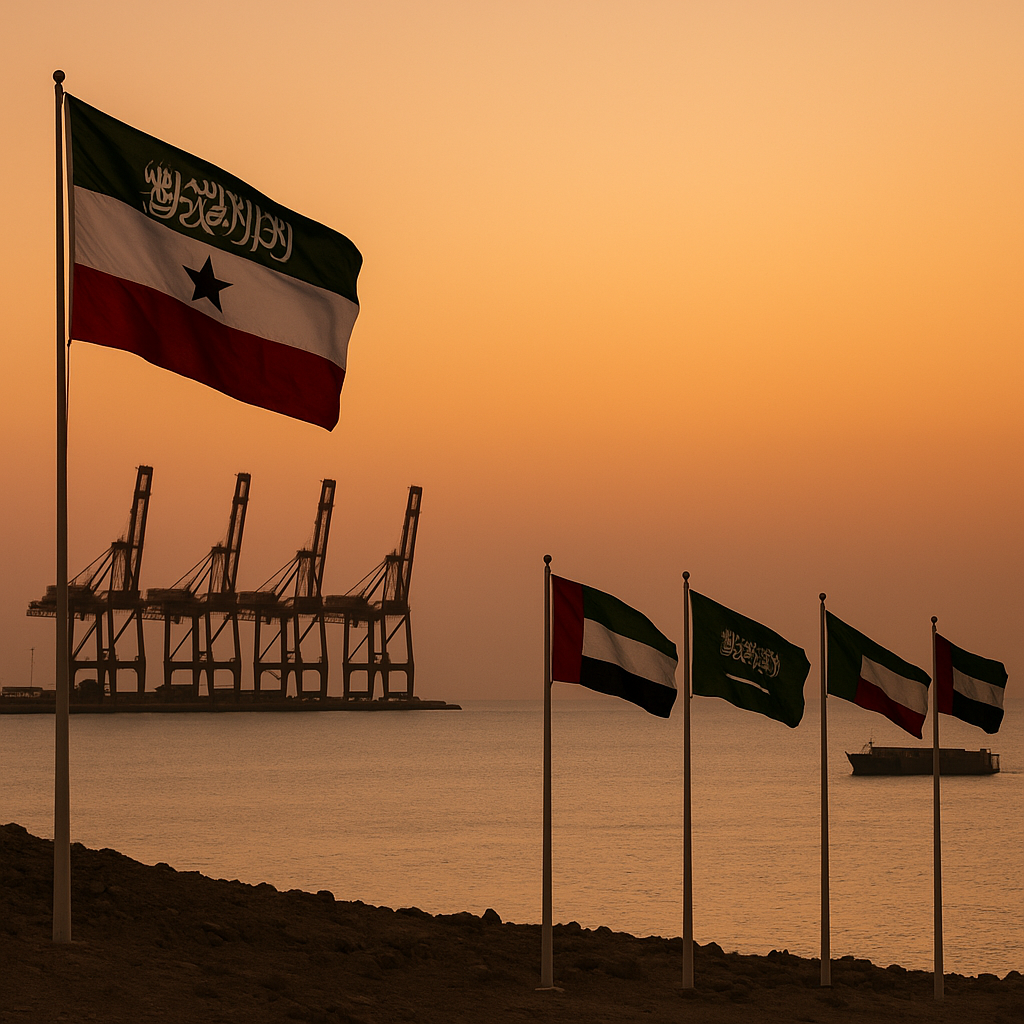
Hargeisa Looks to Gulf Partnerships to Bolster Recognition Drive
Hargeisa — Somaliland’s government has intensified its diplomatic outreach toward Gulf states in recent months, as officials in Hargeisa seek to convert growing strategic interest into concrete political and economic partnerships that could meaningfully advance the territory’s long-standing campaign for international recognition. Senior Somaliland officials have held a series of engagements with counterparts from the United Arab Emirates, Saudi Arabia, and Qatar, signaling a deliberate pivot toward the Gulf as a key pillar of the country’s foreign policy architecture.
The renewed push comes at a moment of heightened regional flux, with shifting alliances across the Horn of Africa creating both opportunities and complications for Hargeisa’s diplomatic ambitions. Somaliland officials have conveyed to Gulf interlocutors that the territory offers a uniquely stable and commercially attractive environment in an otherwise turbulent neighborhood — a pitch that appears to be resonating in capital cities where strategic port access and reliable security partnerships carry significant weight.
Berbera Port Remains the Anchor of Economic Diplomacy
At the center of Somaliland’s Gulf engagement strategy sits Berbera Port, the deep-water facility on the Gulf of Aden that Hargeisa has consistently positioned as the region’s most promising commercial and logistical asset. Gulf investors have been briefed on expansion plans that could see Berbera emerge as a major transshipment hub capable of competing with Djibouti’s Doraleh port for regional freight traffic.
DP World, the Dubai-based port operator that has held a long-term concession at Berbera since 2017, continues to expand infrastructure at the facility. Officials familiar with the discussions have indicated that Somaliland authorities are pressing for an acceleration of investment timelines, hoping that tangible commercial progress will generate the kind of Gulf business community interest that translates into diplomatic leverage at the governmental level.
The Berbera Corridor — the road and logistics network connecting the port to Ethiopia’s landlocked interior — remains a critical component of this pitch. With Ethiopia’s access to maritime infrastructure a persistent geopolitical concern across the region, Somaliland’s ability to offer a credible alternative route to Djibouti continues to generate serious interest from Addis Ababa and from Gulf investors who see Ethiopian trade volumes as a major commercial prize.
A Fragile but Consequential Window of Opportunity
Analysts tracking Somaliland’s foreign affairs note that the current diplomatic environment, while complex, presents a window that Hargeisa would be unwise to squander. The Ethiopia-Somaliland MoU signed in early 2024, which envisions Ethiopian access to Berbera in exchange for diplomatic support and potential recognition, generated significant international attention and placed Somaliland’s case before a broader global audience than it had previously reached.
Though the MoU’s implementation has proceeded cautiously amid regional sensitivities — particularly Somalia’s fierce opposition — the agreement fundamentally altered the calculus for outside actors considering closer ties with Hargeisa. Gulf governments that had previously treated engagement with Somaliland as a low-priority matter are now reportedly devoting greater analytical attention to the territory’s strategic profile.
One regional affairs analyst described the shift as a meaningful inflection point, noting that Somaliland had successfully reframed its recognition campaign from a narrow legal argument about post-colonial borders into a broader conversation about regional stability, commercial opportunity, and counterterrorism cooperation — themes that resonate directly with Gulf foreign policy priorities.
Hargeisa Navigates a Crowded and Competitive Landscape
Despite the optimistic framing emanating from government circles in Hargeisa, observers caution that the path to formal recognition remains extraordinarily difficult. Somalia continues to exert sustained diplomatic pressure on Arab League members to refrain from any engagement that could be construed as recognition of Somaliland’s sovereignty, and several Gulf states remain sensitive to maintaining working relationships with Mogadishu.
The competition for Gulf attention is also intensifying. Djibouti, Eritrea, and Somalia itself are all actively courting Gulf investment and strategic partnerships, leaving Somaliland to make its case in a crowded field. Hargeisa’s comparative advantage, officials argue, lies in its democratic governance record, its relative internal stability, and the tangible commercial infrastructure already in place at Berbera.
Somaliland’s Foreign Ministry has signaled that the current period of diplomatic activity is part of a structured long-term strategy rather than reactive opportunism. Officials have emphasized that the goal is not merely to secure investment pledges but to build the kind of sustained political relationships that could, over time, create the conditions for formal recognition by at least one Gulf state — an outcome that would dramatically alter the territory’s international standing and open new doors across the diplomatic world.
As Hargeisa continues to press its case, the coming months will test whether the momentum generated by the Ethiopia MoU and the growing interest from Gulf capitals can be converted into durable political gains — or whether structural obstacles will once again defer Somaliland’s long-deferred aspirations.

