
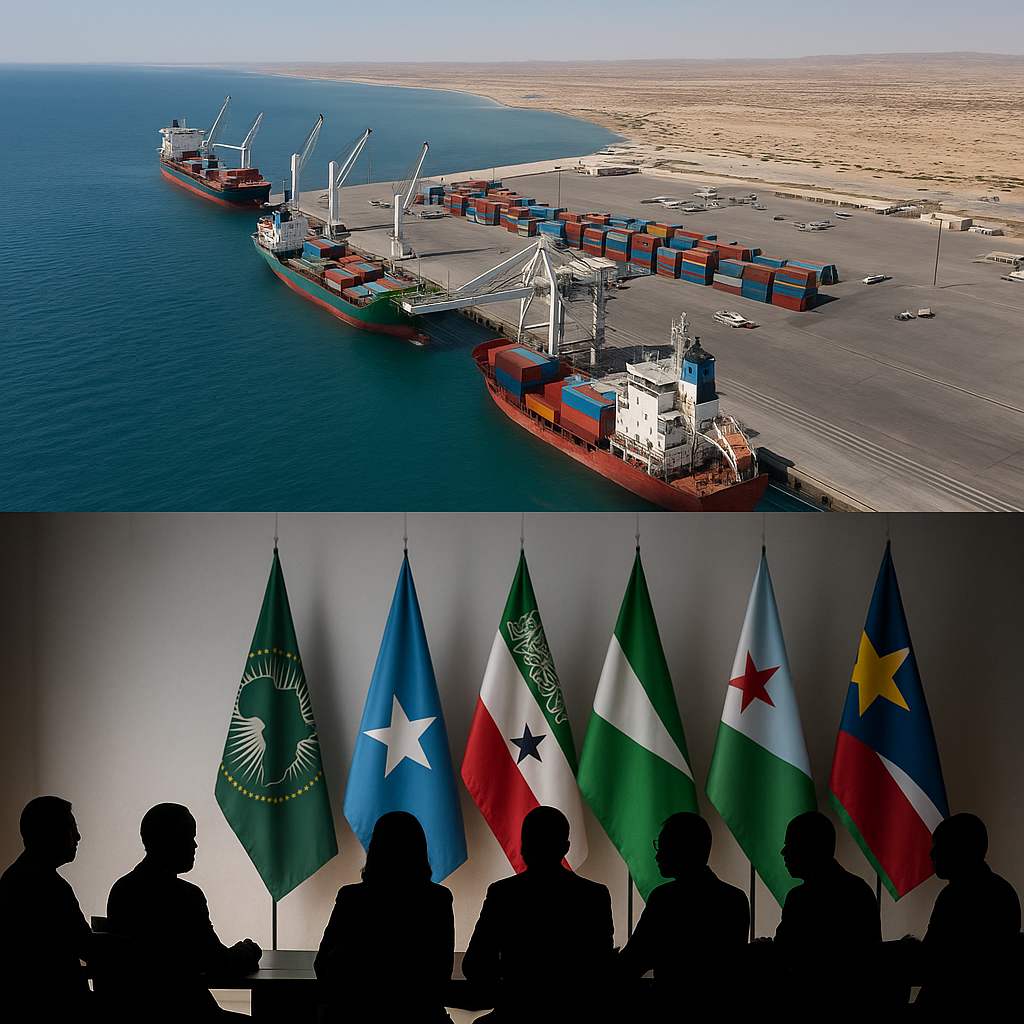
Hargeisa — A week of notable diplomatic movement across the Horn of Africa has kept Somaliland’s foreign affairs apparatus busy, as the self-declared republic works to consolidate its international standing while managing complex relationships with neighbours whose own alliances continue to evolve. From the still-reverberating implications of the Ethiopia-Somaliland memorandum to renewed engagement with Gulf partners and jostling between Djibouti and Addis Ababa over Red Sea access, the region’s diplomatic chessboard rarely sits still. Below is this week’s briefing on the developments that matter most.
Ethiopia-Somaliland MOU: Implementation Questions Loom Large
The landmark memorandum of understanding signed between Hargeisa and Addis Ababa earlier this year — granting Ethiopia access to the Gulf of Aden coastline in exchange for a package that could include diplomatic recognition of Somaliland — continues to dominate regional conversation, even as concrete steps toward implementation remain elusive. Sources familiar with negotiations suggest that internal political pressures within Ethiopia, including sensitivities around federalist arrangements and opposition from Somali regional state leaders, have slowed the timetable for translating the agreement into tangible outcomes.
For Somaliland, patience is being tested but officials continue to describe the process as on track, emphasising that agreements of this magnitude require careful calibration. The deal, if fully realised, would represent the most significant diplomatic breakthrough in Somaliland’s three-decade pursuit of international recognition. Analysts warn, however, that the longer implementation is delayed, the greater the risk that domestic political cycles in both countries will erode the political will needed to see it through.
Djibouti Watches Warily as Port Competition Intensifies
Djibouti’s government has grown increasingly vocal in its opposition to any arrangement that would see Ethiopia shift a meaningful portion of its trade corridor away from the Port of Djibouti toward Somaliland’s Port of Berbera. Djiboutian officials have been engaged in a quiet but determined diplomatic campaign with Gulf investors and international partners, seeking to underscore their country’s continued strategic value as the region’s dominant logistics hub.
The rivalry between Berbera and Djibouti is not merely commercial — it carries deep geopolitical weight, given that port revenues constitute the backbone of Djibouti’s economy and its leverage in hosting foreign military installations. Somaliland’s port development, backed in part by DP World, has been steadily advancing its capacity and efficiency metrics, presenting a credible alternative that is no longer easy to dismiss. Regional observers note that the competitive tension between the two ports is reshaping diplomatic alignments in ways that will have lasting consequences for the Horn’s infrastructure politics.
Somalia Doubles Down on International Lobbying Against Somaliland Recognition
The federal government in Mogadishu has intensified its diplomatic outreach to the African Union and Arab League member states, seeking formal declarations of opposition to any move by Ethiopia or other nations to extend recognition to Somaliland. Somali foreign ministry officials have framed the issue explicitly as a matter of territorial integrity under the African Union’s foundational principle of respecting colonial-era borders, a position that still resonates with many member states despite Somaliland’s unique historical circumstances.
Hargeisa has responded by accelerating its own parallel outreach, particularly to countries that maintain trade or development relationships with the territory. Somaliland’s argument — that its case is legally and historically distinct from secessionist movements elsewhere on the continent — has gained traction in some quarters but faces an uphill battle against the institutional conservatism of the AU. The diplomatic contest between Mogadishu and Hargeisa for the ears of African capitals is intensifying, and both sides are committing significant resources to shaping the narrative.
Kenya Signals Deeper Interest in Somaliland Engagement
Nairobi has moved quietly but deliberately to deepen its practical engagement with Somaliland, with senior Kenyan government officials making contact with their counterparts in Hargeisa around trade facilitation, livestock export standards, and joint counter-piracy cooperation in the Gulf of Aden. Kenya has long maintained an informal but functional relationship with Somaliland, and signals from Nairobi suggest an appetite to formalise aspects of that relationship without crossing the threshold of full diplomatic recognition.
The motivation for Kenya is partly economic — Somaliland’s livestock trade represents significant regional commerce — and partly strategic, as Nairobi seeks to position itself as a broker of stability in a region it regards as critical to its own northern security buffer. For Somaliland, Kenyan engagement offers both practical benefits and symbolic value as yet another Horn of Africa neighbour demonstrating willingness to do business on terms that acknowledge Hargeisa’s de facto governance reality.
Eritrea-Ethiopia Tensions: A Distant but Relevant Shadow
The ongoing deterioration in relations between Asmara and Addis Ababa continues to send ripples through the broader Horn of Africa diplomatic environment. Reports of military posturing along the shared border and a breakdown in the dialogue channels that briefly flourished following the 2018 peace agreement have raised concern among regional observers and international mediators. While Somaliland is not directly party to this dispute, any significant destabilisation involving Ethiopia carries implications for Hargeisa’s strategic calculus.
A Ethiopia distracted by a northern border confrontation with Eritrea is a less reliable partner for Somaliland’s recognition ambitions, and a less capable investor in the Berbera corridor development that underpins the MOU’s economic logic. Somaliland officials are understood to be monitoring the situation carefully, and diplomatic sources suggest Hargeisa has been in quiet contact with Gulf state intermediaries who maintain influence in both Addis Ababa and Asmara.
Gulf Engagement: UAE Deepens Berbera Footprint
The United Arab Emirates has continued to expand its presence in Berbera, with logistics and infrastructure activity at the port accelerating in recent weeks. The UAE’s interest in Somaliland is multidimensional — commercial, military-strategic, and tied to Abu Dhabi’s broader ambition to anchor influence across the Red Sea and Gulf of Aden littoral. Emirati investment in Berbera has proceeded largely insulated from the diplomatic turbulence surrounding the Ethiopia MOU, reflecting a relationship that predates and operates independently of the recognition question.
For Somaliland, the UAE’s sustained commitment provides both economic oxygen and a degree of informal international legitimacy that is difficult to quantify but impossible to overlook. As Hargeisa’s leadership continues to argue its case for formal recognition, the visible presence of Emirati capital and operational activity in Berbera functions as a powerful piece of evidence that the territory is a functional, investable entity — recognition or not.

