
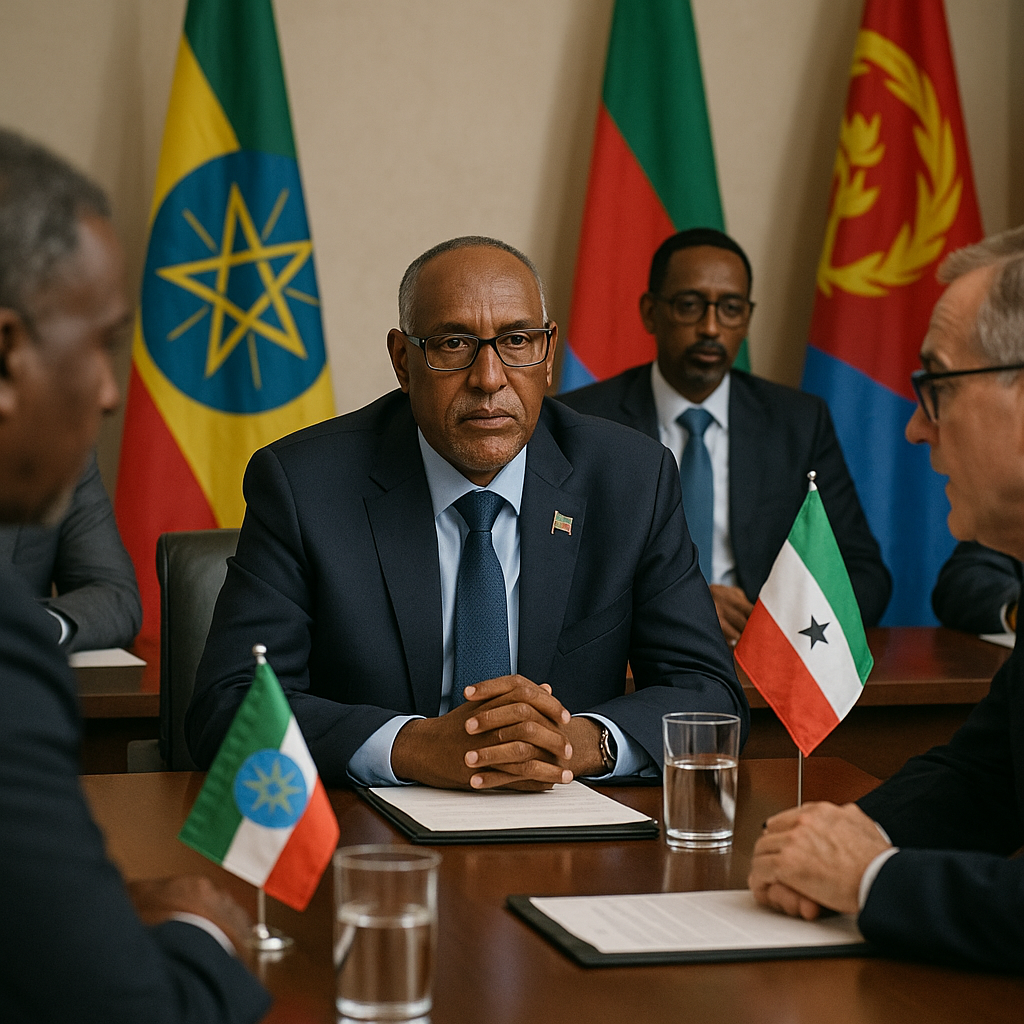
Hargeisa — The diplomatic landscape across the Horn of Africa continues to shift at a rapid pace, with Somaliland at the centre of several consequential developments this week. From renewed pressure over its bid for international recognition to escalating tensions along Ethiopia’s contested borders, the region’s leaders face a dense web of competing interests. Below is this week’s roundup of the most significant political, diplomatic, and security developments shaping the Horn.
Somaliland–Ethiopia Access Deal: Uncertainty Persists
The memorandum of understanding between Somaliland and Ethiopia, which would grant Addis Ababa access to the Red Sea coast in exchange for diplomatic recognition, remains in a state of prolonged ambiguity. Ethiopian officials have continued to signal interest in a sea outlet through Berbera port, but no formal progress on the recognition component has been publicly confirmed. Analysts note that domestic political calculations in Addis Ababa — particularly Prime Minister Abiy Ahmed’s need to manage relations with Mogadishu — continue to complicate forward movement on any formal acknowledgment of Somaliland’s statehood.
For Hargeisa, the delay is a source of frustration but not panic. Somaliland’s government has reiterated its position that the port and basing arrangements cannot be permanently decoupled from the political recognition question, and officials have cautioned that indefinite stalling could push Somaliland to revisit the terms of the agreement entirely. The outcome of this standoff will have far-reaching consequences for regional port competition and the balance of influence along the Red Sea littoral.
Mogadishu–Hargeisa Relations: Dialogue Stalled
Efforts to restart formal dialogue between the Federal Government of Somalia and Somaliland’s administration have made little tangible headway this week, with both sides trading pointed statements through official channels. Mogadishu has continued to frame Somaliland’s international engagement — particularly its outreach to Gulf states and East African governments — as a violation of Somalia’s constitutional framework, while Hargeisa has maintained that it operates as a sovereign entity requiring no permission from the south.
The impasse is significant because international partners, including the African Union and certain Gulf states, have quietly urged both administrations to find a negotiated framework that reduces tensions without requiring either side to abandon its core position. Without a credible mediator acceptable to both parties, however, the prospects for near-term dialogue remain slim. The longer the gap widens, the more entrenched public opinion on both sides becomes, reducing the political space for any future compromise.
Ethiopia–Eritrea: Border Tensions Resurface
Reports from the Ethiopia–Eritrea border region this week indicate a renewed buildup of military assets on both sides of the frontier, raising concerns among regional observers that the fragile post-2018 peace between Addis Ababa and Asmara may be deteriorating further. The two countries, which signed a landmark peace agreement under Prime Minister Abiy and President Isaias Afwerki, have seen their relationship cool considerably in the years since, with Eritrea’s role in the Tigray conflict a persistent source of grievance and mutual distrust.
The implications for the wider Horn are considerable. A renewed deterioration in Ethiopian-Eritrean relations would divert Addis Ababa’s diplomatic energy and military resources away from other pressing priorities, including its engagement with Somaliland and its counterterrorism commitments in Somalia. Regional bodies including the Intergovernmental Authority on Development have so far offered little effective mechanism for de-escalation, and external powers with influence over both governments — including Gulf states — have not publicly intervened.
Kenya’s Somalia Engagement: Nairobi Deepens Ties with Mogadishu
Kenya and Somalia moved to strengthen their bilateral relationship this week, with senior officials from both governments meeting to discuss security cooperation, trade, and the management of Somali refugee flows from camps in northeastern Kenya. The rapprochement marks a notable warming after years of strained ties, including a prolonged maritime border dispute that was adjudicated by the International Court of Justice in 2021 and which Mogadishu considers settled in its favour.
The closer alignment between Nairobi and Mogadishu carries implications for Somaliland, which has historically maintained workable, if informal, relations with Kenya. An increasingly Somalia-aligned Nairobi could complicate Somaliland’s efforts to cultivate African partners willing to engage with it outside the framework of Somali federal sovereignty. Hargeisa will be watching developments closely to assess whether Kenya’s engagement signals a broader regional closing of ranks around Mogadishu’s position.
Al-Shabaab Activity: Pressure Mounts in Central Somalia
The armed group Al-Shabaab intensified its operations across central and southern Somalia this week, carrying out a series of attacks targeting Somali National Army positions and civilian infrastructure. Despite years of pressure from African Union transition mission forces and Somali government offensives, the group has demonstrated a persistent capacity to regenerate and strike across a wide geographic area, undermining confidence in the security transition currently underway.
The security deterioration has renewed debate among international donors about the pace of the African Union mission’s drawdown and whether Somali security forces are adequately prepared to assume full responsibility. For Somaliland, the instability reinforces its longstanding argument that its own security model — built on a community-based approach and a relatively stable internal environment — represents a more viable governance outcome than the internationally subsidised framework in the south.
Djibouti: Balancing Act Continues Amid Red Sea Tensions
Djibouti’s government this week reaffirmed its commitment to maintaining its role as the Horn of Africa’s primary hub for foreign military basing, even as the broader Red Sea security environment continues to be disrupted by Houthi activity in Yemeni waters. Djibouti hosts military installations from several global powers and has positioned itself as an indispensable node in the region’s security architecture.
However, Berbera’s growing infrastructure and Somaliland’s active courtship of external partners — including the United Arab Emirates, which operates a port concession there — means that Djibouti faces a slow but real erosion of its near-monopoly status. The competition between the two ports is no longer merely commercial; it is increasingly geopolitical, with implications for which external powers gain strategic footholds in the Red Sea and Gulf of Aden corridor in the years ahead.

