
Hargeisa — Israel recognised Somaliland in December 2025 and appointed its first ambassador, Michael Lotem, in April 2026. Somaliland sent its own ambassador, Dr. Mohamed Omar Hagi Mohamoud, to Jerusalem in February. The diplomatic architecture is in place. What is not yet in place — and what the rapidly deteriorating security environment makes urgently necessary — is a bilateral defense framework that gives this partnership strategic teeth before the adversaries of both nations act to prevent it.
The window is open. It is also closing.
Somalia’s Bab el-Mandeb Threat: Directed at Israel, Heard Around the World
On April 17, 2026, Somalia’s Ambassador to Ethiopia and the African Union, Abdullahi Warfa, posted a statement on X that represents the most direct threat a Somali official has made against Israel since the recognition was announced. “Any country interfering in Somalia’s internal affairs and compromising its territorial integrity and sovereignty will face repercussions, including potential restrictions on access to the Bab-el-Mandeb Strait,” Warfa wrote. The statement followed Israel’s formal appointment of its ambassador to Somaliland. No other country had been recognized. No other country had just appointed an envoy to Hargeisa. The target of the threat was not ambiguous.
The Bab el-Mandeb Strait — the narrow chokepoint between Djibouti and Yemen through which approximately 14 percent of global trade passes — is Israel’s lifeline to the East. Access to the Red Sea, the Indian Ocean, and Asian markets depends on it. Since Houthi attacks disrupted the northern Red Sea route beginning in late 2023, Israel’s maritime exposure at this chokepoint has only deepened. Somalia’s State Minister for Foreign Affairs, Ali Omar, speaking at the Antalya Diplomacy Forum, amplified the theme, warning that Israeli actions threatened to “create more difficulties in a region that is already fragmented” and cautioning against the risk of drawing non-state actors into the dispute — language widely read as an allusion to Houthi alignment.
Somalia currently operates without a functional navy, lacks an air force, and has no missile capabilities. Its maritime security is largely maintained by foreign forces under international arrangements. The threat, in operational terms, is today more rhetoric than reality. But today is not the only day that matters.
The Turkish Military Architecture That Is Being Built Against Somaliland
The more serious and concrete threat to Somaliland is not what Somalia can do today but what it is building toward — and the Turkish military architecture underpinning that ambition is advancing faster than Somaliland’s diplomatic momentum.
Turkey has already transformed Somalia into its largest overseas military investment. Camp TURKSOM serves as Turkey’s largest overseas military base, and since 2017, Turkish forces have trained over 15,000 Somali troops, including naval and special operations members. The 2024 defense and economic framework agreement deepened that relationship further, with Turkey’s plans to increase its military presence in Somalia aiming to reach as many as 2,500 soldiers by 2026. Turkish-trained special forces — the Gorgor unit — are already the most capable ground combat element in Somalia’s federal arsenal. Turkish drones, Turkish armored vehicles, and Turkish tactical doctrine now form the operational backbone of Somalia’s most elite formations.
And now Turkey is moving east — directly toward Somaliland’s territory.
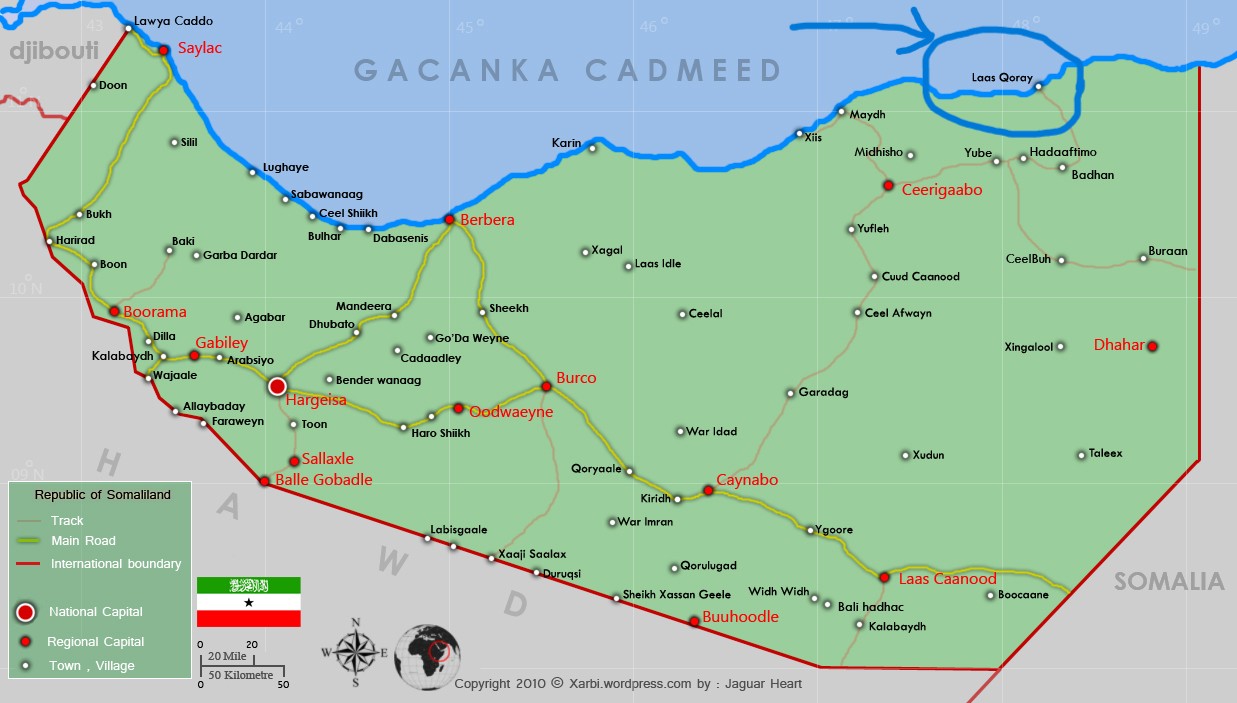
Turkey has reportedly accelerated the construction of a military base in the Lasqoray district of Somaliland’s Sanaag region, amid growing regional tensions following Israel’s move to establish a military presence in Somaliland. According to Turkish media outlet TRHaber, Ankara views recent geopolitical developments in the Horn of Africa as having direct implications for regional security. Lasqoray has been selected due to its strategic location along the Gulf of Aden. The construction is being carried out with the consent and cooperation of the Federal Government of Somalia.
Lasqoray is not a peripheral location. It sits on the Gulf of Aden coast in the Sanaag region — territory that Somaliland claims as its own but which has been under the Puntland administration, also claimed by the recently made-up regional administration of Eastern Sool Region, also known as SSC-Khatumo, the Mogadishu-aligned administration that emerged from the 2023 conflict around Las Anod. Local reports suggest that Turkey and Somalia have long planned to establish another military base in Las Qoray, a port with direct access to the Red Sea located in the Eastern Sanaag region of Somaliland.
A Turkish military base at Lasqoray would place Turkish-commanded forces on Somaliland’s eastern flank, on the Gulf of Aden coastline, within striking distance of the maritime approaches to Berbera. It would give Mogadishu — equipped with Turkish drones, Turkish-trained special forces, and Turkish naval escort — a forward operating base from which to threaten Somaliland’s eastern regions. A former Turkish ambassador noted that “an Israeli move toward recognition of Somaliland would directly undercut Turkey’s geopolitical position, giving Israel a foothold on both sides of the Bab al-Mandeb and countering Turkish influence.” The Lasqoray base is Ankara’s counter-move to Israel’s recognition — a race to establish facts on the ground before Somaliland’s international status solidifies.
The Eastern Front: Somalia’s Staging Ground
The strategic logic of a Somali military operation against Somaliland — using the Eastern Sool region, controlled by Somalia-affiliated militia, as a staging ground — is not speculative. It follows directly from the geography of the 2023 conflict, the current disposition of forces, and the political incentives facing Hassan Sheikh Mohamud.
Eastern Somaliland — the Eastern Sool and some parts of the Sanaag regions — represents the most vulnerable segment of Somaliland’s defensive perimeter. Somaliland forces withdrew from Las Anod in 2023 following the battle of Goojacade, described by The Economist as a “humiliating defeat.” Somaliland’s territory has been reduced as a result, and the conflict has created new and militarised zones in Eastern Sool and some pockets of Eastern Sanaag, where Somaliland and Eastern Sool region militia are stationed in close proximity, facing each other. The front line is active and tense, 100 kilometers from Las Anod.
The political incentive for Mogadishu to act militarily against Somaliland is now higher than at any point since 1991. Mohamud’s domestic legitimacy is contested, his parliamentary mandate has expired, and his presidential term ends in May 2026. A successful military operation against Somaliland — framed as the restoration of Somali territorial integrity — would provide a nationalist rallying point that could unite a fractured political class behind the government. The Turkey connection provides the military capability. The Eastern Sool Region’s relationship provides geographic access. The Israeli recognition provides the pretext.
The timing calculus is also deliberate. Israel is currently engaged in active military operations against Iran and other regional adversaries. Its political bandwidth for peripheral commitments is constrained. Its military assets are deployed elsewhere. Somalia, advised by Turkish strategic planners who understand Israel’s current posture, knows this. The window for action — before Israel can project meaningful deterrence to Somaliland, before Somaliland’s forces can be retrained and re-equipped, and before international recognition momentum makes a Somali military operation diplomatically catastrophic — may be measured in months rather than years.
What Israel Needs to Do — And Why It Cannot Wait
The case for an urgent bilateral defense framework between Somaliland and Israel rests on five concrete pillars.
First, air defense. Somaliland has no meaningful air defense capability. Turkish F-16s currently based in Mogadishu and patrolling Somali airspace represent an air superiority asset that Somaliland cannot currently contest. An Israeli air defense package — even a limited one, including man-portable air defense systems and early warning radar — would fundamentally change the calculus of any Turkish-supported Somali air operation against Somaliland’s territory. Israel has supplied comparable systems to partners in comparable threat environments.
Second, intelligence sharing. Israel’s signals intelligence and satellite surveillance capabilities are among the most advanced in the world. Real-time intelligence on Turkish force movements in Lasqoray, drone deployments, naval patterns in the Gulf of Aden, and military preparations in the Eastern Sool region would give Somaliland’s defense establishment enhanced situational awareness. This is the cheapest and fastest form of support available — and potentially the most decisive in the early stages of any escalation.
Third, elite force training. Turkish-trained Somali special forces represent a genuine qualitative threat to Somaliland’s military. Israel has a demonstrated capacity — through its training programs in Rwanda, Georgia, and elsewhere — to rapidly elevate the operational capability of partner forces. A structured Israeli training program for Somaliland’s special operations and officer corps, delivered urgently, would begin to close the qualitative gap opened by Turkish investment.
Fourth, maritime security cooperation. Berbera Port is Israel’s primary strategic interest in Somaliland. Its protection requires naval coordination that neither Somaliland nor Israel currently has the bilateral framework to provide. A maritime security agreement — covering patrol coordination, vessel tracking, and port security protocols — would both protect the asset and signal to Mogadishu and Ankara that Berbera is under a deterrence umbrella.
Fifth, a public defense commitment. The most powerful deterrent available is the simplest: a public, formal Israeli declaration that any armed attack on Somaliland’s territory will be treated as an attack on a strategic Israeli partner and will trigger a proportionate Israeli response. This does not require Israeli troops on the ground. It requires words — the right words, from the right officials, in the right forums. Israel’s deterrence posture in other contested environments has repeatedly demonstrated that clearly communicated red lines prevent conflicts that ambiguity invites.
The Lasqoray Counterpoint
Turkey’s proposed military base at Lasqoray on Somaliland’s eastern Gulf of Aden coast represents a direct strategic counter to Israel’s position at Berbera. If completed, it would give Turkey and Somalia a naval and air presence on both the eastern flank of Somaliland’s territory and the western approaches to the Gulf of Aden — effectively bracketing Somaliland between two Turkish-influenced military positions and challenging any future Israeli base at Berbera.
Kani Torun, a former Turkish ambassador with extensive Horn of Africa expertise, stated: “If Israel establishes a military facility in Somaliland, it would gain access to the Bab al-Mandeb Strait and the Red Sea, and exert influence in East Africa. A second goal would be to counterbalance Turkey’s influence in the Horn of Africa.” The Israeli-Turkish competition in the Horn of Africa is real, acknowledged by both sides, and being prosecuted on the ground right now. Somaliland is the prize. Lasqoray versus Berbera is the contest. The side that moves faster and more decisively will shape the strategic geography of the western Indian Ocean for a generation.
The Moment That Cannot Be Wasted
Israel’s recognition of Somaliland was historic. The appointment of Ambassador Lotem was a serious act of strategic commitment. But recognition without defense cooperation is a diplomatic gesture without a deterrence function. It tells Mogadishu and Ankara that Israel has chosen a side. It does not yet tell them that choosing against that side carries a cost.
Somalia’s ambassador threatened the Bab el-Mandeb on April 17. Turkey is accelerating construction at Lasqoray. Hassan Sheikh Mohamud is facing a domestic political crisis that a military adventure could temporarily resolve. Israel’s current military commitments constrain its bandwidth. And Somaliland’s eastern defenses remain thin.
The combination of these factors creates a threat window that both Israel and Somaliland must take seriously. History records that in this part of the world, windows close quickly — and the price of missing them is paid in years, not months. A formal, comprehensive bilateral defense framework between Israel and Somaliland — signed urgently, implemented rapidly, and communicated publicly — is not merely desirable. It is, given what is being assembled against Somaliland in Mogadishu and on the Gulf of Aden coast, a strategic necessity.

