
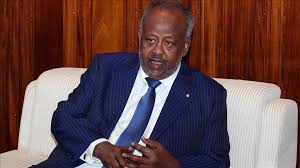
Hargeisa — On April 10, 2026, the Republic of Djibouti held what its government called a presidential election. By the time results were announced, incumbent President Ismail Omar Guelleh had won 97.81 percent of the vote. His sole opponent, Mohamed Farah Samatar of the Unified Democratic Centre, received 2.19 percent. Voter turnout was reported at 80.33 percent.
On the surface, these are the statistics of an election. In substance, they are the statistics of a performance — a carefully choreographed exercise in the appearance of democratic legitimacy, designed not to contest power but to confirm its permanent entrenchment.
The Constitution Was Changed to Let Him Run
The most fundamental fact about the April 2026 election is that Ismail Omar Guelleh was not legally eligible to contest it — until he changed the law to make himself eligible.
In 2010, Guelleh himself amended Djibouti’s constitution, removing presidential term limits while imposing a new restriction: no candidate over the age of 75 could stand for the presidency. At the time, this appeared to be a concession to democratic norms — a man who had removed the ceiling on how many times he could run had at least placed a ceiling on how long he could physically do so.
By 2025, Guelleh was 77 years old and the April 2026 election was approaching. He was constitutionally barred from running. The age limit he himself had introduced in 2010 was now the last formal obstacle standing between him and a sixth consecutive term in office.
On October 26, 2025, all 65 members of Djibouti’s National Assembly voted to remove it. The vote was unanimous. There was no dissent. The constitutional amendment was then ratified by parliament on November 2. Guelleh approved the change rather than submit it to a national referendum — the alternative option available under Djiboutian constitutional procedure.
On November 8, 2025 — six days after the ratification — Guelleh officially announced his candidacy.
The sequence is worth absorbing. A president changed the constitution. The parliament he controls unanimously approved the change. He then announced his candidacy. The law was not applied to the election. The election was applied to the law.
He Had Already Said He Would Not Run
In a 2022 interview with the BBC, Guelleh was asked directly whether he would seek another term. His answer was unequivocal. “No, no, no, three times no. You can remember that, I am over the age limit and I have to hand over.”
Those words — “three times no” — are now the most cited phrase in any serious analysis of the 2026 Djiboutian election. Guelleh did not merely reverse course. He reversed course after amending the constitution that had made his earlier answer true.
His Own Senior Advisor Resigned in Protest
The constitutional manipulation was so brazen that it prompted a public resignation from within Guelleh’s own inner circle. On September 22, 2025 — weeks before the parliamentary vote — Alexis Mohamed, a senior presidential advisor, resigned his position. He cited democratic backsliding and nepotism, and explicitly stated that he could not endorse any constitutional amendment designed to extend Guelleh’s rule. Mohamed subsequently indicated he could not return to Djibouti due to concerns about his personal safety — a detail that speaks volumes about the operating environment for political dissent in the country.
The Opposition Either Boycotted or Supported Guelleh
A credible election requires credible competition. The 2026 Djiboutian election had neither.
Djibouti’s major opposition coalitions — including the Bloc for National Salvation, a coalition of the Republican Alliance for Democracy and the Movement for Democratic Renewal and Development — refused to field a candidate. This is not new. These parties have boycotted every Djiboutian election since 2016, on the grounds that the conditions for free and fair competition do not exist. They have a point. The government controls all media. Independent journalism is effectively nonexistent inside the country. Djibouti ranks 168th out of 180 nations in the 2025 Reporters Without Borders press freedom index — placing it among the ten most hostile environments for journalism on the planet.
The one opposition party that did participate, the Union for Democracy and Justice, chose to support Guelleh and voted in favour of the constitutional amendment lifting the age limit. This is not opposition. It is co-optation.
The sole candidate against Guelleh — Mohamed Farah Samatar — was a former member of Guelleh’s own ruling party, the People’s Rally for Progress. He was widely described as unknown to the general public. One Djiboutian voter, speaking to AFP on election day, said: “I don’t even know what his opponent looks like.” Samatar held campaign rallies attended by a few dozen people. Guelleh’s rallies drew thousands. State media covered Guelleh extensively; Samatar’s events were barely visible.
This is what a managed election looks like. The opponent is not there to win. He is there to provide the appearance of competition.
The Numbers Themselves Are the Evidence
Democratic elections, even in countries where incumbents enjoy genuine popularity, produce results that reflect human variation — different communities, different interests, different levels of enthusiasm. When a leader wins 97.81 percent of the vote, it does not mean 97.81 percent of the electorate genuinely chose him over the alternative. It means the result was not determined by votes.
For context: Guelleh won 98 percent in 2021. He won 87 percent in 2016. He won 80 percent in 2011. The trajectory moves in only one direction — toward unanimity. As opposition participation has decreased and media control has tightened, his vote share has increased. This is not the pattern of a popular leader winning more convincingly over time. It is the pattern of a system in which the outcome is predetermined and the margin reflects the completeness of control rather than the will of the electorate.
The Addis Standard, one of the Horn of Africa’s most respected analytical publications, described the 2026 election plainly before a single ballot was cast: “The 2026 election does not represent a contest for power but rather a ritual confirming its permanent entrenchment.”
Why the World Stays Silent
Djibouti is a small country of approximately one million people. But its geography makes it one of the most strategically valuable pieces of real estate on the planet. Sitting at the Bab al-Mandeb Strait — the narrow chokepoint between the Red Sea and the Gulf of Aden through which an estimated 12 to 15 percent of global trade passes — Djibouti hosts the only permanent United States military base in Africa, alongside military installations operated by France, China, Japan, and Italy.
This geometry of power explains a great deal about why the world’s democratic powers say very little about Djibouti’s elections. The United States needs Camp Lemonnier for counterterrorism operations across the Horn of Africa and Yemen. France maintains its historical colonial foothold. China operates its first overseas military base from Djiboutian soil. None of these powers have any incentive to press for democratic accountability in a country where the incumbent’s continuity is directly in their strategic interest.
Guelleh has governed Djibouti since 1999. He succeeded his own uncle, Hassan Gouled Aptidon, the country’s founding president. He is now East Africa’s third-longest-serving leader, behind only Uganda’s Yoweri Museveni and Eritrea’s Isaias Afwerki — two leaders not generally celebrated as democratic exemplars. He is reportedly grooming his stepson, Naguib Abdallah Kamil, as a successor — transforming what is nominally a republic into something that increasingly resembles a dynasty.
Freedom House currently classifies Djibouti as “Not Free,” with a score of 24 out of 100. Youth unemployment stands at an estimated 76 percent. The country carries substantial public debt, much of it owed to Beijing. The strategic revenues from military bases and port operations have not translated into broadly shared prosperity.
What This Means for the Region
For Somaliland, Djibouti’s democratic deterioration matters strategically. Somaliland’s entire recognition case rests on the argument that it is a genuine democracy in a region of authoritarian governance — that its elections are real, its institutions are functional, and its people have chosen their leadership freely. Every time a neighbouring state demonstrates that elections in the Horn of Africa can be engineered rather than contested, it provides ammunition to those who argue that the region’s democratic credentials are universally superficial.
Somaliland must not allow that argument to go unanswered. The contrast between Somaliland’s competitive multi-party elections — where incumbents have genuinely lost power — and Djibouti’s managed performances is stark and real. It should be stated loudly and consistently on every international platform where Somaliland’s democratic record is being assessed.
An election in which the president changes the constitution to become eligible, his own advisor resigns in protest, the main opposition boycotts, the sole opponent is unknown to most voters, and the winner receives 97.81 percent of the vote is not a democratic exercise. It is the performance of one. Djibouti’s people deserve better. The region’s democratic future depends on distinguishing between the two.

