
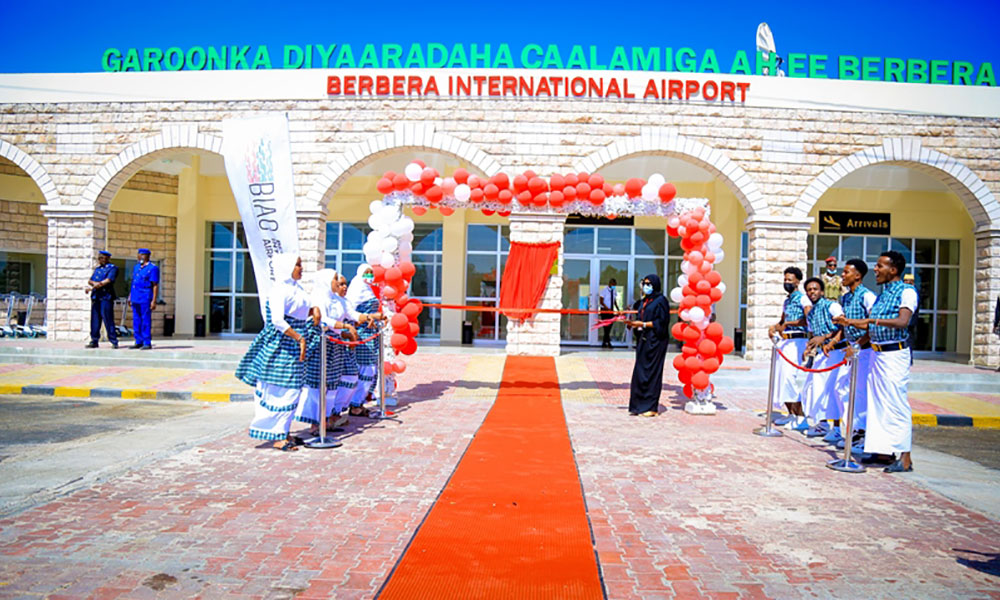
Hargeisa — Fresh details emerging from President Abdirahman Mohamed Abdullahi Cirro’s annual parliamentary address on Tuesday have shed new light on Somaliland’s deepening military ties with Israel, while a separate report by French newspaper Le Monde has revealed that Berbera Airport is undergoing a significant and largely covert transformation from a civilian facility into a military-focused site.
Cirro Hails Israel as ‘Reliable Partner’
Delivering his second annual address to a joint session of parliament on Tuesday, President Cirro described Israel as the first country to take a bold decision to recognise Somaliland, calling the move a turning point in the territory’s long-standing quest for international recognition. He expressed confidence that Israel would become a reliable partner, and indicated that additional countries are already seeking diplomatic relations and cooperation with Somaliland at a level comparable to formal recognition.
The President did not name the countries in question but said the momentum generated by Israel’s recognition in December 2025 has opened doors that were previously firmly closed. He reiterated that Somaliland’s first embassy abroad will be established in Israel, describing it as a historic milestone that reflects the depth of the two countries’ shared interests.
President Cirro also praised Ethiopia as a key regional partner, thanking Addis Ababa for maintaining what he called a healthy and respectful relationship with Somaliland over many years. He acknowledged that the Ethiopia-Somaliland relationship remains in a sensitive phase following the Ankara Declaration, which left the landmark 2024 port access memorandum of understanding in an uncertain state, but signalled his commitment to preserving and deepening the partnership.
Berbera Airport: A Quiet Military Transformation
In a significant development that has received little attention in the international press, Le Monde has reported that Berbera Airport is undergoing extensive construction that security analysts and satellite imagery suggest is transforming it from a civilian facility into a dual-use military site. Work observed between late 2025 and early 2026 includes the excavation and covering of trenches believed to be used for protected storage of ammunition and fuel, as well as the construction of raised structures that analysts say may support air defense systems.
The scale and nature of the construction has attracted the attention of regional security experts, who note that Berbera Airport already possesses one of Africa’s longest runways — originally developed as a NASA emergency landing site — making it one of the few facilities in the Horn of Africa capable of handling large military aircraft. Its proximity to the Bab el-Mandeb Strait, through which approximately 14 percent of global shipping now passes, adds further strategic significance.
Somaliland officials have not publicly commented on the specific nature of the construction, and neither Israel nor Somaliland has confirmed plans for an Israeli military base at the facility. However, Somaliland officials have not ruled out military cooperation with Israel, and both governments have left the door open for future security arrangements.
The development comes as Somaliland has simultaneously offered the United States access to Berbera Port and the airport for military basing purposes, positioning the territory as a potential hub for Western military operations in a region of growing strategic importance.
Maritime Security Elevated
Separately, Somaliland’s Ministry of Foreign Affairs convened a quarterly meeting of the Maritime Security Coordination Mechanism last week, bringing together key government institutions to assess emerging threats along Somaliland’s 850-kilometre coastline. The meeting focused on the evolving maritime security landscape in the Red Sea and Gulf of Aden amid the ongoing conflict involving Iran, the Houthis, and international shipping routes.
Officials reaffirmed Somaliland’s commitment to combating terrorism, transnational crime, and smuggling networks operating in the region, and agreed to strengthen the Maritime Domain Awareness framework through improved inter-agency collaboration and expanded information-sharing mechanisms with regional and international partners.
The convergence of these developments — a presidential speech reaffirming ties with Israel, credible reports of military construction at Berbera Airport, and a maritime security meeting addressing Red Sea threats — underscores Somaliland’s growing role as a strategic actor in one of the world’s most contested maritime corridors. For a territory that has spent 34 years seeking international recognition, the current moment represents an unprecedented convergence of diplomatic and military opportunity.