
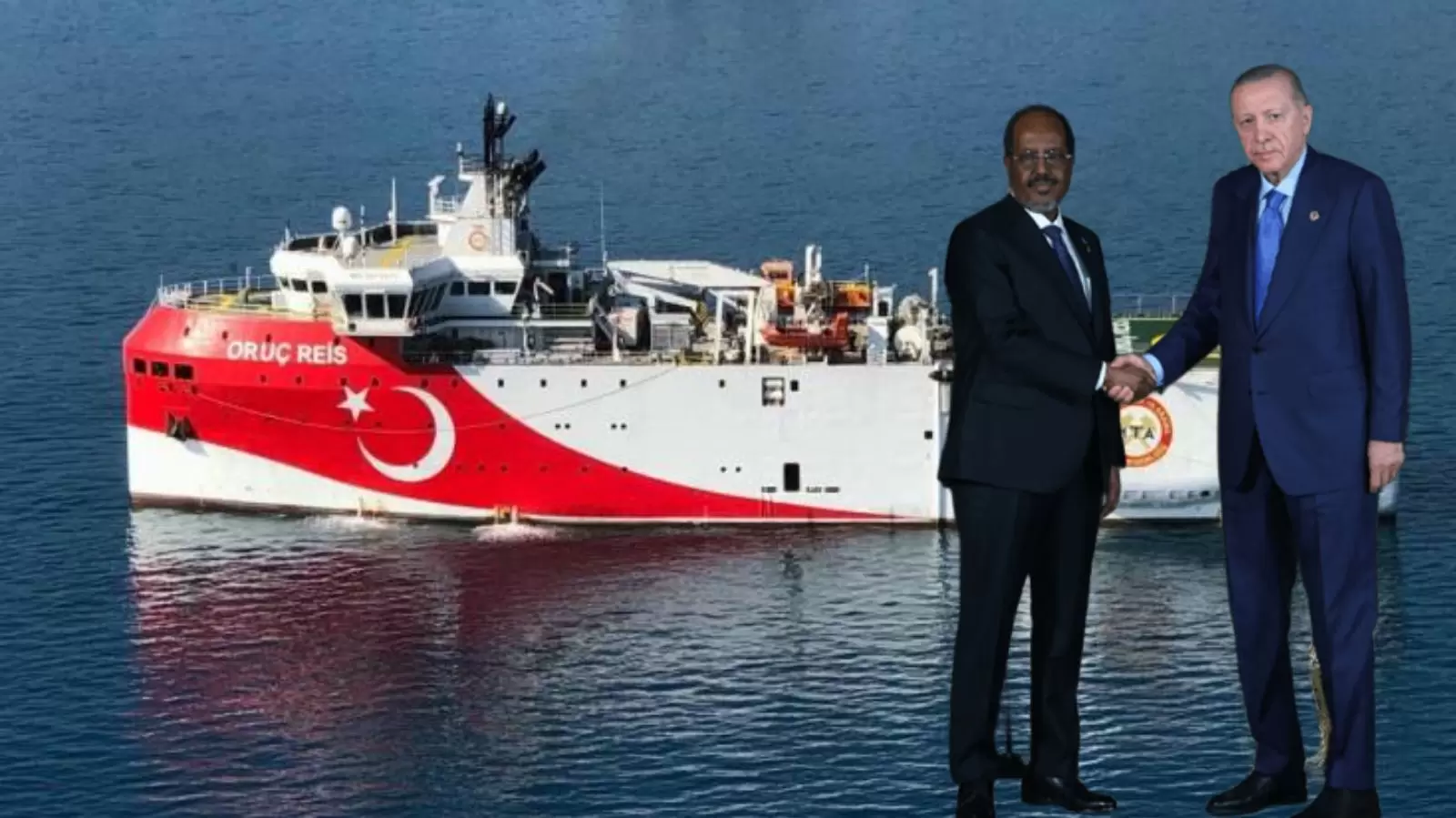
Hargeisa — A hydrocarbon agreement quietly signed between Somalia and Turkey in March 2024 has emerged as one of the most lopsided resource contracts in modern African history — granting Turkey’s state oil company sweeping control over Somalia’s offshore energy reserves while leaving Somalia with as little as 5 percent in royalties, no upfront payments, and no binding requirements for job creation or technology transfer.
The full text of the agreement was not disclosed to the Somali public or parliament when it was signed. It only became public when Turkey submitted it for ratification by the Turkish Grand National Assembly (TBMM) in April 2025 — meaning Somalis learned the terms of a deal over their own natural resources through the Turkish parliament, not their own.
What the Agreement Actually Says
The document, formally titled “Agreement Between the Government of the Republic of Türkiye and the Federal Government of the Federal Republic of Somalia in the Field of Hydrocarbons,” was signed on March 7, 2024 in Istanbul by Turkish Energy Minister Alparslan Bayraktar and Somali Petroleum Minister Abdirizak Omar Mohamed. It grants Turkey’s state-owned Turkish Petroleum Corporation (TPAO) exclusive rights to explore and produce oil and gas across Somalia’s offshore and onshore blocks — territory believed to hold up to 30 billion barrels of hydrocarbon potential and 6 billion cubic metres of proven natural gas reserves.
The key provisions, now confirmed through the published text, reveal a structure that overwhelmingly benefits Turkey:
No upfront costs whatsoever. Under Article 4.5, Turkey is explicitly exempted from paying any signature bonuses, development bonuses, production bonuses, surface fees, or administrative charges — at the time of signing or at any point during the contract. This deviates sharply from standard international practice, where host governments typically demand substantial upfront payments as compensation for granting exclusive exploration rights. Somalia received nothing at the outset.
Turkey recovers 90 percent of oil output before Somalia sees a dollar. Article 4.7 entitles Turkey to recover up to 90 percent of annual petroleum production as “cost petroleum” — a mechanism allowing the operator to recoup exploration and production costs before profit-sharing begins. In practical terms, this means that in the early years of production, nine barrels out of every ten go to Turkey. Only after those costs are recovered does profit-sharing begin.
Somalia’s royalty is capped at 5 percent. Article 4.6 limits Somalia’s royalty to a flat 5 percent — far below the international standard of 10 to 20 percent. This rate applies regardless of the scale of production or the price of oil on international markets. Analysts from the London School of Economics have noted that this structure effectively shuts down one of the Somali government’s few early revenue opportunities.
Turkey keeps all oil revenues abroad. Article 4.8 allows Turkish entities to export their share of oil and gas at international market prices and retain all proceeds outside Somalia — without Somali approval or oversight. Somalia has no visibility into or control over the financial flows from its own resources.
Turkey can transfer its rights to third parties without Somalia’s consent. Article 4.3 permits TPAO or any designated Turkish entity to assign its rights under the agreement to third parties, without establishing a local company or permanent office in Somalia. Somalia’s offshore reserves can effectively become tradable assets controlled from abroad.
Somalia bears the cost of its own laws. Article 8 contains a stabilisation clause stipulating that if Somalia enacts any legislation that increases Turkey’s costs — new taxes, environmental regulations, labour laws — Somalia must compensate Turkey within one year of the law’s enactment. This provision effectively penalises Somalia for exercising its own legislative sovereignty.
Legal disputes go to Istanbul, not Mogadishu. Article 10 routes any disputes to international arbitration in Istanbul — placing Somalia at a potential disadvantage in terms of access, legal costs, and negotiating leverage.
Signed in Secrecy, Ratified Abroad
Perhaps most damaging to Somalia’s institutional credibility is how the agreement was handled domestically. According to Somali analysts and legal experts, the hydrocarbon agreement was neither presented to Somalia’s Council of Ministers nor submitted to the Somali Parliament for review or approval before it was signed. President Hassan Sheikh Mohamud signed it unilaterally, bypassing the legislative branch entirely.
This stands in stark contrast to the Turkish side, where the agreement was properly submitted to the Grand National Assembly for parliamentary ratification — following constitutional requirements. The agreement was approved by the TBMM alongside related defence cooperation frameworks.
Critics in Mogadishu have pointed to the irony: Turkey respected its own constitutional process. Somalia did not.
The Military Architecture Behind the Deal
The hydrocarbon agreement does not stand alone. It is embedded within a broader framework of Turkish strategic entrenchment in Somalia that blurs the line between commercial partnership and de facto protectorate.
Turkey operates Camp TURKSOM — its largest military base outside NATO territory — in Mogadishu, where it has trained over 15,000 Somali troops since 2017. A separate 2024 Defence and Economic Cooperation Framework Agreement provides for Turkish naval vessels to patrol Somali waters for a decade — protecting Turkey’s own energy exploration vessels, including the seismic research ship Oruç Reis, which was escorted into Somali maritime zones by five Turkish navy warships in September 2025 to begin offshore surveys. Turkish F-16 fighter jets have been deployed to Mogadishu, and a Turkish air wing equipped with attack helicopters and drones operates alongside Somali forces.
In December 2025, a fisheries agreement granted a newly formed joint company named SOMTURK — controlled by OYAK, the Turkish Armed Forces Assistance and Pension Fund — centralised control over all licensing, monitoring, and regulation of Somalia’s entire exclusive economic zone, one of the richest fishing grounds in Africa. OYAK has no prior fisheries management experience.
The Horn Review, a regional analytical publication, has characterised this arrangement as a modern protectorate relationship: “Turkey managing critical infrastructure, commanding security forces, and securing exclusive rights to the country’s natural resources.”
Turkish Drilling Vessel Docks in Mogadishu
The pace of implementation has continued without pause. On April 10, 2026, the Turkish drilling vessel Cagri Bey docked at the Port of Mogadishu — just 72 hours before Somalia’s parliamentary mandate expired. The Addis Standard described the timing as “surgical,” noting that the administration had created a fait accompli by locking in the energy framework before any political transition could disrupt it.
A second onshore agreement was signed in Ankara on April 10, 2025, granting TPAO seismic survey rights across three land blocks covering approximately 16,000 square kilometres of Somali territory. Somali Petroleum Minister Dahir Shire Mohamed called it “a historic day.” No financial details were disclosed.
Defenders and Critics
Turkish officials and their allies defend the deal robustly. Turkish analyst Tunç Demirtaş has dismissed the 90 percent figure as a misrepresentation, arguing that cost recovery is standard industry practice and that any profits beyond cost recovery belong to Somalia. “Türkiye has no interest in owning Somali resources,” he has stated. Some analysts point to the Guyana model — where a similar cost recovery structure eventually produced substantial government revenues — as evidence that Somalia could benefit long term.
Defenders also note that Somalia carries no financial risk: if exploration yields nothing, Somalia owes nothing. The agreement includes commitments to community development and workforce training, and technology transfer is built into its framework.
Critics counter that these assurances are aspirational rather than binding, and that the comparison to Guyana ignores the absence of Somalia’s institutional capacity to enforce contract terms, monitor compliance, or hold Turkish entities accountable. “This is not development,” said one Somali civil society advocate. “It is dependency with a flag.”
What This Means for the Region
For Somaliland, the Turkey-Somalia energy partnership is a direct strategic concern. Turkish F-16s in Mogadishu, a Turkish naval presence in the Gulf of Aden, and an increasingly Turkish-managed Somali security apparatus represent a substantial shift in the military balance across the Horn of Africa. The same military infrastructure that protects Turkey’s drilling operations in Somali waters is the infrastructure that backs the Mogadishu government’s claim to sovereignty over Somaliland’s territory.
The question that Somalia’s citizens, its parliament, and its international partners must now confront is straightforward: when a government signs away 90 percent of its country’s oil output without parliamentary approval, without upfront compensation, and without transparency — who is the deal actually serving?
The full text of the Turkey-Somalia Hydrocarbons Agreement is available through the Turkish Grand National Assembly (TBMM) parliamentary proceedings, where it was submitted for ratification in April 2025.

