
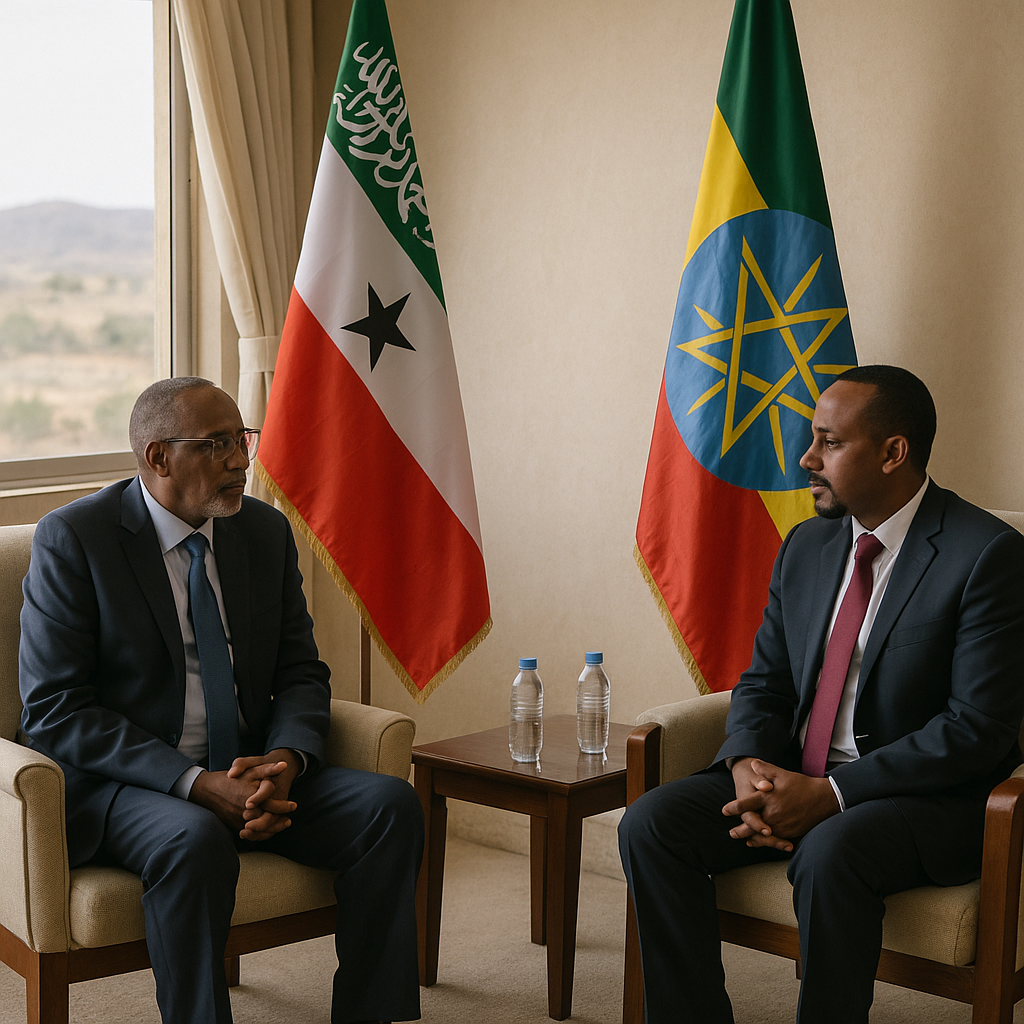
Senior Officials Meet in Addis Ababa as Both Sides Seek to Salvage Landmark Port Access Agreement
Hargeisa — Senior officials from Somaliland and Ethiopia convened in Addis Ababa this week for a new round of high-level diplomatic talks aimed at clarifying the future of the Ethiopia-Somaliland port access and naval base agreement, a deal that has faced mounting uncertainty in recent months amid shifting regional dynamics and sustained pressure from Mogadishu. The discussions, described by participants on both sides as frank and constructive, signal that both governments remain committed to finding a workable framework even as significant obstacles persist.
The memorandum of understanding, originally signed in January 2024, granted landlocked Ethiopia preferential access to the port of Berbera and outlined a broader strategic partnership that included the possibility of Ethiopia establishing a naval presence on the Red Sea coast. The agreement was widely seen as a potential turning point for Somaliland’s long pursuit of international recognition, raising hopes in Hargeisa that Addis Ababa might formally acknowledge Somaliland’s statehood in exchange for the strategic concessions on offer.
Talks Focused on Implementation Roadmap
According to sources familiar with the discussions, the Addis Ababa meetings centered on establishing a concrete implementation roadmap, with technical working groups tasked with examining port infrastructure requirements, revenue-sharing arrangements, and the legal architecture that would govern Ethiopian operations at Berbera. Both delegations reportedly acknowledged that the original timeline for operationalizing the agreement had slipped, and expressed a shared desire to put the process back on track before the end of the year.
Somaliland’s lead negotiator conveyed to Ethiopian counterparts that Hargeisa remains open to deepening the partnership but expects tangible progress on the question of diplomatic recognition within a defined timeframe. Ethiopian officials, for their part, indicated that Addis Ababa continues to view access to a Red Sea outlet as a matter of strategic necessity and that the Berbera corridor remains the most viable option currently on the table, despite competing proposals from other regional actors.
Regional Pressure Complicates the Equation
The talks are taking place against a backdrop of intensifying regional pressure. The Federal Government of Somalia has consistently and forcefully objected to the MoU, characterizing it as a violation of Somali sovereignty and a direct challenge to Mogadishu’s territorial claims over Somaliland. Somalia’s government has lobbied African Union member states and Arab League partners to withhold support for any arrangement that implicitly legitimizes Somaliland’s separate status, a campaign that has had some effect in complicating Ethiopia’s diplomatic calculus.
Meanwhile, the internal political situation in Ethiopia — including ongoing tensions in several regions — has slowed Addis Ababa’s ability to commit fully to large-scale external infrastructure investments. Ethiopian officials privately acknowledge that parliamentary and budgetary pressures have made it difficult to move as quickly as Hargeisa would like on the commitments outlined in the original agreement.
Berbera’s Strategic Value Remains Central
Despite the complications, the underlying strategic logic of the deal has not diminished. The Berbera Port and the Berbera Corridor continue to represent one of the most efficient and cost-effective routes for Ethiopian trade to reach global markets. Analysts note that Ethiopia imports and exports tens of billions of dollars in goods annually, almost entirely through the port of Djibouti, creating a single-point vulnerability that Addis Ababa’s strategic planners have long sought to reduce.
Port development at Berbera has accelerated in recent years, with DP World overseeing significant upgrades to terminal capacity and the road corridor linking the port to the Ethiopian border. Those improvements have made Berbera an increasingly attractive alternative, and regional economists argue that the economic case for Ethiopian engagement is arguably stronger today than it was when the MoU was first signed.
Hargeisa Watches Closely
In Somaliland’s capital, public and political attention to the talks is high. President Abdirahman Irro, who came to office earlier this year following a landmark election, has made deepening international engagement a centerpiece of his administration’s foreign policy. His government has signaled a willingness to revisit certain elements of the original MoU if doing so accelerates a path toward formal recognition, while drawing firm lines around Somaliland’s sovereignty and territorial integrity.
Civil society voices in Hargeisa have urged caution, with some analysts warning that Somaliland should not allow the prospect of Ethiopian recognition to become an indefinite carrot that delays concrete returns. Others argue that patience is warranted given the enormous strategic prize that formal recognition by a major African state would represent for Somaliland’s decades-long pursuit of international recognition.
Further rounds of technical discussions are expected in the coming weeks, with both sides tentatively aiming to produce a revised implementation schedule by the close of the current quarter. The outcome of those sessions is likely to determine whether the Ethiopia-Somaliland partnership emerges as the transformative regional arrangement its architects envisioned, or remains a landmark agreement that struggles to move from paper to practice.

