
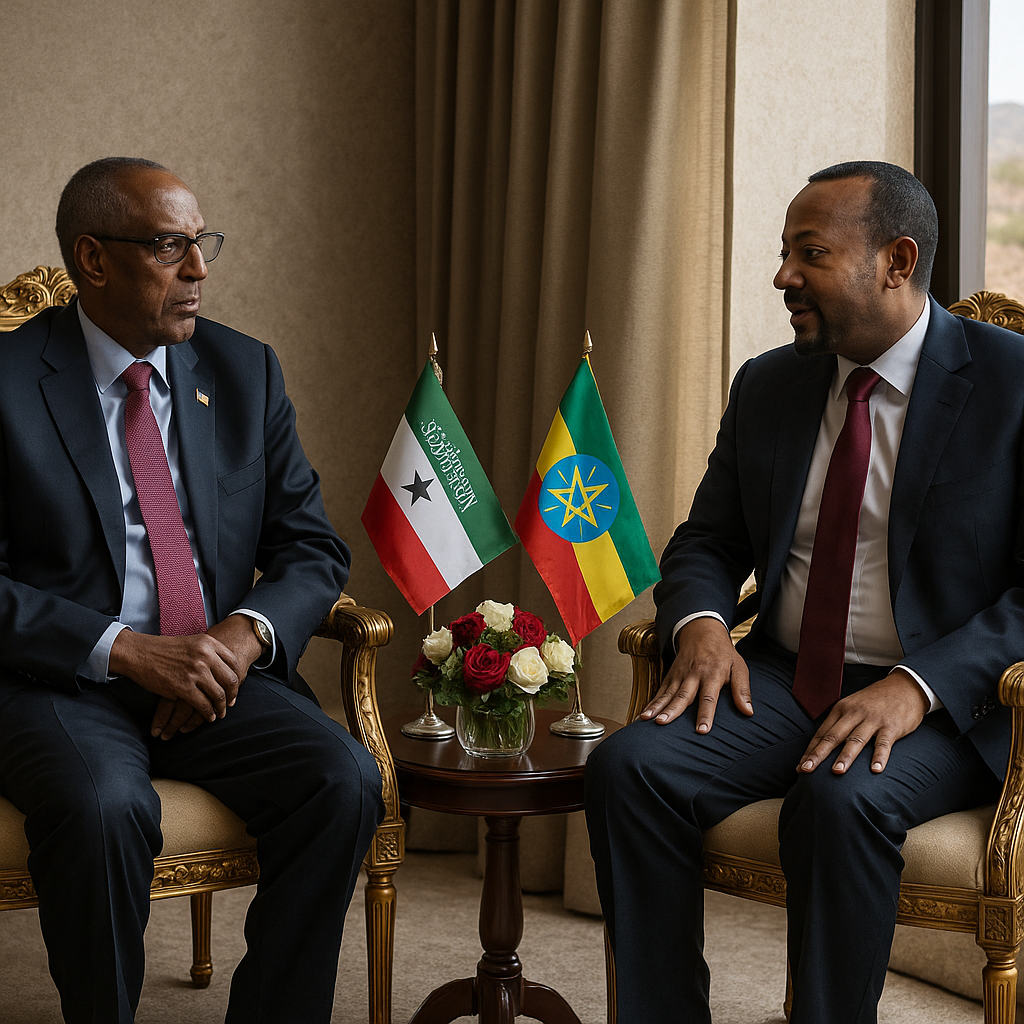
Delegations Meet in Addis Ababa Amid Renewed Push to Salvage Landmark Access Agreement
Hargeisa — Senior officials from Somaliland and Ethiopia convened in Addis Ababa this week for high-level consultations aimed at reviving stalled negotiations over the implementation of the Ethiopia-Somaliland port access and naval base agreement, which was signed with considerable fanfare in January 2024 but has since been mired in diplomatic and legal complications. The talks represent the most significant direct engagement between the two sides in several months, and regional analysts are cautiously watching for signs of a breakthrough.
The memorandum of understanding, which was meant to grant landlocked Ethiopia commercial access to the Red Sea coast through Berbera as well as a potential naval facility, generated immediate controversy. Somalia condemned the deal as a violation of its sovereignty, and pressure from Mogadishu — backed by regional and international actors — contributed to a cooling of relations and a slowdown in implementation discussions. Ethiopia, navigating its own complex diplomatic calculus in the Horn, has repeatedly declined to formally clarify the status of the agreement.
Somaliland Delegation Pushes for Concrete Timeline
According to sources familiar with the discussions, the Somaliland delegation, led by senior figures from the Ministry of Foreign Affairs, pressed their Ethiopian counterparts for a concrete and binding timeline for moving the agreement forward. The Somaliland side made clear that continued ambiguity was not a sustainable position, and that the republic’s leadership needed visible progress to justify the political costs the deal had imposed domestically and regionally. Ethiopian officials, for their part, signaled a continued interest in the arrangement but stopped short of committing to specific deadlines, according to the same sources.
The talks come at a delicate moment for Somaliland’s broader international posture. President Abdirahman Irro, who took office following the landmark November 2024 elections, has made renewed engagement with Ethiopia and the pursuit of formal international recognition central pillars of his administration’s foreign policy agenda. His government has sought to reframe Somaliland’s long-standing bid for international recognition not merely as a legal question but as a practical matter of regional stability and infrastructure development.
Berbera Port Remains Central to Negotiations
At the heart of the discussions remains the strategic value of Berbera Port and the Berbera Corridor, the inland trade route linking the coast to Ethiopia’s Somali regional state and beyond. Ethiopian trade officials have long viewed Berbera as a viable alternative to Djibouti, through which the vast majority of Ethiopia’s imports and exports currently pass. Diversifying access routes has been a stated strategic priority for Addis Ababa, particularly as the Ethiopia-Djibouti relationship has experienced periodic tension over port fees and political frictions.
Infrastructure observers note that Berbera’s expanded container terminal, developed with significant investment from DP World, is now operationally capable of handling considerably greater volumes of cargo than it currently processes. A formal and sustained Ethiopian commitment to routing trade through Berbera would represent a transformative economic development for Somaliland, potentially generating substantial port revenues and accelerating broader economic growth.
Regional Pressures Complicate Path Forward
Despite the renewed engagement, significant obstacles remain. Somalia’s federal government has maintained its position that any bilateral arrangement between a foreign state and Somaliland that implies recognition of the latter’s sovereignty is legally void and politically unacceptable. Mogadishu has lobbied the African Union and Arab League to reject the MoU, and has cited it as a source of ongoing regional instability.
Regional analysts suggest that Ethiopia is unlikely to move decisively on the agreement without broader diplomatic cover, or a significant shift in the geopolitical environment. Some observers have pointed to recent warming between Addis Ababa and Mogadishu — part of a broader Turkish-mediated normalization effort — as a factor that further complicates Ethiopia’s willingness to openly champion the Somaliland deal in the near term.
Nevertheless, Somaliland officials have expressed measured optimism following the Addis Ababa meetings. Government spokespersons indicated that the conversations were substantive and that both sides remained committed in principle to the goals outlined in the original agreement. A follow-up technical meeting is expected to be scheduled within the coming weeks, though no formal date has yet been confirmed.
Outlook
Whether this latest round of talks translates into tangible progress or represents yet another cycle of diplomatic engagement without resolution remains to be seen. What is clear is that the stakes — for Somaliland’s economy, its recognition aspirations, and the broader strategic balance in the Horn of Africa — continue to make the Ethiopia-Somaliland relationship one of the most consequential and closely watched in the region.

