
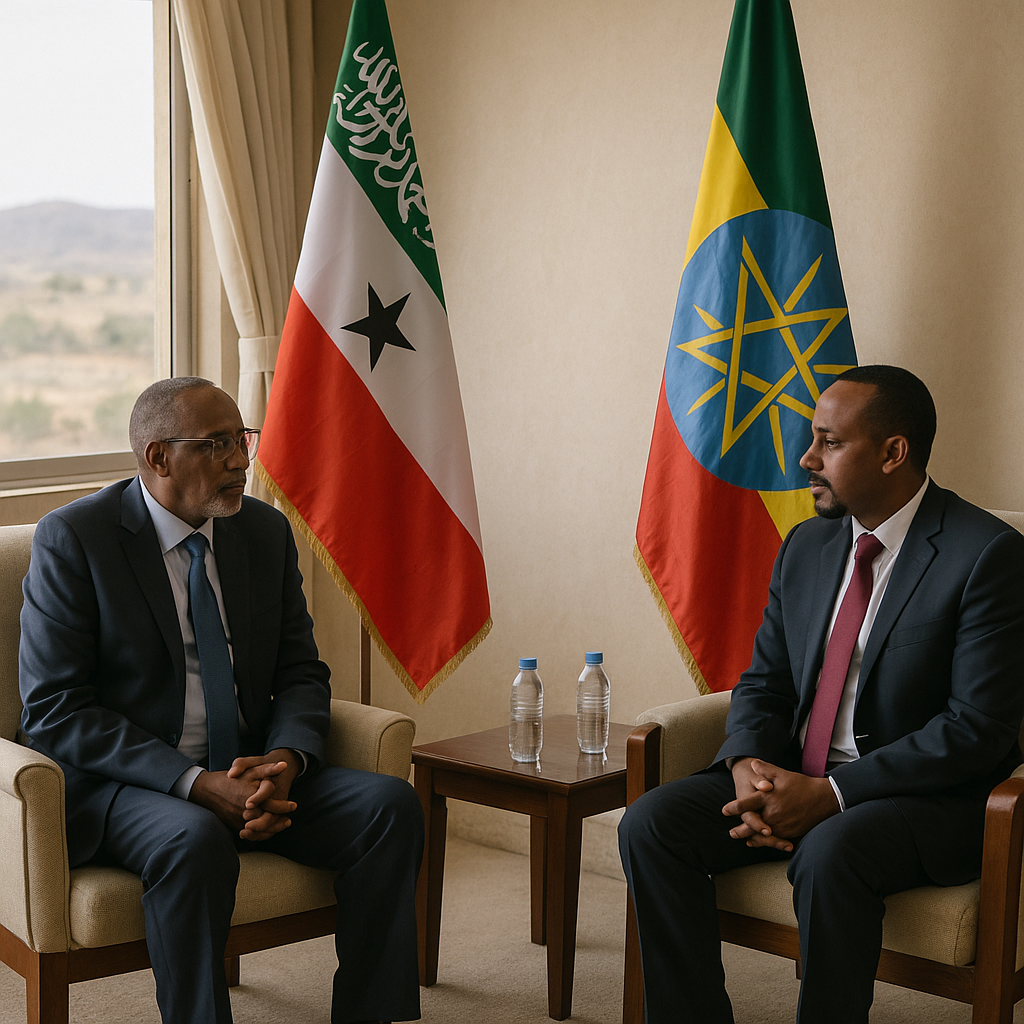
Hargeisa — Ethiopia’s Diplomatic Pivot Raises Alarm in Somaliland
Hargeisa — A significant diplomatic tremor is reverberating across the Horn of Africa this week as Ethiopia signals a notable warming of relations with the Federal Government of Somalia in Mogadishu, a development that Somaliland officials and analysts say could undermine the landmark Ethiopia-Somaliland port access agreement signed in January 2024 and threaten Hargeisa’s broader strategic ambitions in the region.
Senior Ethiopian government figures have held a series of high-level meetings with Somali federal officials in recent weeks, with both sides announcing intentions to strengthen bilateral cooperation on security, trade, and diplomatic matters. The rapprochement comes amid sustained pressure from the African Union, Arab League member states, and key Gulf partners on Addis Ababa to de-escalate tensions with Mogadishu that had flared following the announcement of the Somaliland memorandum of understanding.
Hargeisa Watches Closely as Strategic Calculations Shift
Somaliland’s Ministry of Foreign Affairs issued a carefully worded statement indicating that the government is monitoring regional developments and remains confident that its agreements with Ethiopia retain full validity. Officials speaking on background, however, conveyed a more guarded tone, suggesting that Hargeisa is increasingly concerned that Addis Ababa may be recalibrating its Horn of Africa posture in ways that deprioritize Somaliland’s interests.
Political analysts based in Hargeisa argue that Ethiopia’s landlocked status and its urgent need for reliable Red Sea access have not changed, meaning that Berbera Port and the Berbera Corridor remain strategically indispensable to Addis Ababa regardless of any diplomatic gestures toward Mogadishu. Nevertheless, they caution that the pace of infrastructure development and investment under the MoU could slow if Ethiopian political will wavers under external pressure.
One Hargeisa-based analyst described the situation as a test of whether Ethiopia’s interest in Somaliland was rooted in genuine long-term strategic thinking or was primarily a pressure tactic to extract concessions from Mogadishu. The analyst suggested that Somaliland should not wait passively but should actively diversify its international partnerships to reduce dependence on any single bilateral relationship.
Somalia Presses Its Case Internationally
Mogadishu has pursued an aggressive diplomatic campaign since the Ethiopia-Somaliland MoU was first announced, lobbying Arab League states, the African Union, and Western governments to oppose any arrangement that it characterizes as a violation of Somali sovereignty and territorial integrity. Somalia’s efforts have found receptive audiences in Cairo and Ankara, both of which have publicly backed Mogadishu’s position.
Somalia’s federal government has framed its reconciliation with Ethiopia as a diplomatic victory, with officials indicating that Addis Ababa had effectively acknowledged Mogadishu’s concerns. Ethiopian officials, for their part, have been more ambiguous, stopping short of formally abandoning the Somaliland agreement while simultaneously engaging Somalia with renewed diplomatic energy.
Somaliland’s Recognition Bid Faces New Headwinds
The shifting regional dynamics come at a sensitive moment for Somaliland’s long-running campaign for international recognition. After more than three decades of self-governance, Hargeisa had pinned considerable hope on the Ethiopia deal as a catalyst that might encourage other states to formalize ties, potentially opening a path toward broader diplomatic acknowledgment.
Those hopes now appear more complicated. Gulf Cooperation Council members, who wield considerable financial and diplomatic influence across the Horn, have largely aligned with Mogadishu on the recognition question, and any perception that Ethiopia is stepping back from its Somaliland commitment could further dampen international momentum.
Somaliland’s president is expected to convene an emergency session with senior cabinet and foreign policy advisers in the coming days to reassess the government’s strategic options. Sources close to the presidency indicate that outreach to Gulf partners and European governments is being intensified, with Hargeisa seeking to secure new economic and diplomatic anchors ahead of what could be a difficult period in its relations with Addis Ababa.
Regional Stability Implications
Beyond the immediate bilateral dimension, analysts warn that a faltering of the Ethiopia-Somaliland arrangement could have broader destabilizing consequences. Ethiopia’s access to Red Sea ports remains one of the most consequential unresolved questions in Horn of Africa geopolitics, and any prolonged uncertainty risks fueling competition among external powers — including Egypt, the Gulf states, and Turkey — all of whom are actively seeking influence in the region’s maritime corridors.
For Somaliland, the stakes are equally high. A weakened relationship with Ethiopia at this juncture would not only set back economic development plans centered on Berbera but could also embolden internal critics of the current government’s foreign policy approach ahead of a politically sensitive domestic calendar. Hargeisa’s next moves will be watched closely across the region.

