
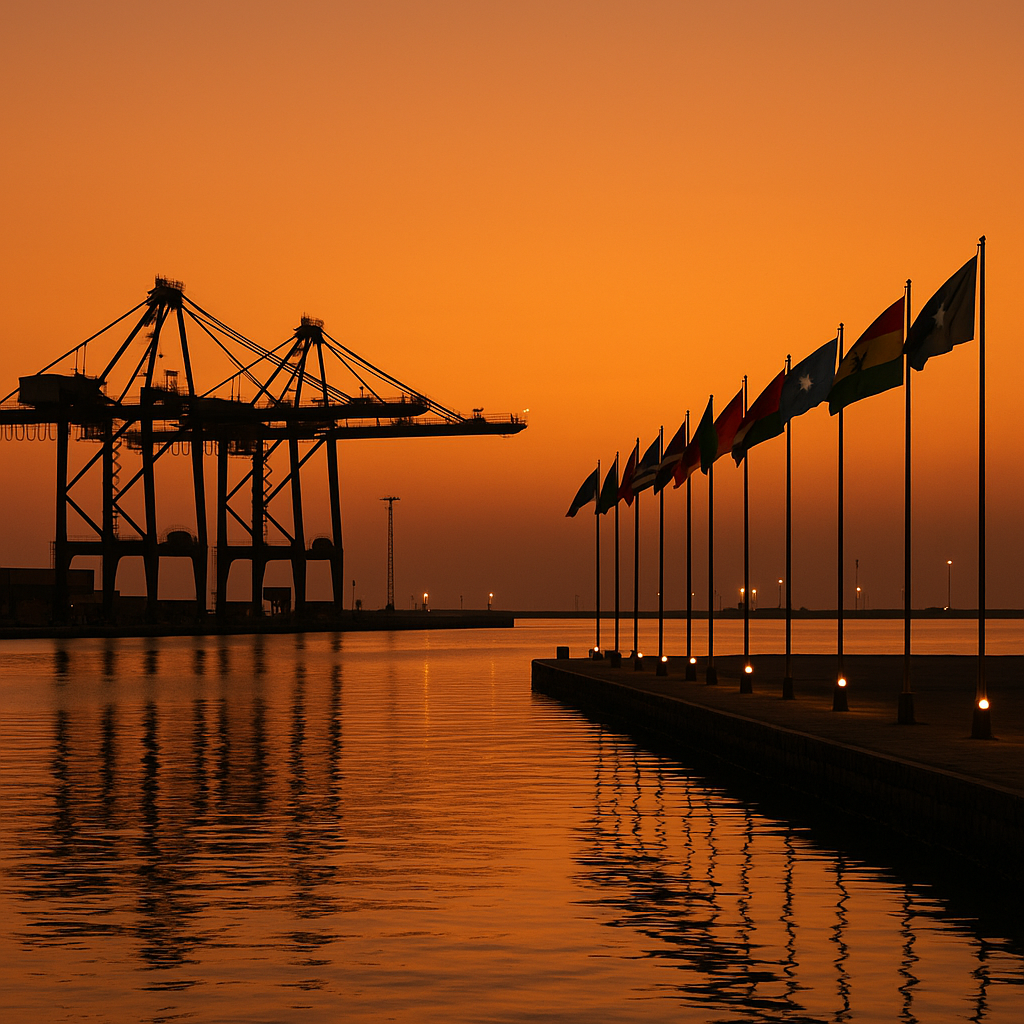
Hargeisa — As the Horn of Africa navigates another week of shifting alliances, contested maritime interests, and cautious diplomatic outreach, Somaliland finds itself at the centre of several consequential regional developments. From ongoing negotiations over port access to fresh overtures from Djibouti and continued uncertainty in Ethiopian foreign policy, this week’s briefing captures the diplomatic currents shaping the region’s near-term trajectory.
Somaliland–Ethiopia Relations: Port Diplomacy Continues to Define the Partnership
The framework agreement signed earlier this year between Somaliland and Ethiopia regarding access to the Red Sea port of Berbera continues to generate both diplomatic activity and political anxiety across the region. Ethiopian officials have maintained a studied ambiguity about the precise scope of their intentions, but Addis Ababa’s strategic interest in securing a reliable maritime outlet remains undimmed. Regional analysts note that Ethiopia’s landlocked status — and the economic pressures that accompany it — keeps the Berbera corridor firmly on the agenda in Ethiopian foreign policy circles, regardless of political turbulence elsewhere.
For Somaliland, the relationship represents a rare opportunity to translate geographic advantage into tangible diplomatic capital. Hargeisa has been careful to frame the arrangement as a mutual economic benefit rather than a security pact, seeking to reassure neighbouring states and international partners that the agreement does not carry destabilising military dimensions. The coming weeks are expected to bring further technical-level discussions as both sides work to operationalise aspects of the broader memorandum.
Djibouti: A Cautious Neighbour Eyes New Engagement
Djibouti, long wary of any arrangement that might erode its dominance as the region’s premier maritime hub, has signalled a more nuanced posture toward Somaliland in recent diplomatic exchanges. Rather than adopting open opposition, Djiboutian officials have indicated a willingness to explore complementary trade linkages — a shift that observers attribute in part to growing pressure from international investors seeking diversified logistics routes in the Horn.
The warming of tone, however measured, is significant. Djibouti hosts several major foreign military installations and serves as a critical node in global shipping lanes, giving it outsized geopolitical leverage relative to its size. Any movement toward normalised engagement with Hargeisa would carry symbolic weight for Somaliland’s broader international recognition campaign, even if concrete agreements remain some distance away. Berbera Times understands that informal contacts between the two administrations have increased in frequency over recent months.
Somalia–Ethiopia Tensions: Mogadishu Pushes Back on Addis Ababa
Relations between Mogadishu and Addis Ababa remain strained following a period of public disagreement over Ethiopian foreign policy moves in the region, particularly those involving Somaliland. Somalia’s federal government has continued to press its case at the African Union and in bilateral diplomatic channels, insisting that any arrangement touching on Somali territorial claims — including those involving Berbera — must receive Mogadishu’s explicit consent.
Ethiopia, for its part, has shown little public appetite for backing down, and diplomatic sources suggest that Addis Ababa views Somalia’s objections as a negotiating posture rather than a firm red line. The standoff carries broader implications for the Intergovernmental Authority on Development (IGAD), the regional bloc that nominally binds both states, and raises questions about the bloc’s capacity to mediate disputes among its own members. A resolution, if one comes, is likely to be incremental and largely conducted out of public view.
Kenya and Somaliland: Trade and Security Cooperation on the Quiet
Kenya has continued to deepen its practical engagement with Somaliland through trade facilitation and low-profile security cooperation, even in the absence of formal diplomatic recognition. Nairobi has long maintained a pragmatic approach to Hargeisa, viewing a stable Somaliland as a buffer against instability spreading southward from the wider Somali space.
Recent weeks have seen renewed discussions around livestock export routes and cross-border health protocols — bread-and-butter issues that nonetheless form the connective tissue of the relationship. Kenyan private-sector actors have also shown growing interest in investment opportunities in Berbera’s expanding free zone. Officials in Hargeisa have welcomed what they characterise as a relationship defined by substance over ceremony, even as they continue to advocate for Kenya to take a more assertive public stance on Somaliland’s recognition bid.
Gulf States: UAE Maintains Strategic Footprint at Berbera
The United Arab Emirates has continued to consolidate its commercial and strategic presence at Berbera port, with DP World’s operations at the facility proceeding steadily. The UAE’s dual interest — combining logistics infrastructure investment with a broader regional security calculus — keeps Abu Dhabi closely attentive to any diplomatic developments that might alter the port’s operational environment or ownership dynamics.
Emirati officials have engaged quietly with both Somaliland and Ethiopian counterparts to ensure that evolving agreements do not inadvertently complicate DP World’s concession arrangements. The UAE’s sustained investment remains one of the strongest arguments Somaliland can make to prospective international partners that the territory offers a credible and stable environment for long-term economic engagement. Hargeisa, meanwhile, has sought to position the Berbera relationship with Abu Dhabi as a model for the kind of partnership it hopes to replicate with other Gulf and Western states.
Eritrea: Asmara’s Regional Ambitions Warrant Watching
Eritrea’s increasingly assertive regional posture has drawn renewed attention from Horn of Africa analysts this week, with Asmara deepening ties with several non-state actors and engaging in diplomatic manoeuvres that appear designed to counterbalance Ethiopian and Somali influence. While Eritrea does not share a border with Somaliland, its relationships with key regional players — and its historical role as a spoiler in Horn dynamics — make it a factor that Hargeisa’s foreign policy planners cannot entirely discount.
The broader picture is one of a region in flux, where traditional alignments are being tested by economic pressures, shifting great-power interest, and the unresolved question of Somaliland’s international status. For Hargeisa, the diplomatic challenge remains constant: to convert geographic and institutional advantages into the formal recognition that would unlock a new chapter in the territory’s development.

