
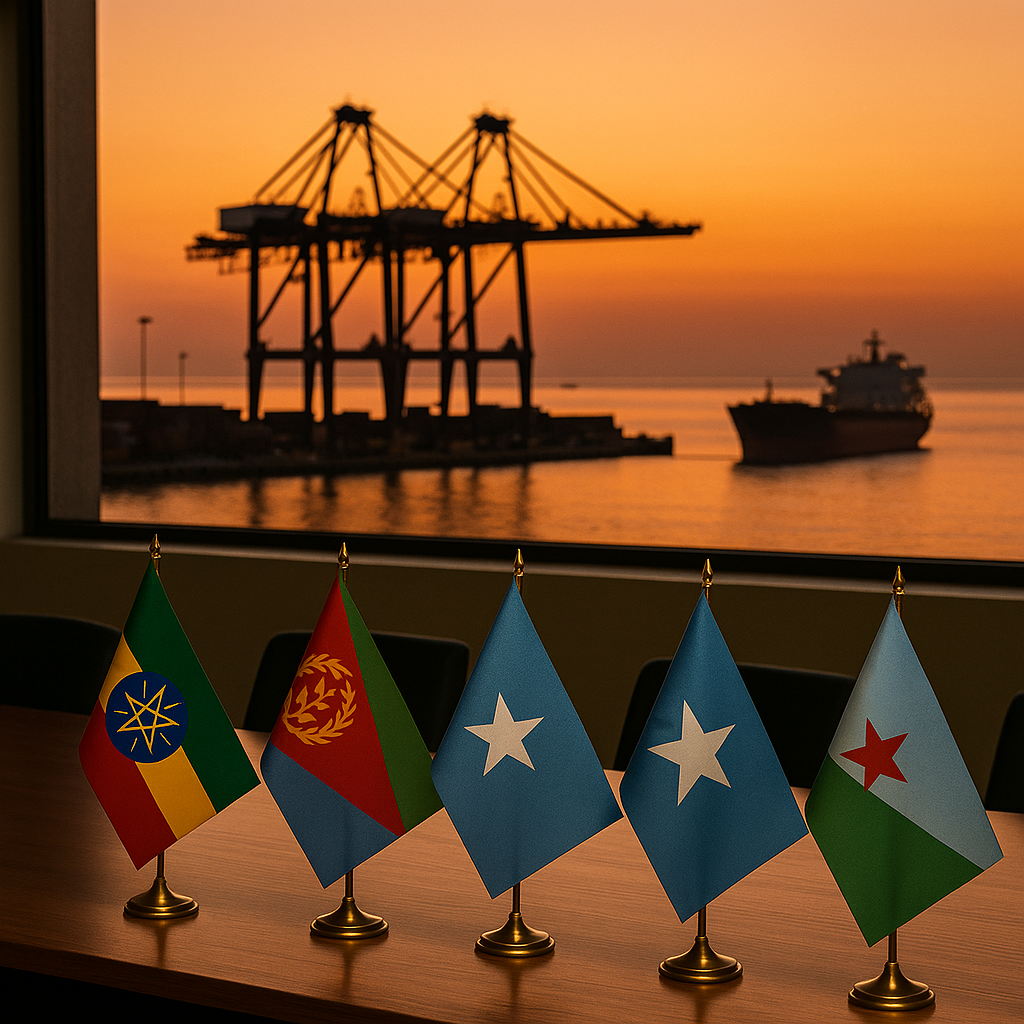
Hargeisa — Somaliland’s diplomatic calendar remained active this week as the self-declared republic continued to advance its international standing, deepen engagement with neighbouring states, and monitor shifting political currents across the Horn of Africa. From ongoing dialogue with Addis Ababa to evolving port diplomacy in the Red Sea corridor, this week’s briefing captures the most consequential regional developments shaping Somaliland’s strategic environment.
Somaliland–Ethiopia Relations: Port Access Talks Continue to Simmer
Discussions between Hargeisa and Addis Ababa over Ethiopia’s long-sought access to the Gulf of Aden coastline have continued to evolve, with diplomatic sources indicating that both sides remain engaged through back-channel contacts even as a formal, publicised agreement has yet to materialise. Ethiopian officials have reiterated the country’s need for reliable sea access as a national economic and strategic priority, and Somaliland’s coastline — anchored by the Port of Berbera — remains one of the most viable options under consideration.
The significance of these talks extends well beyond trade logistics. A formalised port-access arrangement would almost certainly elevate Somaliland’s international visibility, providing de facto diplomatic leverage with third-party countries and multilateral institutions. Analysts in Hargeisa note that Somaliland’s government is keen to extract meaningful political recognition concessions alongside any commercial agreement, making the negotiations complex but potentially transformative for the republic’s long-standing push for sovereignty acknowledgment.
Djibouti’s Balancing Act: Watching Berbera’s Rise with Caution
Officials in Djibouti have grown increasingly attentive to Berbera’s expanding port infrastructure and the accompanying diplomatic momentum that Somaliland has accumulated over recent months. Djibouti, whose economy depends heavily on port revenues and transit fees from landlocked Ethiopia, views any deepening Ethiopia–Somaliland commercial relationship as a structural challenge to its regional position as the Horn of Africa’s dominant maritime gateway.
While Djibouti and Somaliland do not share an overtly hostile relationship, the competitive undercurrents are well understood by policymakers in both capitals. Hargeisa has so far pursued a pragmatic posture, emphasising that Berbera’s development is complementary rather than adversarial to wider regional trade networks. Whether Djibouti ultimately accepts this framing — or seeks to complicate Somaliland’s diplomatic outreach — remains one of the more closely watched dynamics along the northern Horn littoral.
Somalia’s Federal Government Renews Pressure on International Partners
Mogadishu intensified its diplomatic efforts this week to discourage foreign governments and institutions from deepening formal ties with Hargeisa. The Federal Government of Somalia dispatched communications to several partner nations reaffirming its constitutional position that Somaliland is an integral part of the Somali state and that any arrangement treating it as a separate entity undermines Somalia’s territorial integrity.
This recurring diplomatic offensive has had mixed results historically, and Somaliland’s administration in Hargeisa characterised the latest round as a predictable attempt to stifle the republic’s legitimate international engagement. What is notable, however, is the timing: it comes as several Gulf and East African states have shown incremental interest in Berbera’s strategic location along one of the world’s busiest shipping corridors, prompting Mogadishu to recalibrate its counter-recognition toolkit ahead of potential new partnerships.
Kenya–Somalia Maritime Boundary: Regional Implications for Coastal Governance
The long-running maritime boundary dispute between Kenya and Somalia entered a quieter phase this week following renewed diplomatic outreach between Nairobi and Mogadishu, with both governments signalling a preference for negotiated frameworks over further international arbitration. The two countries have agreed in principle to establish a joint technical committee to manage overlapping claims in the Indian Ocean, a move welcomed by regional observers as a step toward de-escalation.
For Somaliland, the Kenya–Somalia dynamic carries indirect but real consequences. Kenya has historically maintained pragmatic, if informal, ties with Hargeisa, viewing it as a stable interlocutor in a volatile sub-region. A warmer Nairobi–Mogadishu relationship could theoretically reduce Kenya’s appetite for maintaining strong parallel engagement with Somaliland, though analysts caution that Nairobi’s interest in regional stability typically keeps multiple diplomatic channels open simultaneously.
Eritrea and Regional Realignment: Quiet Shifts Along the Red Sea
Asmara’s geopolitical positioning continued to attract attention from regional analysts this week as Eritrea maintained its calibrated distance from both the African Union-led processes in the Horn and several Gulf-brokered initiatives. Eritrea’s ports on the Red Sea — particularly Massawa and Assab — have seen renewed interest from external powers seeking maritime footholds, adding another layer of complexity to an already contested maritime geography that directly affects Somaliland’s own positioning along the Gulf of Aden.
Somaliland’s strategic value partly derives from being perceived as a stable, democratically governed alternative in a region where instability and authoritarian governance are common. Eritrea’s continued isolation from multilateral structures, by contrast, serves as a cautionary reference point that Hargeisa’s diplomats have quietly leveraged in conversations with Western and Gulf interlocutors — underscoring Somaliland’s governance record as a reason to deepen engagement rather than maintain the status quo of non-recognition.
Gulf Engagement: UAE Consolidates Horn of Africa Footprint
The United Arab Emirates continued to expand its strategic and commercial presence across the Horn of Africa this week, with Emirati officials holding consultations with counterparts in Ethiopia and discussions reported regarding infrastructure investment frameworks in the sub-region. The UAE’s interest in Red Sea and Gulf of Aden logistics infrastructure makes Berbera — where DP World already operates — a continued focal point of Emirati strategic thinking.
For Somaliland, the UAE relationship represents one of its most substantive informal partnerships, combining port operations, investment interest, and discreet diplomatic goodwill. Hargeisa has worked carefully to maintain and expand this relationship, recognising that Gulf backing — even when not translated into formal recognition — provides critical economic and reputational capital as the republic continues its long campaign to secure a permanent place on the international stage.

